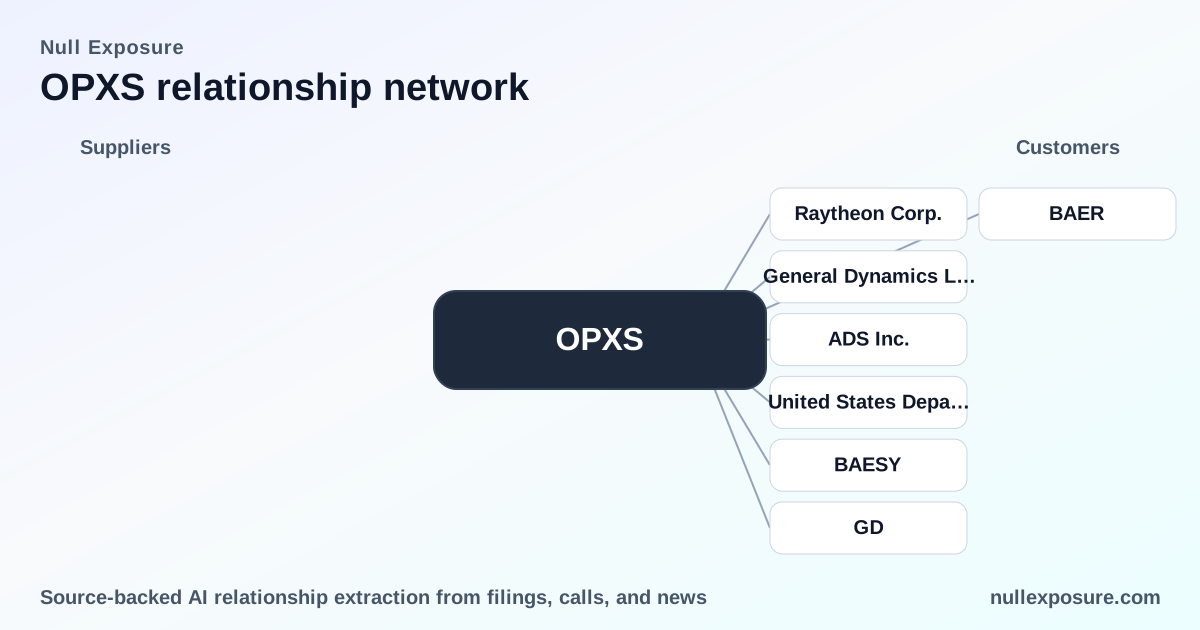
OPXS: Customer Map and the Revenue Dynamics That Drive Valuation
Optex Systems Holdings manufactures optical sighting systems and assemblies primarily for U.S. defense and allied militaries, selling both directly to government agencies and through major prime contractors; the business monetizes through build‑to‑print hardware contracts, multi‑year IDIQ and fixed‑price orders, and aftermarket spare parts. Revenue visibility rests on a small set of large customers and on long‑dated contract vehicles, creating both predictable cash flow and concentration risk that are central to any investment thesis. Learn how these relationships translate into revenue, risk, and optionality at https://nullexposure.com/.
Why customers are the core valuation lever for Optex
Optex is a classic defense‑tier supplier: low SKU complexity, high dependency on prime contractors, and mission‑critical end uses. The company discloses that roughly 70% of gross revenue comes from five major customers and that about 95% of revenue is domestic, concentrating demand in North America and the U.S. defense budget. These dynamics produce three immediate investor implications: (1) contract length and vehicle type drive revenue visibility, (2) customer concentration is the single largest risk to near‑term top‑line stability, and (3) pricing and margin recovery are constrained by build‑to‑print obligations and prime contractor negotiations.
Optex’s FY2025 filing and recent market coverage show the company operating with relatively tight margins but positive operating leverage potential as orders normalize; the investor calculus should therefore weigh contract durability and counterparty credit as much as product-level economics.
Customer map — every reported relationship, in plain English
-
Raytheon Corp. — Optex cites major defense primes such as Raytheon as typical conduits for sub‑prime contracts that the company fulfills for end platforms. Source: FY2025 10‑K (Optex Systems Holdings, Inc., filed for fiscal year ended Sept. 28, 2025).
-
ADS Inc. — ADS is listed alongside other prime contractors through which Optex receives sub‑prime task orders, indicating Optex sells components down the supply chain to large systems integrators. Source: FY2025 10‑K (FY2025 filing).
-
General Dynamics Land Systems — The FY2025 filing specifically names General Dynamics Land Systems as a channel for sub‑prime contracts, signaling direct exposure to armored vehicle programs. Source: FY2025 10‑K (Optex FY2025).
-
U.S. Government — Optex announced a government award for laser interference filters used in night‑vision goggles, a $1.23 million contract reported in May 2026, demonstrating direct sales to federal agencies on programmatic hardware. Source: Investing.com news report, May 3, 2026.
-
GD (General Dynamics, news coverage) — Market commentary highlights General Dynamics among the five customers that together account for approximately 70% of gross revenues, underscoring the strategic weight of that prime. Source: Alphastreet analysis, March 2026.
-
United States Department of Defense — Analysts and press coverage explicitly note Optex’s role delivering mission‑critical hardware to the DoD; the DoD is therefore a direct strategic customer for core product lines. Source: Alphastreet, March 2026.
-
Elbit — In an earnings‑call transcript, Optex identified its Applied Optics Center (AOC) as supplying coatings to external customers including Elbit, confirming commercial links to international defense OEMs. Source: Investing.com earnings call transcript, May 3, 2026.
-
L3Harris — The same transcript lists L3Harris among AOC’s customer set for specialty coatings, indicating supplier relationships with other U.S. defense primes. Source: Investing.com earnings call transcript, May 3, 2026.
-
Trijicon — AOC supplies coatings to optics manufacturers such as Trijicon, reflecting Optex’s role inside the optics supply chain for both military and commercial sighting systems. Source: Investing.com earnings call transcript, May 3, 2026.
-
BAE Systems (news coverage) — Alphastreet’s coverage cites BAE as one of the leading primes through which Optex derives meaningful revenue, reinforcing the company’s ties to global prime contractors. Source: Alphastreet, March 2026.
-
General Dynamics (alternate Alphastreet entry) — A duplicate market article reiterates General Dynamics’ presence among Optex’s top five customers, confirming the prime’s recurring prominence in public commentary. Source: Alphastreet, March 9–10, 2026.
-
BAER (10‑K entry) — The FY2025 10‑K includes BAER/BAE references in the list of major primes that issue sub‑prime contracts to Optex, aligned with other prime contractor citations in the filing. Source: FY2025 10‑K (Optex FY2025).
-
BAE (10‑K entry) — The FY2025 report similarly lists BAE in the context of prime contractors that route orders to Optex, consistent with the company’s described customer mix. Source: FY2025 10‑K (FY2025 filing).
-
Vortex — Company commentary on its AOC business identifies Vortex among external customers for coatings, indicating aftermarket and commercial optics exposure in addition to defense sales. Source: Investing.com earnings call transcript, May 3, 2026.
Operating constraints and what they mean for investors
The filings and recent press collectively describe a company operating under several persistent constraints that shape both upside and downside.
-
Contracting posture: framework and IDIQ vehicles. The FY2025 10‑K documents open US Government IDIQ‑type contracts for periscopes, vision blocks and collimators with ordering periods extending into July 2030, indicating multi‑year framework vehicles that provide ordering predictability and backlog optionality. This is a direct company disclosure tied to government counterparty arrangements.
-
Contract maturity: long‑term fixed pricing. Optex reports multi‑year fixed‑price contracts with delivery horizons up to five years, giving revenue visibility but limiting near‑term pricing flexibility.
-
Customer concentration: material and structural. Approximately 70% of gross revenue derives from five large customers including the U.S. government and major primes; this concentration is structural to the defense supply chain and is the dominant single risk factor.
-
Counterparty mix: government and large enterprises. The business mixes direct government sales (roughly 28–29% of revenue) with prime contractor sales (majority share), so counterparty credit and prime program health are critical value drivers.
-
Geography: North America dominated. About 94–95% of revenue is domestic, concentrating geopolitical and budgetary risk but simplifying contract administration and regulatory exposure.
-
Materiality and spend profile. The company flags a number of significant contracts in the $1–10 million award range and discloses about 120 active contracts overall, implying many mid‑sized awards rather than single mega‑contracts.
-
Role and stage: seller and active order book. Optex operates as a manufacturer of build‑to‑print hardware with an active order backlog (Optex booked $36.2 million in new orders in the most recently completed 12 months), so execution cadence and throughput are operational levers for margin recovery.
For deeper diligence on counterparty concentration trends, program awards, and order visibility, see more at https://nullexposure.com/.
Investment implications — clear tradeoffs
-
Upside: Long‑dated IDIQs and multi‑year fixed contracts produce steady revenue and support valuation multiple expansion if margins normalize and buybacks continue. The company’s niche optical capabilities deliver high technical stickiness to certain vehicle platforms.
-
Risk: Customer concentration and dependence on a handful of primes and the DoD create single‑event exposure; program cancellations or award shifts would materially affect cash flow. Domestic revenue concentration also ties performance closely to U.S. defense procurement cycles.
-
Operational sensitivity: As a build‑to‑print manufacturer, Optex’s margin recovery is tied to scale, contract re‑pricing at renewal, and continued success winning prime contractor work.
Conclusion: Optex’s customer mix is simultaneously the company’s principal asset and its principal risk — valuable revenue visibility comes hand‑in‑hand with concentration risk, and investors should underwrite both when assigning upside to margin improvement or buybacks.