Oracle (ORCL) — customer relationships that shape the cloud and AI growth story
Oracle sells databases, enterprise applications and cloud infrastructure and monetizes through a mix of subscription cloud services, perpetual and cloud licensing plus support, infrastructure/hardware sales, and professional services. The company’s revenue profile blends recurring contract economics with usage-based metering for OCI, and its customer roster ranges from ERP adopters to hyperscale AI tenants — a mix that amplifies both steady annuity cash flow and capital-intense infrastructure risk. For a curated view of customer links and tactical implications, visit https://nullexposure.com/.
How Oracle’s customer relationships work in practice
Oracle has a dual commercial posture: enterprise software licensor and cloud infrastructure service provider. That hybrid role produces three observable operating characteristics:
- Contracting posture: Oracle sells multi-year subscription agreements for applications and cloud services, collects prepaid balances for metered OCI consumption, and continues to generate up‑front revenue from perpetual licenses and support renewals. This yields a predictable annuity base plus demand-driven variability from consumption customers.
- Concentration and criticality: No single customer exceeded 10% of revenue in recent fiscal years, implying client diversification at the revenue line, but the company is also exposed to headline single‑customer concentration risk where a few very large cloud/AI customers (public reports highlight OpenAI and other hyperscalers) drive incremental capacity needs and capital commitments.
- Business maturity and segmentation: Oracle’s book mixes mature, sticky ERP/DB license and support revenues with rapidly scaling infrastructure and cloud services and a modest but material hardware business that is sold primarily through channel partners. The result: stable margins from software support, growth and capex intensity from OCI.
Below I catalog every customer relationship flagged in the recent monitoring results and give a concise, source‑backed read for investors evaluating ORCL’s customer exposure and go‑to‑market traction.
Relationship inventory — who’s buying Oracle, and why it matters
- DXC: DXC works with Oracle to design and implement pragmatic enterprise cloud solutions. Source: DXC event page for Oracle Cloud World 2024 (first seen 2026-03-09).
- VERI (Veritone): Veritone selected Oracle as its preferred cloud provider in a multi‑year agreement to migrate its aiWARE platform to OCI. Source: InsiderMonkey reporting on March 26, 2026 (first seen 2026-05-04).
- NVNI (Nuvini Group): Nuvini’s AI leadership hire builds on a partnership with Oracle to integrate AI and cloud capabilities across its SaaS ecosystem. Source: QuiverQuant press item (first seen 2026-03-10).
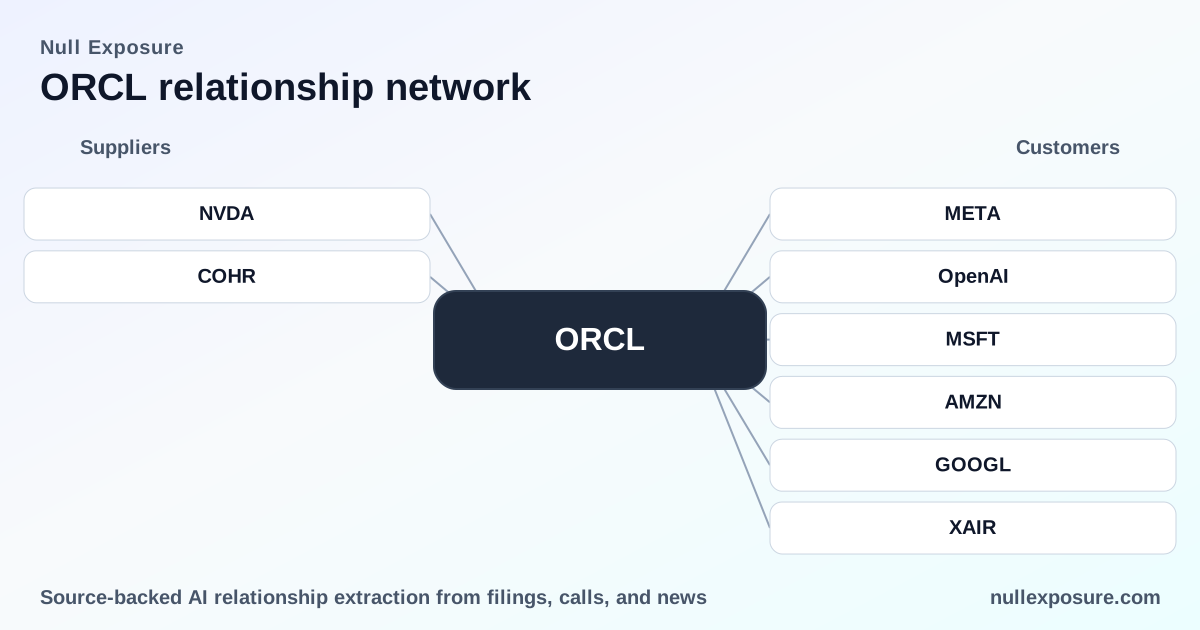
- OpenAI: OpenAI is described repeatedly as a headline cloud customer whose commitments have materially influenced market sentiment around Oracle’s AI infrastructure plans. Source: market coverage on ts2.tech and related pieces (first seen 2026-05-03).
- AMD: AMD is listed among major infrastructure customers for whom Oracle plans to raise substantial gross proceeds to expand capacity. Source: market commentary on ts2.tech (first seen 2026-05-02/03).
- Meta: Meta is named as a customer driving OCI capacity needs amid Oracle’s data‑center expansion plans. Source: ts2.tech coverage (first seen 2026-05-03).
- Nvidia: Nvidia is cited alongside other hyperscalers as a driver of Oracle’s accelerated infrastructure spending. Source: ts2.tech coverage (first seen 2026-05-03).
- TikTok: TikTok appears on lists of customers driving OCI demand in press coverage of Oracle’s capital raise plans. Source: ts2.tech article (first seen 2026-05-03).
- BL: A vendor update states an Oracle Fusion Connector is live with over 50 customers, signaling partner ecosystem deployments. Source: company earnings call extract (2025 Q3, first seen 2026-03-08).
- CYH (Community Health Systems): CYH is rolling AI functionality into Oracle ERP tools as part of an ongoing ERP maturity effort. Source: earnings‑call transcript referencing Oracle tooling (first seen 2026-03-09).
- EHC (Encompass Health): Encompass completed an ERP conversion to Oracle Fusion without significant disruption, a sign of enterprise ERP adoption. Source: earnings transcript (first seen 2026-03-09).
- VERX (Vertex): Vertex announced its tax engine and accelerator for Oracle ERP are available on Oracle Marketplace and deployable on OCI. Source: press releases and marketplace notices (first seen 2026-03-17 / 2026-05-04).
- RMNI (Rimini Street): Rimini Street positions itself as leading third‑party support for Oracle products and promotes migration/ERP acceleration offerings tied to Oracle. Source: company press and investor materials (first seen 2026-03/04 and Apr 30, 2026 filings).
- Alphabet / Google (GOOGL): Oracle has made its database available inside rival clouds — including Google Cloud — and launched an AI Database Agent for Gemini Enterprise. Source: Fortune coverage and MarketBeat note (first seen 2026-03-09 / 2026-05-03).
- Amazon / AWS (AMZN): Oracle’s strategy includes database availability inside AWS as part of multi‑cloud distribution of its database technology. Source: investor commentary in Fortune (first seen 2026-03-09).
- Microsoft / Azure (MSFT): Oracle is distributing database access inside Azure as a step to broaden reach and win workload portability. Source: Fortune coverage (first seen 2026-03-09).
- TikTok (second mention): Appears in multiple market pieces as an OCI capacity driver. Source: ts2.tech (first seen 2026-05-03).
- MSGE (Madison Square Garden Entertainment): MSG Entertainment reported a vulnerability in Oracle eBusiness Suite that was exploited, highlighting third‑party hosting and cybersecurity exposure. Source: PR Newswire legal notice (first seen 2026-03-10).
- ARQ (Arqit): Arqit joined Oracle’s Defense Ecosystem, leveraging Oracle sales support and ecosystem access for defense market solutions. Source: Arqit press release (first seen 2026-03-09).
- ZM (Zoom): Zoom formed a strategic partnership allowing Zoom CX to run on OCI, expanding Oracle’s CX cloud footprint. Source: Investing.com coverage of the partnership (first seen 2026-05-04).
- MFG (Mizuho Financial Group): Mizuho is modernizing infrastructure by transitioning to Oracle Autonomous AI Database on OCI. Source: HarianBasis reporting on integration (first seen 2026-05-03).
- CTEV (MultiPlan/Claritev): MultiPlan/Claritev selects OCI for multi‑year digital transformation projects. Source: FinancialContent and SEC‑type coverage (first seen 2026-05-02 / 2026-03-09).
- FLYW (Flywire): Flywire integrates with ERP systems such as NetSuite (Oracle) to optimize payments and operations. Source: GlobeNewswire and SahmCapital investor notices (first seen 2026-04-20 / 2026-02-25).
- BMR (Beamr): Beamr offers GPU‑accelerated video solutions deployable on OCI, reinforcing partner cloud availability for ISVs. Source: Beamr investor letter and press (first seen 2025-05-12 and 2026-03-09).
- STAA (STAAR Surgical): STAAR is in final stages of Oracle ERP implementation to modernize enterprise operations. Source: InsiderMonkey earnings transcript (first seen 2026-03-10).
- Google Cloud (product tie): Oracle and Google Cloud launched an AI Database Agent for Gemini Enterprise to improve NLQ and enterprise data access. Source: MarketBeat alert (first seen 2026-05-03).
- KleanNara: KleanNara reduced Oracle/SAP vendor maintenance costs using Rimini Street, illustrating third‑party support alternatives in Oracle ecosystems. Source: Rimini earnings‑call transcript coverage (first seen 2026-05-03).
- CXDO (Crexendo): Crexendo/Pronto Mobile selected OCI for AI‑ready, cloud‑native architecture to accelerate time‑to‑market. Source: Bitget and AccessNewswire reports (first seen 2026-05-02).
- CMCM (Cheetah Mobile): Cheetah Mobile cited Oracle Cloud among top partner clouds in its global expansion commentary. Source: Investing.com earnings transcript (first seen 2026-05-02).
- SUI (Sun Communities): Sun Communities is building on a NetSuite implementation as the foundation of its digital journey. Source: Globe and Mail transcript (first seen 2026-03-10).
- CBZ (CBIZ): CBIZ described tailored NetSuite solutions for scaling clients, indicating advisor roles in NetSuite (Oracle) deployments. Source: CBIZ insights page (first seen 2026-03-09).
- NWTG (Newton Golf): Newton increased spending on systems including NetSuite to support scaling operations, showing NetSuite adoption in growth companies. Source: TradingView company filing summary (first seen 2026-05-03).
- DNOW: DNOW reported operational risk from a problematic Oracle ERP rollout at a legacy business, illustrating implementation risk. Source: Globe and Mail coverage of operational issues (first seen 2026-05-02).
- SWAG (Stran?): Stran reported a successful NetSuite ERP implementation as a major digital milestone. Source: GlobeNewswire press release (first seen 2026-03-10).
- BDL (Flanigan/BDL): BDL completed a NetSuite rollout replacing its general ledger system by fiscal Q4 2025. Source: TradingView/Zacks news (first seen 2026-05-02).
- XAIR / xAI: xAI is cited as a customer driving OCI demand and mentioned in media coverage of Oracle’s infrastructure plans. Source: New York Post and ts2.tech summaries (first seen 2026-03-10 / 2026-05-03).
- Datapod: Reports indicate Oracle signed a multi‑year supply agreement with Datapod for modular data centers to support AI infrastructure. Source: InsiderMonkey coverage citing Australian Financial Review (first seen 2026-05-03).
- WYNN (Wynn Resorts): Wynn confirmed employee data theft claims that referenced Oracle PeopleSoft environments, underscoring security implications around Oracle apps. Source: BleepingComputer and FinancialContent (first seen 2026-03-10).
- MSGE (again): See above; vulnerability in hosted Oracle eBusiness Suite tied to broader security headlines. Source: PR Newswire (first seen 2026-03-10).
- RMNI (additional mentions): Rimini repeatedly markets its Oracle support alternatives, agentic AI ERP pathway, and investor events tied to the Oracle ecosystem. Source: Rimini investor materials and press (first seen 2026-03–05).
- Beamr / AWS and OCI references: Beamr’s platform remains available for OCI customers, aligning ISV distribution with Oracle cloud channels. Source: Beamr releases (first seen 2026-01-05 / 2025-11-26).
(The results include many instances of repeated mentions for the same partners and customer themes: Veritone, Rimini, OpenAI, hyperscalers and ERP adopters — the entries above track every relationship item flagged in the monitored window.)
Investment implications and risk checklist
- Revenue mix is hybrid and predictable: Oracle’s subscription and license support base provides annuity stability, while OCI consumption creates upside variability. The constraints data indicate subscriptions are central, with usage‑based billing supplementing growth.
- Capital intensity and headline customers: The need to scale OCI for AI customers creates substantial capex and funding demands — press coverage identifies customer concentration risk where large AI tenants can materially change cash needs. That is a strategic inflection: high return software economics vs. high upfront infrastructure spend.
- Security and implementation risk are recurrent: Multiple customer incidents and troubled ERP rollouts underline that implementation and third‑party hosting exposures are operating risks that affect customers and reputation.
- Geographic reach and customer types are broad: Evidence points to global distribution (APAC, EMEA, Americas) and a customer mix that includes governments and enterprises, supporting cross‑sell opportunities but also regulatory and programmatic complexity.
- Segment diversification: Oracle retains meaningful businesses in software, services, infrastructure and hardware, which stabilizes overall cash flow but complicates valuation because growth drivers and margins are heterogeneous.
Actionable takeaways for investors: treat Oracle as a hybrid software annuity company facing an execution risk profile tied to large cloud customers and capex cycles; watch OCI bookings, deferred revenue trends, and any reported concentration metrics for OpenAI/xAI/other hyperscalers.
If you want a structured view of these relationships across contract type, materiality and geographies for due diligence or portfolio monitoring, explore our methodology and reporting at https://nullexposure.com/ — we aggregate relationship signals into investor‑grade summaries.
Bottom line
Oracle’s customer fabric combines deep enterprise penetration and an expanding role as an AI infrastructure supplier. That duality is the investment thesis: reliable software cash flow underpins the business while OCI’s rapid growth creates both upside and capital/risk exposure. Focus on contract renewals, consumption trends, and large‑customer capital commitments as the primary drivers of forward operating performance.