ORCU — Cloud customers in the fast lane: what investors need to know
Thesis: ORCU captures value by selling cloud infrastructure and enterprise SaaS to marquee, performance-sensitive customers and monetizes through subscription and usage-based contracts supplemented by strategic partnerships that double as commercial marketing platforms. The company’s revenue mix skews toward recurring cloud consumption and application suites that lock customers into multi-year operational workflows. Learn more at https://nullexposure.com/.
Market-facing relationships give the clearest short-term signal into how ORCU’s products are consumed: sophisticated engineering workloads and core back-office functions are hosted on the platform, while sponsorship-style partnerships convert product usage into public endorsements. Below I walk through the named customer relationships, translate what they mean for contract quality and concentration risk, and flag the operational risks and strategic strengths investors should factor into valuation models.
What the public customer list actually contains
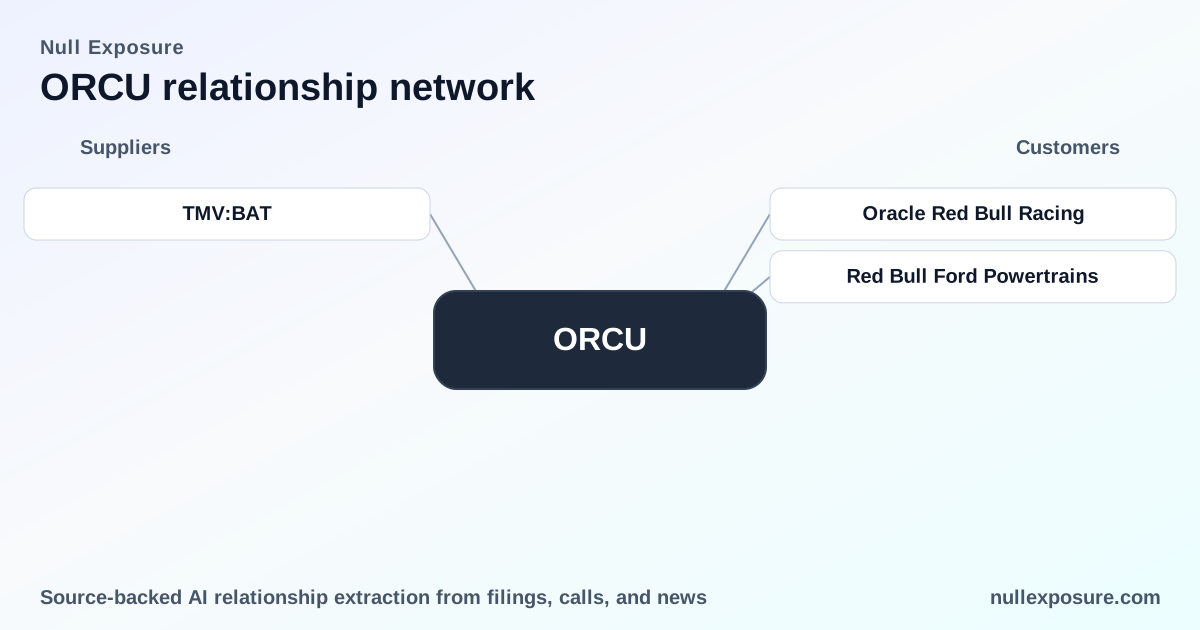
The dataset returns two named relationships tied to high-profile motorsport partners. Both are public-facing and reinforce ORCU’s positioning in high-performance compute and enterprise applications.
-
Oracle Red Bull Racing — The team will use Oracle Fusion Cloud Applications for finance, HR, and marketing to increase productivity, reduce costs, and enhance the employee and fan experience, according to a Barchart news story dated March 10, 2026. This is presented as part of the team’s existing commercial relationship with ORCU and represents enterprise SaaS adoption for core back-office functions (Barchart, March 10, 2026).
-
Red Bull Ford Powertrains — The next-generation hybrid engine for Red Bull Ford Powertrains was engineered with and tested extensively on OCI, signaling use of ORCU’s cloud infrastructure for intensive simulation and engineering workloads, per the same March 10, 2026 Barchart report. This highlights high-performance compute consumption tied to R&D and product development (Barchart, March 10, 2026).
Why these relationships matter to investors
Both relationships are commercially and narratively valuable. They are not random SMB customers; they are marquee partners that function as both paying customers and marketing amplifiers. Investors should treat these ties as two complementary monetization channels:
-
Enterprise SaaS stickiness. The adoption of Fusion Cloud Applications for finance, HR, and marketing is a lock-in mechanism: once core transactional systems and personnel processes run on the platform, switching costs rise materially. That supports recurring revenue forecasts and improves churn assumptions for enterprise application lines.
-
High-performance infrastructure demand. Engineering and simulation workloads run on OCI are usage-intensive and duration-variable, generating high-margin consumption revenue when utilization spikes for product development cycles. This supports a throughput-based monetization thesis for cloud infrastructure.
Both relationships therefore validate dual monetization — subscription SaaS + usage-based cloud consumption — and provide tangible marketing feedstock that increases ORCU’s brand halo around performance and reliability.
Contracting posture, concentration, criticality, and maturity — what the signals say
The dataset shows no reported contractual constraints. That absence is itself informative as a company-level signal: no disclosed contractual limitations or exceptions surfaced in the sources examined, which suggests public-facing partners are presented as standard commercial customers rather than being governed by unusual or restrictive terms in public filings.
From an operating-model perspective:
- Contracting posture: ORCU engages in public-facing, commercial partnerships that include both enterprise SaaS deals and high-profile sponsorship arrangements; the posture is one of long-term commercial collaboration rather than short-term transactional buys.
- Concentration: Sample size is small and concentrated among high-profile accounts; the publicly known customer set is not diversified, so investors should assume concentration risk in marquee partnerships until broader customer disclosure confirms scale.
- Criticality: Products are used for core back-office operations (finance/HR/marketing) and mission-critical engineering workloads. This elevates customer-side switching costs and positions ORCU as a critical infrastructure provider for these clients.
- Maturity: The use cases (enterprise cloud applications and engineering simulations) imply enterprise-grade product maturity and feature parity necessary to support regulated back-office functions and high-throughput compute environments.
These characteristics justify premium revenue multiples for the SaaS lines and higher volatility assumptions for infrastructure revenue tied to usage cycles.
Risks and downside considerations
Investors should weigh several company-level risk factors that flow from these relationships and the operating signals:
- Customer concentration risk. Publicly visible customers are marquee and high-profile; if similar customers account for an outsized share of revenue, earnings are sensitive to renewal and reputational events.
- Revenue cyclicality from compute workloads. Engineering and simulation consumption is episodic; infrastructure revenue will show higher variance than core application subscription revenue, complicating short-term forecasting.
- Public partnership optics over underlying economics. Sponsorship-style deals amplify brand but do not guarantee long-term incremental enterprise account growth; investors must separate marketing value from contracted economics.
How to read the marketing signals versus contractual reality
High-profile partnerships give ORCU an outsized share of the business narrative, but investors must translate press announcements into cash-flow expectations. Public reports show adoption of both Fusion Cloud Applications and OCI for substantial workloads, which is indicative of real revenue streams — not mere branding exercises. However, the available public references are promotional in nature; investors should confirm ARR and consumption baselines through earnings disclosures or customer-count metrics before embedding aggressive growth assumptions into models.
If you want a concise, investor-ready dossier linking these relationship signals to valuation inputs, see our research hub at https://nullexposure.com/.
Bottom line for investors
- ORCU monetizes through a hybrid SaaS + consumption model that benefits from high switching costs in back-office applications and high-margin bursts from compute-intensive workloads.
- High-profile partnerships like Oracle Red Bull Racing and Red Bull Ford Powertrains provide both recurring contract signals and marketing leverage, but the public sample is small and concentrated.
- Absence of disclosed contractual constraints in the examined sources is a neutral-to-positive company-level signal regarding standard commercial terms and ease of public partnership communications.
For investors building financial models, treat enterprise application revenue as stable and recurring, model infrastructure revenue with higher volatility, and apply a discount for concentration until more diversified customer data is available. For direct research follow-up and access to relationship-level tracking, consult our platform at https://nullexposure.com/.