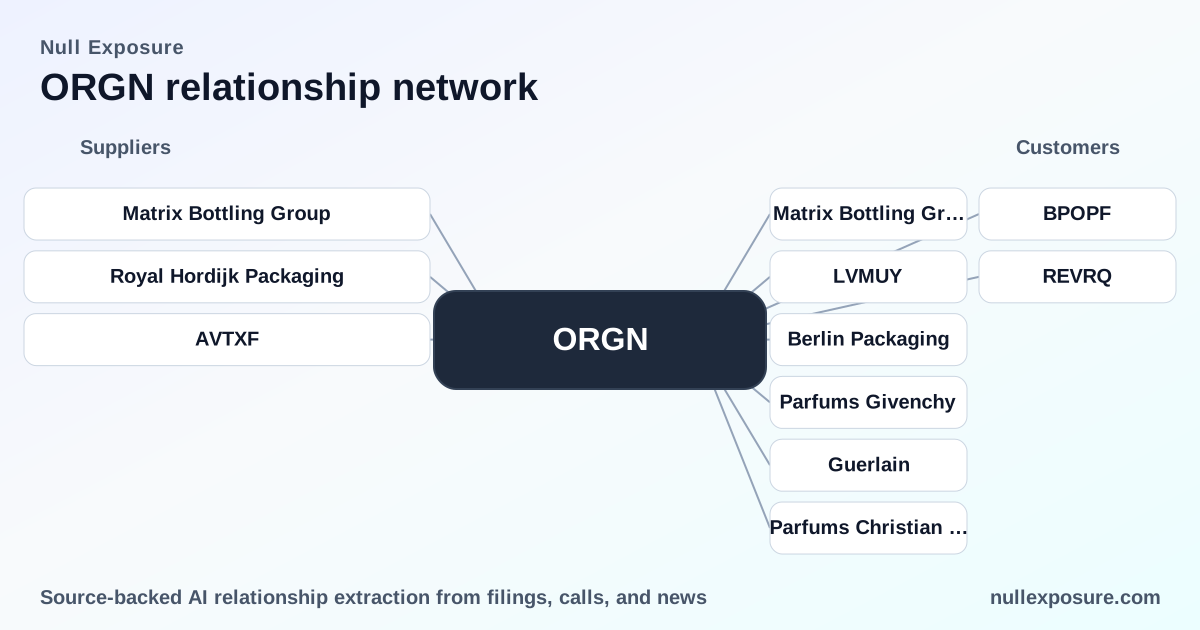
ORGN Customer Map: Who’s Buying Origin Materials’ Sustainable PET and Why It Matters
Origin Materials sells carbon-negative and sustainable PET resins and PET closures, monetizing through product sales and commercial service arrangements with brand and distribution partners. The company focuses near-term revenue on mono-material, fully recyclable PET closures sold to packaging partners and consumer brands, recognizing revenue upon shipment and under service contracts as performance obligations are satisfied. For a concise corporate feed and relationship tracking, visit https://nullexposure.com/.
Investment thesis up front
Origin’s route to commercialization is distribution-led: it wins large, strategic offtake or distribution agreements with packaging networks and consumer brands, then scales production to fulfill recurring orders. Revenue concentration is high, margins are early-stage negative, and near-term upside hinges on converting non-binding commitments and pilot programs into repeatable commercial volumes. Investors should view ORGN as a commercialization play with high customer concentration risk balanced by access to large global closures and packaging markets.
How the commercial model actually works
Origin positions itself primarily as a seller of engineered PET products (closures and resins) while also engaging in services tied to commercialization and product qualification. The company sells product upon shipment and executes service agreements that pay at contract commencement and at scheduled milestones. This contracting posture produces early revenue spikes when pilot customers convert, but also high variability while customer testing and qualification are ongoing.
Customer relationships and what each one signals
Below I cover every customer relationship reported in the dataset and the practical implication for Origin’s go-to-market.
Berlin Packaging — distribution scale and initial orders
Berlin Packaging placed its first order in 2025 and is presented by Origin as a sales and distribution partner that opens access to beverage manufacturers and premium water accounts. This relationship signals Origin’s route to market through an established packaging network. According to Origin’s Q3 2025 earnings call transcript, Berlin placed its first order and is in the fulfillment phase (2025 Q3 earnings call).
Matrix Bottling Group — global beverage distribution for PET caps
Matrix Bottling Group is described in multiple media reports as a partner to distribute recyclable PET bottle caps to beverage brands, supporting global access for closures. Packaging Europe (reported via IndexBox, March 2026) and follow-ups in Packaging Gateway and Traders Union document Matrix as a distribution ally announced in early 2026, aimed at beverage OEMs (news reports, March–May 2026).
HP Embalagens — strategic distributor in Brazil
Origin named HP Embalagens a strategic distributor for sustainable PET bottlecaps, targeting the Brazilian and broader Latin American beverage markets; company communications and market coverage flagged this arrangement in March–May 2026. TradingView and Traders Union coverage remark on HP Embalagens’ role as the Brazil distributor announced in March 2026 (news, March–May 2026).
LVMH Beauty — brand-level purchase commitments for cosmetic packaging
LVMH Beauty entered a strategic partnership to purchase carbon-negative PET for fragrance and cosmetics packaging, with explicit brand rollouts across Dior, Givenchy and Guerlain. FashionUnited reported the LVMH tie-up in 2022, noting LVMH’s intent to buy sustainable PET materials for its luxury beauty packaging (FashionUnited, 2022).
- Parfums Christian Dior, Parfums Givenchy, Guerlain — LVMH brands
- Origin will work with these LVMH brands on sustainable packaging solutions, indicating brand adoption at the premium cosmetics tier and validating material performance and aesthetic standards required by luxury brands (FashionUnited, 2022).
Revlon — memorandum to reserve commercial volumes
Revlon signed a memorandum of understanding to reserve commercial volumes of Origin PET, signalling a commercial interest from a global cosmetics firm and a potential material lift in consumer-packaged goods demand if pilots convert to supply contracts (TheIndustry.Beauty report, 2022).
power hydration — pilot shelf placements
Origin referenced product placements with a brand called power hydration during investor communications; the mention comes from the company’s Q4 2025 earnings call transcript indicating pilot shelving occurred in August (earnings call transcript, Q4 2025). This is an example of a retail pilot that validates product fit in shelf-ready consumer formats.
What the relationship set implies about operating constraints and risk
The relationship evidence and company statements together reveal a set of structural characteristics that should shape investor expectations:
- Concentration and criticality: Company-level disclosures indicate that a very large share of near-term revenue derives from a limited number of customers — the top two customers accounted for roughly 96% of revenues in 2024 and a similarly concentrated portion of accounts receivable, which flags client concentration risk and cash flow sensitivity to a few counterparties (company disclosure, FY2024).
- Contracting posture: Origin combines product sales recognized at shipment with service arrangements that include upfront and milestone payments; this hybrid model produces revenue when production and contractual milestones align, and it requires careful execution of supply chains and fulfillment to realize cash flows (company filing language).
- Stage mix — active vs prospect: The company runs active commercial arrangements with several distributors and brands (Berlin, Matrix, HP Embalagens, LVMH relationships) while maintaining predominantly non‑binding commitments with other prospective buyers who are in testing or evaluation; that duality explains volatile near-term revenue potential (company filing commentary).
- Geography vs global ambition: Financial statements indicate historically U.S.-attributable revenue for the periods presented, yet Origin explicitly targets a >$65 billion global closures market, and its distributor strategy (Berlin, Matrix, HP) signals rapid international expansion beyond U.S. sales (company filings and opportunity statements).
- Segment mix: Origin expects the majority of near-term revenues from core PET closures, while also generating service revenues under specific agreements — this shows an emphasis on recurring product sales once distribution partners convert pilot volumes into purchase orders.
Strategic takeaways for investors
- Upside is concentrated in conversion: The commercial case is straightforward — convert LVMH, Revlon memoranda, Berlin orders and distributor programs into recurring shipments and the topline scales quickly. Coverage in packaging industry press and earnings calls confirms these are live commercial pathways (various news reports and earnings transcripts, 2022–2026).
- Downside is client concentration risk: Reported metrics show extreme revenue concentration in a handful of customers; a single large customer slowdown would materially affect cash flow (company filings, FY2024).
- Execution and scale matter more than raw technology: Origin’s current milestones are commercial — fulfilling orders, qualifying products with luxury brands, and scaling closures manufacturing through distribution partners. Performance against these execution milestones will dictate valuation re-rating.
For ongoing tracking of Origin’s commercial rollouts and to compare relationship developments across peers, see https://nullexposure.com/ for tailored signals and relationship timelines.
Bold relationships and distributor wins are the near-term growth engine; conversion and diversification are the levers that control risk and reward.