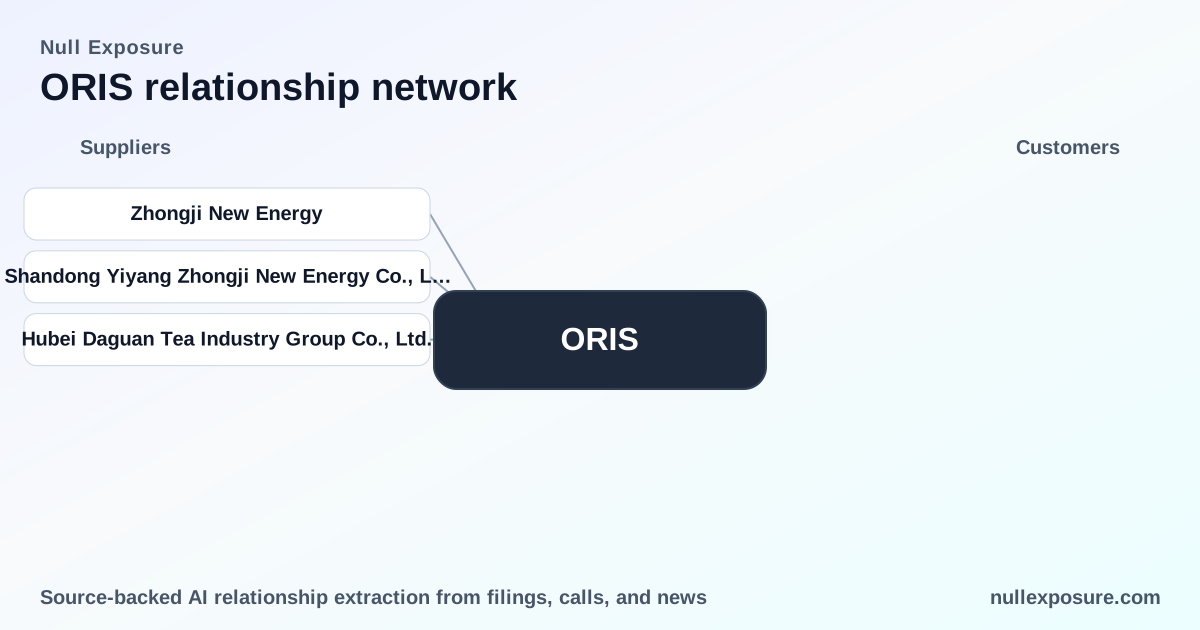
ORIS Customer Relationships: Tea distributors and a solar operator reshape the revenue mix
Oriental Rise Holdings Limited (ORIS) operates as an opportunistic investment and operating vehicle that acquires and partners with niche consumer and infrastructure assets to generate cash flow and upside through ownership, operations and long-term contracts. Its monetization is delivered through equity ownership (acquisitions/LOIs), operating revenue from acquired distributors and leased asset operations (e.g., photovoltaic systems), and portfolio-level value realization. For investors, the notable signal is a pivot from pure technology/entertainment positioning toward control-oriented acquisitions in consumer packaged goods and contracted energy projects—a change that materially influences revenue predictability and counterparty risk. For further dossier-style tracking, see https://nullexposure.com/.
What recent customer relationships tell investors about ORIS’s playbook
ORIS’s public mentions in 2025–2026 reveal two discrete types of customer/partner relationships: consumer distribution assets (tea distributors) acquired via non-binding LOIs, and a long-term asset operator/lessee arrangement with a photovoltaic installer/operator. These deal forms indicate an operating posture oriented to control and cash generation through existing commercial channels rather than pure minority financial stakes. The transactions change revenue composition from variable, market-facing bets to contracted, asset-backed cash flows that investors can underwrite with a different risk lens.
- Contracting posture: LOIs to acquire distributors suggest willingness to assume full operational control and the liabilities that come with it. The photovoltaic project is structured as a long-term lease, indicating an asset-lease operating model rather than an arm’s-length supplier relationship.
- Concentration and criticality: Acquiring two leading local distributors concentrates ORIS’s consumer exposure in tea distribution verticals; these are likely critical to near-term revenue if acquisitions close and are integrated.
- Maturity and predictability: Long-term lease/operator arrangements for solar installations produce multi-year predictable cash flows; distribution acquisitions deliver near-term revenue but require integration to stabilize margins.
Customer relationships — the public record (each relationship covered)
Fujian Daohe Tea Technology Co., Ltd.
Oriental Rise announced a non-binding Letter of Intent to acquire 100% of Fujian Daohe Tea Technology, positioning the company to control a leading regional tea distribution channel and capture wholesale and retail margins. The announcement was reported in coverage of ORIS’s July 28, 2025 communications about proposed acquisitions. (Ts2 Tech, July 28, 2025)
Ningde Minji Tea Co., Ltd.
In the same July 28, 2025 disclosure, ORIS disclosed a non-binding LOI to acquire 100% of Ningde Minji Tea, a second regional tea distributor, indicating a grouped acquisition strategy to consolidate local distribution and rapidly scale consumer-facing revenues. (Ts2 Tech, July 28, 2025)
Shandong Yiyang Zhongji New Energy Co., Ltd.
ORIS is linked to a project in which Zhongji New Energy installs and operates photovoltaic systems while utilizing certain plantation areas under a long-term lease, reflecting an asset-backed energy revenue stream where ORIS is positioned as the counterparty to a long-term lease/operator arrangement. This was reported in a news dispatch covering the FY2026 project arrangement. (Bitget News, May 2026)
How these relationships affect ORIS’s investor profile
These three customer/partner items collectively change the way investors should value ORIS:
- Revenue quality improves when long-term leases and full ownership replace transient trading or minority stakes. The Shandong photovoltaic arrangement signals multi-year contracted cash flows; the tea distributor acquisitions create immediate top-line exposure that, if integrated effectively, can produce stable gross margins.
- Operational risk rises with direct ownership. Acquiring and integrating consumer distributors increases execution risk—inventory management, channel relationships, and working capital all become ORIS’s responsibility.
- Counterparty concentration becomes a factor. Two acquisitions in the same consumer vertical concentrate exposure to tea distribution and regional Chinese markets; downside in that vertical will have outsized impact on consolidated performance.
Practical investor takeaways and risk checklist
- Deal status matters. The tea transactions are recorded as non-binding LOIs; investors must track progress from LOI to definitive agreement and closing to translate announcements into revenue guarantees. (Ts2 Tech, July 28, 2025)
- Contract structure drives predictability. The photovoltaic engagement is described as a long-term lease/operator model, which provides predictable cash-flows that are easier to underwrite than merchant energy sales. (Bitget News, May 2026)
- Integration execution is the single largest operational risk. The shift toward owning distribution channels will test ORIS’s capacity to manage consumer operations at scale and to convert acquired gross profit into consolidated EBITDA.
- Disclosure and governance should be monitored. Public reporting on these transactions is limited to press coverage at present; investors should demand timely filings and clarity on purchase price, financing, and related-party arrangements.
Constraints and company-level signals
No structured contractual constraints are listed in the available relationship records. At a company level, the absence of detailed constraints in public summaries signals that investors must rely on primary filings and transaction documents to understand pricing, indemnities, earnouts, covenant packages and other deal mechanics. In practice, that means governance and transparency—definitive agreements, due diligence disclosures, and audited results post-close—are the next material information sets investors should prioritize.
Bottom line: where this leaves the investor
ORIS is transitioning into a hybrid operating-investment firm that is buying control of consumer channels while also participating in asset-backed energy projects. That repositioning increases revenue visibility through long-term leases, but also raises execution and concentration risk tied to successful integration and the timing of deal closures. Investors should track LOI progress, definitive agreement terms, and the first full quarterly results after any closing to re-rate value appropriately.
For ongoing tracking and transaction summaries, visit https://nullexposure.com/ for concise, investor-focused updates and document aggregation.