Orangekloud (ORKT) — customer relationships that signal commercial scaling in Southeast Asia
Orangekloud sells a No‑Code / low‑code AI application platform (eMOBIQ) and packages that software as SaaS subscriptions, white‑label deployments, and channel distribution agreements. The company monetizes through recurring SaaS fees, professional deployment services and partner distribution contracts that convert platform capability into immediate revenue commitments; recent partner announcements point to an emphasis on regional go‑to‑market via system integrators and local distributors. For investors, the core thesis is simple: Orangekloud is leveraging channel partnerships to accelerate customer acquisition in SME markets while its top‑line growth and negative margins reflect early commercial scale and investment in go‑to‑market. Visit NullExposure for expanded relationship intelligence and tracking.
What Orangekloud sells and how the economics work
- Orangekloud operates the eMOBIQ No‑Code AI App Development Platform and markets both branded SaaS and white‑label ISV solutions to enterprise and SME customers. Revenue converts through monthly/annual subscriptions, deployment and customization fees, and revenue from partners who resell or white‑label the platform.
- Financial signals show revenue generation and active growth (Revenue TTM approximately $5.68M with quarterly revenue growth positive), but operating losses and negative EBITDA reflect heavy reinvestment; market capitalization and limited institutional ownership indicate a small‑cap, high‑execution risk profile.
- Key business drivers: partner distribution, recurring ARR conversion, and product adoption in under‑penetrated Southeast Asian SME markets. Key risks: narrow institutional investor base, negative margins, and the need for partner‑led deals to scale efficiently.
Customer relationship log — every reported item and what it means Below I list each relationship item in the provided results and summarize the commercial point and source for investors.
- Intellsync Sdn. Bhd. — strategic partnership announced to adopt eMOBIQ for Malaysian SMEs. According to a Yahoo Finance press release dated May 3, 2026, Orangekloud announced a strategic partnership with Malaysian system integrator Intellsync to accelerate digital transformation for SMEs using the eMOBIQ AI App Development Platform. (Source: Yahoo Finance, May 3, 2026.)
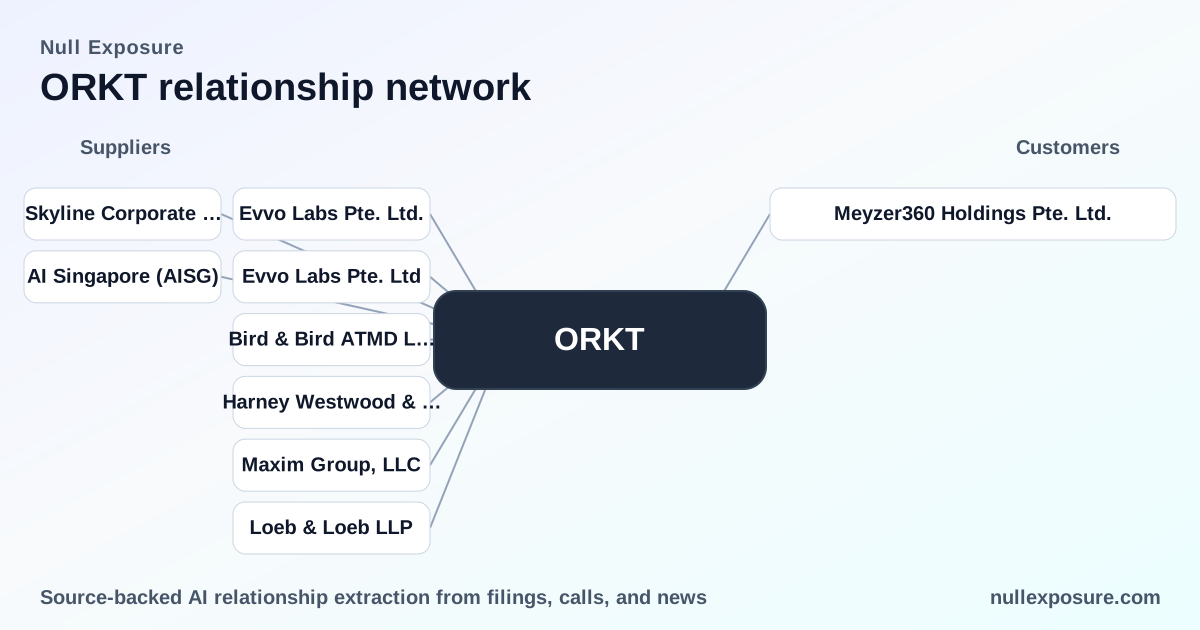
- Meyzer360 Holdings Pte. Ltd. — MOU for AI deployment and distribution worth minimum USD 390,000 over 12 months. A MarketScreener report (March 10, 2026) details an MOU where Orangekloud commits a minimum total value of USD 390,000 in AI solution deployments to Meyzer360, including white‑label rights and international distribution arrangements. (Source: MarketScreener, March 10, 2026.)
- Intellsync Sdn. Bhd. — partnership framing captured by Sahm Capital press coverage describing the Malaysia go‑to‑market. Sahm Capital published a summary on May 3, 2026 describing the same strategic partnership and the intent to deploy eMOBIQ to local SMEs via Intellsync’s workforce‑enablement services. (Source: Sahm Capital, May 3, 2026.)
- Intellsync Sdn. Bhd. — technical deployment narrative referencing the iSync7777 Solution Squad. A QuiverQuant news item dated May 3, 2026 notes Intellsync’s “iSync7777 Solution Squad” will deploy Orangekloud’s eMOBIQ AI to automate operations, illustrating how the partner intends to operationalize the product in customer environments. (Source: QuiverQuant, May 3, 2026.)
How to read these partner entries together All reported items show a consistent commercial playbook: Orangekloud signs system integrators and distributors who commit to deploy, white‑label and resell eMOBIQ to regional SMEs. The Meyzer360 MOU includes a defined minimum monetary commitment (USD 390k over 12 months), which is meaningful for a company at Orangekloud’s scale and signals structured revenue expectations from partner relationships. Multiple press captures for Intellsync indicate both the public relations push and the partner’s operational plan to embed eMOBIQ into client workflows.
Operational and business model constraints (company‑level signals) There are no explicit constraint excerpts tied to a particular partner in the source material; however, company‑level signals derived from the public profile and results produce actionable constraints investors should incorporate into valuation and execution risk assessment:
- Contracting posture: partner‑centric go‑to‑market — Orangekloud relies on system integrators and distributors to secure customer conversions, implying longer sales cycles but potentially lower direct selling costs.
- Concentration: early‑stage partner concentration risk — a small number of partner contracts with explicit monetary commitments (like Meyzer360) can drive meaningful near‑term revenue, increasing short‑term concentration risk if those partners underperform.
- Criticality: platform dependency for partners — partners are adopting eMOBIQ as a core tool for SME digitalization; partner success will be critical to Orangekloud’s recurring revenue trajectory.
- Maturity: commercial stage, not yet mature profitability — positive revenue growth coupled with negative EBITDA and EPS indicates an investment phase; the business is scaling commercial operations rather than delivering stable margins.
What this means for investors: upside and risks Orangekloud’s partner announcements underline a replicable route to market in Southeast Asia, where local integrators hold distribution leverage with SMEs. The Meyzer360 MOU provides a near‑term, contractually framed revenue opportunity, while the Intellsync engagement demonstrates practical deployment and operationalization.
Investors should weigh:
- Upside: accelerating partner revenue, product fit with SME digitalization needs, and evidence of international distribution rights that could amplify addressable market.
- Risk: small market cap, low institutional ownership, negative margins, and dependence on a limited set of partner engagements to drive meaningful ARR.
Actionable takeaways
- Partner deals are the lever for growth — both distribution and white‑label arrangements have explicit revenue implications.
- Monitor delivery and conversion — the Meyzer360 USD 390k MOU establishes expectations; follow‑through on implementations will determine realized revenue.
- Cash‑flow and margin trajectory matter — revenue growth must translate into scalable recurring ARR to justify higher multiples given current negative profitability metrics.
For ongoing tracking and deeper relationship analysis, visit NullExposure.