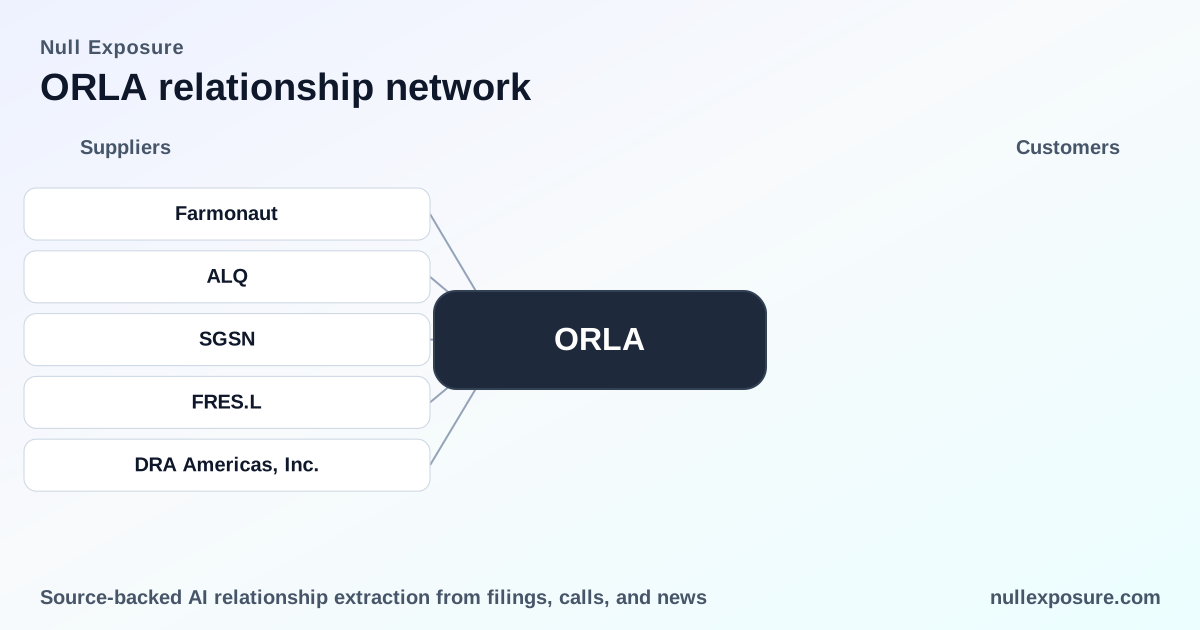
Orla Mining (ORLA): Customer Relationships and What They Mean for Investors
Orla Mining acquires, explores and develops gold assets and monetizes through gold production and asset-centric partnerships—operating mines, selling physical production to market, and interacting with third-party royalty and streaming counterparties who take a share of future cash flows. For investors, the critical lens is how those external partners (royalty holders, offtakers and financiers) affect cash flow stability, capital intensity and optionality across Orla’s portfolio. For a concise view of partner exposures and implications, visit https://nullexposure.com/.
How Orla generates cash and why partner links matter
Orla is a mid-cap gold producer with FY2025 revenue of roughly $1.06 billion and EBITDA near $619 million, delivering operating margins north of 50%—metrics that reflect an asset-backed operating profile rather than a services business. The company’s capital structure and earnings mix mean that third-party royalty and stream holders extract a fixed portion of future production value, which reduces headline free cash flow but also transfers capital and operational risk off Orla’s balance sheet.
- Scale and profitability: Orla’s gross profit and operating margins indicate the business generates meaningful in-mine cash flow that supports reinvestment and debt capacity.
- Stakeholder concentration: Institutional investors hold over 70% of shares outstanding, signaling sophisticated ownership that monitors partner contracts and project execution.
- Valuation posture: A trailing P/E around 45 but forward P/E near 8 implies the market is pricing growth from development assets into future earnings.
These factors make understanding each counterparty’s stake essential to forecasting distributable cash, capital requirements and dilution risk.
Royalty holders: a structural customer class
Royalty and stream counterparties behave like customers because they monetize a share of production revenue and influence internal economics. For Orla, these relationships are structural—they are embedded in project financing, reduce capital needs, and are often long-dated and non-operational. That creates a contracting posture where Orla retains operational control while ceding a portion of margin to non-operating partners.
Company-level signals from the reviewed material:
- No external constraints were flagged in the source material provided, which is a neutral signal on contractual restrictions in the reviewed window.
- Orla’s model shows moderate concentration of cashflow drivers around a handful of sizeable assets; partner stakes therefore have high criticality to near-term free cash flow.
- The operating model is mature at producing assets (concentrated, contracted cash flows) while still growth-oriented via development studies and feasibility updates.
Notable customer relationship: Gold Royalty (GROY) — South Railroad
Gold Royalty holds a 0.44% NSR (partial coverage) on the South Railroad asset that Orla recently advanced. According to an InvestingNews summary of Gold Royalty’s FY2026 update (published March 9, 2026), Orla released an optimized NI 43-101 feasibility study on January 15, 2026, that reaffirms South Railroad’s robust economics, which in turn supports the valuation and near-term cashability of Gold Royalty’s small NSR position. (Source: InvestingNews, March 9, 2026.)
Implication: Even a small NSR position can be meaningful to a royalty holder’s narrative when feasibility converts to production, because feasibility improvements typically accelerate financing and de-risking milestones. For Orla, the study strengthens the company’s ability to monetize the asset on favorable terms and keeps royalty payouts predictable.
Why this relationship matters for earnings and risk
The Gold Royalty connection illustrates two broader dynamics:
- Cash flow leakage vs. capital trade-off: Orla concedes a slice of production to royalty holders like Gold Royalty, which reduces retained margin but lowers the upfront capital Orla must supply to develop projects.
- Visibility on project economics: Public feasibility studies, such as the NI 43-101 on South Railroad, increase visibility into mine life, capex phasing and expected production—variables that directly drive both Orla’s revenue trajectory and the payout profile to royalty customers.
Key takeaway: Royalty counterparties are predictable cash claimants; positive project updates convert optionality into realized cash for both Orla and its royalty customers.
Constraints and operating posture — what the absence of flagged items signals
The review returned no explicit constraints tied to Orla’s customer relationships in the provided material. Treat this as a company-level signal: there is no immediate, disclosed contractual constraint in the scraped window that alters Orla’s operating flexibility. From an investor perspective, that absence combined with the company’s financials supports a working assumption of stable contracting posture—Orla retains operational control of assets, while partner claims are governed by standard NSR/royalty terms.
Operational maturity is heterogeneous across Orla’s portfolio: producing assets deliver cash today; development assets require capital and are sensitive to execution and permitting timelines. Concentration of economic upside in a few assets elevates the importance of each partner relationship.
Investment implications and a disciplined checklist
For analysts and operators evaluating Orla as a customer-facing counterparty, focus on:
- Project milestones that convert feasibility into construction decisions—those milestones materially change royalty cash flows.
- The size and structure of royalty and streaming agreements relative to project NPV—look for fixed-rate royalties versus production-percentage NSRs.
- Balance sheet flexibility given anticipated royalty payouts and capex schedules.
- Counterparty credit: large, diversified royalty holders reduce payment risk; small holders can signal idiosyncratic exposure.
Actionable investor move: Monitor feasibility study outcomes and financing announcements around South Railroad and similar assets—those are the inflection points that determine how much cash Orla retains versus what flows to royalty customers. For a consolidated partner-signal view, explore our platform at https://nullexposure.com/.
Bottom line
Orla’s revenue and margin profile position it as an asset-rich gold producer where royalty relationships are an intentional lever to fund growth and de-risk capex. The Gold Royalty (GROY) NSR on South Railroad illustrates the real-world mechanics: independent feasibility work by Orla crystallizes the economics upon which royalty payers depend. For investors, the critical work is parsing how each partner claim slices production cash flow across Orla’s pipeline of producing and development assets—this determines sustainable free cash flow and the company’s long-term valuation trajectory.