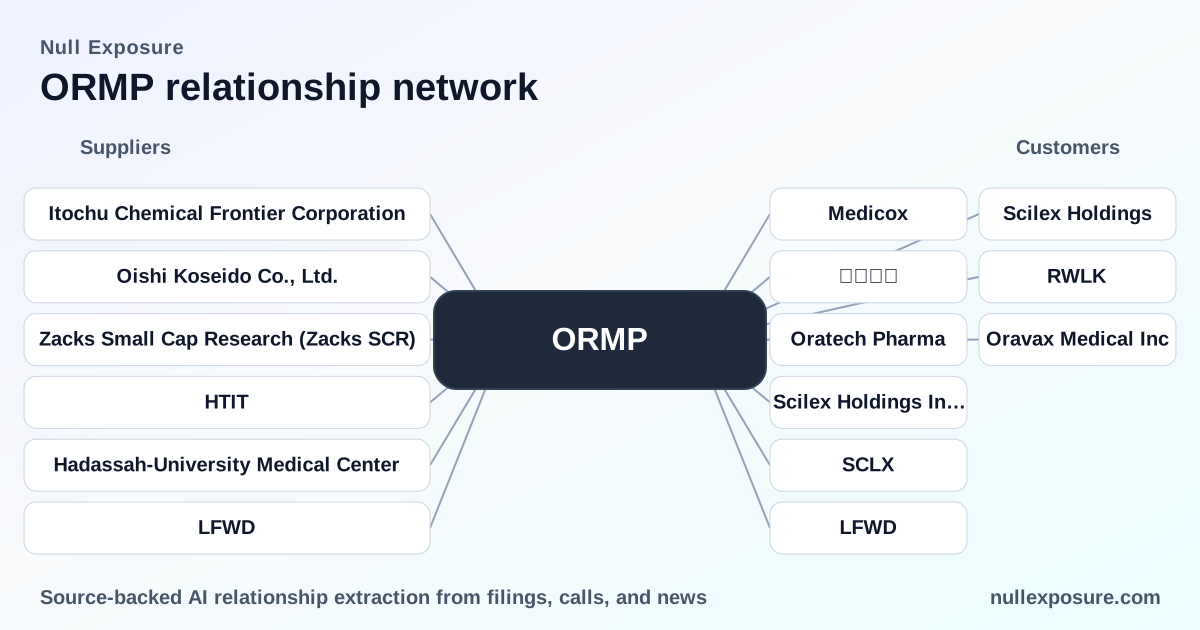
Oramed Pharmaceuticals (ORMP): Customer relationships driving near-term cash and strategic asset redeployment
Oramed develops orally ingestible peptide therapeutics, monetizing through a hybrid model of product transfers, licensing deals and strategic asset sales that convert R&D value into near-term cash. The company recognizes revenue from license and distribution agreements, contract research management, milestone receipts and one-off strategic transactions while retaining an equity stake in partners where it transfers platform technology. For investors, the core underwriting is Oramed’s ability to monetize the POD™ delivery platform and its oral insulin program through partner agreements that deliver both upfront cash and contingent upside. Learn more at https://nullexposure.com/.
Market takeaways
- Oramed is executing a mix of licensing, product transfer sales and strategic divestitures to fund operations and advance trials.
- Revenue sources are non-recurring and partner-dependent, concentrating commercial risk in a handful of counterparties.
- Recent transactions convert platform IP into equity and milestone structures, shifting future operational cost to partners while preserving upside.
Strategic licensing in APAC: Medicox is the commercial foothold in South Korea
Oramed’s 2024 Form 10‑K identifies Medicox as a customer under a Medicox License Agreement that grants Medicox an exclusive, 10‑year license to seek regulatory approval and distribute ORMD‑0801 in the Republic of Korea, with a 180‑day termination right and transfer‑price purchases. According to the 2024 10‑K (FY2024), Medicox also committed to milestone and royalty payments and bought product at an agreed transfer price. (Oramed 2024 10‑K, FY2024)
A Korean-language report confirms Oramed and Medicox signed an exclusive domestic distribution/license arrangement for oral insulin in South Korea. (Kormedi, March 2026)
A trade press write-up describes the agreement structure, noting Medicox will purchase ORMD‑0801 at an agreed transfer price as part of the distribution deal. (DrugDeliveryBusiness, March 2026)
Implication: the Medicox contract is a classic regional licensing play—exclusive territory, milestone/royalty economics and transfer‑priced product purchases provide both revenue visibility and geographic concentration risk. Because the 10‑K explicitly classifies Medicox as a customer, this agreement is a primary example of Oramed’s licensing-to-revenue conversion.
Clinical operations partner: Oratech / OraTech handling trial management
Oramed signed a Clinical Trial Management Agreement with Oratech Pharma (reported Jan 12, 2026) under which Oramed will manage an Oratech clinical trial and receive reimbursement for services, advancing Oratech’s oral insulin program. (TradingView news report, Jan 2026)
TradingView and subsequent reporting state Oramed transferred certain POD responsibilities and agreed that OraTech (also referred to as OraTech/OraTech Pharma in filings) will assume future oral insulin trial costs while Oramed retains clinical management responsibilities and reimbursement. (TradingView coverage of Oramed 2025 10‑K, reported May 2026)
Implication: Oramed is moving to a fee‑for‑service and cost‑transfer posture for clinical execution—reducing future cash burn while retaining program control through trial management fees and operational oversight.
Strategic partner and technology acquirer: Lifeward Ltd. (LFWD)
Oramed completed a strategic transaction transferring its Protein Oral Drug (POD™) delivery technology to Lifeward Ltd., under a structure that gives Oramed the right to acquire up to 49.9% beneficial ownership of Lifeward contingent on terms and provides Lifeward up to roughly $47 million in capital support through equity, convertible notes, milestones and warrants. (Lifeward press releases and Investing.com, March–May 2026)
Multiple outlets report Lifeward completed the acquisition of Oratech Pharma from Oramed as part of this broader transaction and that Oramed will manage and fund the anticipated POD clinical program under a clinical trial management arrangement. (MarketScreener, GlobeNewswire, March–May 2026)
Implication: this is a strategic asset sale that simultaneously de‑risks Oramed’s balance sheet and creates an equity stake in a focused developer, shifting development funding to Lifeward while retaining upside via equity, warrants and revenue‑share structures.
Counterparty capturing immediate cash: Scilex / Scilex Holdings (SCLX)
Oramed has executed multiple cash‑flowing transactions with Scilex, including the receipt of an $18 million payment representing full satisfaction under an Option Agreement and completion of a $28.5 million warrant repurchase (December 30, 2025). These payments were disclosed in Oramed press releases and SEC/press coverage in early 2026. (Oramed press release / PR Newswire; Investing.com; TradingView, Dec 2025–Jan 2026)
A GlobeNewswire item covering Scilex financing referenced the use of proceeds to repay an outstanding senior secured loan provided by Oramed (approx. $85 million), indicating intercompany financing and repayment flows between Oramed and Scilex in prior periods. (GlobeNewswire, 2024)
Implication: Scilex has been a material near‑term cash source to Oramed via option settlements and warrant repurchases; those one‑time receipts improved liquidity and supported a dividend action noted in Oramed press materials.
HTIT license settlement: one‑off revenue contributor
Oramed reported $2.0 million of revenue in 2025 related to an HTIT license settlement, which contributed to reported revenue and EPS outcomes in the company’s 2025 disclosures. (TradingView coverage of Oramed 2025 10‑K, May 2026)
Implication: HTIT is an example of non-recurring licensing settlement revenue that boosts near-term metrics but does not represent sustainable commercial revenue.
Other strategic and historical arrangements: Oravax Medical Inc.
Oramed, together with partners including Premas, formed Oravax Medical Inc., granting exclusive licenses to develop oral COVID‑19 vaccines; this structure reflects Oramed’s historical approach to spin‑outs and platform licensing. (The Nation Thailand, FY2021 reporting)
Implication: Oravax shows Oramed’s prior pattern of creating specialized entities to carry development and commercialization risk while the parent retains licensing upside.
ReWalk Personal Exoskeleton revenue share (RWLK mention)
In connection with the Share Purchase Agreement tied to the Lifeward transaction, reporting references a 4% revenue share on ReWalk Personal Exoskeleton sales as part of the consideration package transfer (TradingView coverage, Jan 2026). (TradingView, Jan 2026; Pulse2 reporting)
Implication: Oramed structured some divestiture consideration to include secondary revenue streams that are peripheral to its core pharma business but provide additional non‑cash or contingent value.
Summary of operating constraints and what they signal for investors
- Contracting posture: Oramed actively uses long‑dated, exclusive licensing (Medicox 10‑year license with 180‑day termination) and asset sale agreements to convert R&D into near‑term cash and contingent upside, reflecting a deliberate shift away from sole‑source in‑house commercialization. (10‑K, FY2024)
- Concentration: Revenue is concentrated in a small set of counterparties—Medicox, Scilex and transaction proceeds from Lifeward—so future topline stability depends on partner execution and milestone delivery.
- Criticality: Licenses delegate regulatory and commercialization responsibility (Medicox responsible for Korean regulatory approval), reducing Oramed’s operating burden but transferring commercial execution risk to partners.
- Maturity: Several agreements are recent (2022 license, 2025–2026 transactions), giving Oramed immediate liquidity while the longer‑dated upside (equity in Lifeward, royalties, milestone payments) remains tied to partner development paths.
Investment lens and risk calibration
Oramed’s model is now more asset‑monetization and partner‑led than direct commercialization. That creates two investor levers: upside from retained equity/warrants and royalties, and downside exposure to partner execution and concentrated counterparties. Short‑term valuation will track further milestone receipts and partner funding; long‑term value depends on Lifeward’s and Medicox’s ability to commercialize ORMD‑0801 and POD™ programs.
If you want a concise, structured feed of Oramed’s commercial counterparties and contract types for due diligence, visit https://nullexposure.com/ for the underlying relationship signals and primary‑source links.