Orion Group Holdings (ORN): Government work and marine infrastructure drive near-term cash; margin leverage depends on project execution
Orion Group Holdings operates as a specialty construction and marine contractor, monetizing through fixed-price and lump-sum construction contracts across marine, concrete and infrastructure work in the U.S., Alaska, Canada and the Caribbean. Revenue is concentrated in project wins and a sizeable bid pipeline; profitability is driven by successful execution on short-duration fixed-price jobs together with a modest base of longer-term contracts. For investors, the company is a play on marine infrastructure spending and selective government contracting, with upside tied to backlog conversion and margin expansion.
If you want a concise portfolio view of Orion’s customer footprint and what it means for revenue quality and contract risk, visit https://nullexposure.com/ for further coverage.
How Orion’s operating model reads to investors
Orion’s commercial posture is a hybrid of short-term fixed-price work with pockets of long-term fixed-price contracts, which produces lumpy but near-term-recognizable revenue. The company reported a large backlog and pipeline — a signal of both current revenue visibility and an opportunity set that supports growth if bid-hit rates and execution hold.
- Contracting posture: A majority of projects are structured as fixed-price lump-sum engagements that are typically short in duration (under one year), while a material portion of revenue is also reported from long-term fixed-price construction contracts. This dual profile raises operating leverage: successful execution expands margins; overruns compress them.
- Concentration and criticality: Government customers are an important part of the mix—federal agencies represent a meaningful share of contract revenue—yet management has stated that, with the exception of the U.S. Navy, no single customer besides the Navy sustains a dominant portion of revenue over time. That creates a moderate concentration risk tied to select defense relationships.
- Geographic and segment footprint: Orion operates across North America and the Caribbean and split its work between marine and concrete/infrastructure segments, underlining regional diversification but sector-specific cyclicality tied to public infrastructure and marine maintenance spending.
- Revenue visibility: As of year-end 2024 the company carried significant remaining performance obligations and a large identified pipeline of opportunities, which supports near-term revenue recognition but requires disciplined project management to convert to profit.
Customer relationships summarized (press and filings)
Below are the customer relationships documented in recent public coverage and transcripts; each entry is a plain-English take with a direct source citation.
U.S. Army Corps of Engineers — large coastal project award
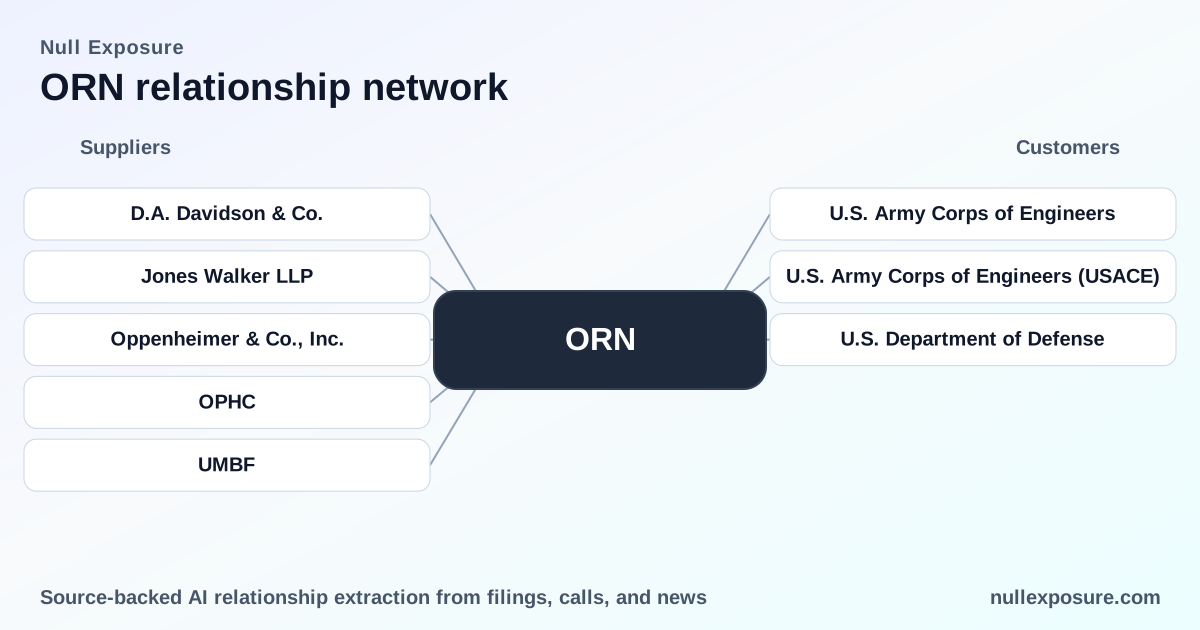
Orion was awarded an $86.3 million shoreline protection and beneficial-use project by the U.S. Army Corps of Engineers, a win that the company announced in March 2026 and that was widely reported across trade and market outlets. According to a March 10, 2026 GlobeNewswire press release distributed via Manila Times, the award specifically cited coastal protection work in Texas and was repeated in industry outlets including DredgingToday. (Manila Times / GlobeNewswire, March 10, 2026; DredgingToday, March 10, 2026.)
U.S. Department of Defense — pipeline via acquisition and direct work
Orion’s acquisition of J.E. McAmis expanded its access to Department of Defense opportunities, with McAmis bringing a $1.4 billion pipeline of potential projects and established DOD relationships. The acquisition was described in Orion’s disclosures and in industry reporting as adding high-margin, complex marine capabilities and client relationships across DOD portfolios. (WorkBoat coverage of the J.E. McAmis acquisition; Orion 4Q/annual results release distributed March 2026.)
U.S. Coast Guard — uptick in activity cited on earnings call
Management referenced an increase in work with the U.S. Coast Guard on the Q1 2026 earnings call, noting an uptick in activity alongside Department of Defense engagements—an operational signal that federal marine maintenance and security-related projects are contributing to current quarter performance. (Earnings-call transcript reported on Investing.com, Q1 2026.)
What these customer ties mean for ORN’s financial profile
Orion’s recent contract awards and acquisition activity clarify the revenue and risk dynamics investors should watch.
- Backlog and near-term revenue recognition: The firm reported substantial remaining performance obligations with roughly 82% expected to convert to revenue within 12 months, producing near-term cash flow visibility tied to current contracts.
- Government as a material customer class: Federal government work represents a sizeable portion of contract revenue (reported at roughly 30% of contract revenues), positioning the company to benefit from infrastructure and coastal resilience budgets, while also exposing it to federal procurement cycles and compliance requirements.
- Spend band and deal scale: The company routinely wins contracts in the tens to hundreds of millions of dollars; recent wins place customer spend in the $100m+ band, which supports scale but increases execution risk on single-project profitability.
- Pipeline-driven growth: Management reports a large addressable pipeline (multi-billion-dollar), and the J.E. McAmis acquisition explicitly increased access to high-value opportunities—an important source of organic growth if Orion converts bids at favorable margins.
- Contract type mix influences margin volatility: The predominance of fixed-price, short-duration contracts drives revenue predictability but creates margin sensitivity to cost overruns and labor/equipment constraints; the presence of longer-term fixed-price contracts provides a partial stabilizer.
Key risks and investor action points
- Execution risk dominates near-term upside and downside. Large marine projects and coastal remediation are capital- and logistics-intensive; project overruns would disproportionately affect margins.
- Customer concentration on federal work is material at the segment level, though management’s commentary indicates no single civilian customer (other than the Navy) dominates revenue—this is a company-level signal to monitor customer mix disclosures.
- Acquisitions change the profile. The J.E. McAmis purchase added assets, relationships and a sizable pipeline; integration success determines whether the deal accelerates margin expansion or adds short-term cost pressure.
For a focused investor briefing that aggregates contract awards, backlog trends and customer concentration metrics for Orion, visit https://nullexposure.com/ to see our latest analysis and signals.
Bottom line
Orion is a specialist contractor whose value to equity investors hinges on backlog conversion, disciplined execution on fixed-price marine projects, and the company’s ability to leverage newly acquired DOD and USACE relationships to expand margins. The current set of customer wins and acquisitions materially improves revenue visibility, but execution and government procurement dynamics remain the principal drivers of performance.