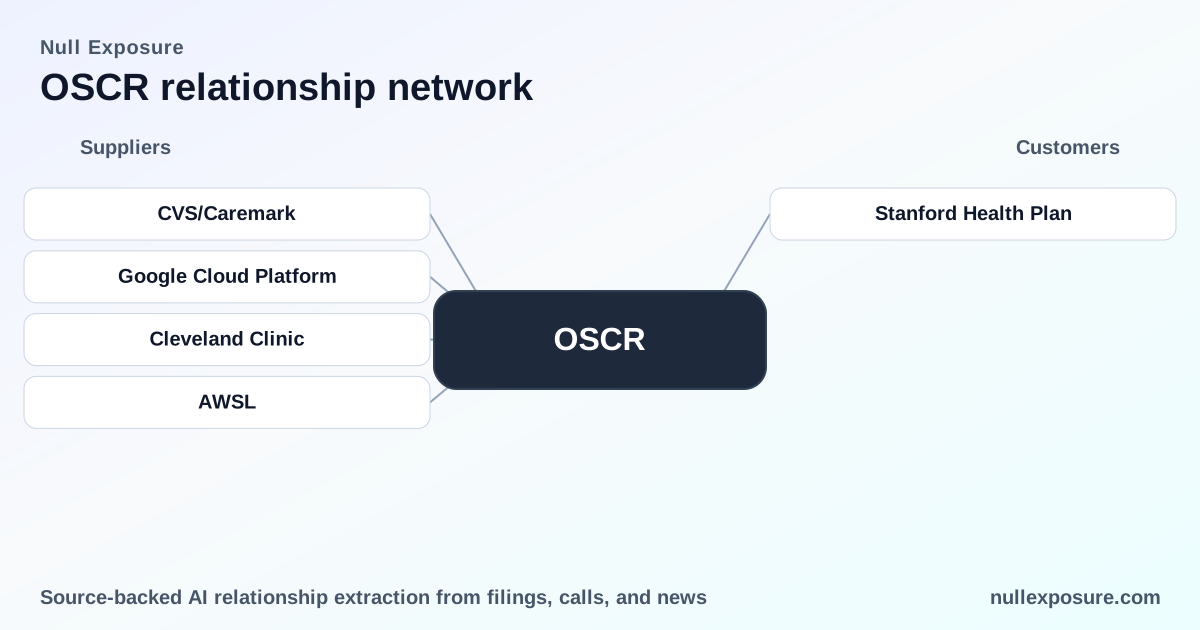
Oscar Health (OSCR) — Customer Relationships and Commercial Footprint
Oscar Health operates as a dual business: a health insurer that collects premiums and bears medical risk, and a healthcare technology provider that licenses its +Oscar platform to other payors and providers. The company monetizes primarily through insurance premiums—largely financed by Advanced Premium Tax Credits collected via CMS—and secondarily through platform and services revenue from clients using +Oscar capabilities such as Campaign Builder. For investors, the critical lens is on revenue concentration, counterparty mix (retail members vs. institutional payors), and how partner relationships amplify both growth and regulatory / payment dependency. For deeper context on the platform signals cited here, see Null Exposure’s research hub: https://nullexposure.com/.
Executive thesis — how relationships drive risk and optionality
Oscar’s economics are driven by scale in retail membership and select high-value platform partnerships. Premium flows underpin cash generation and are therefore material and operationally critical; platform relationships such as those feeding Campaign Builder represent a diversification path that can lift margins if adoption broadens. However, the balance sheet and margins remain sensitive to claims experience, CMS payment flows, and the pace of platform monetization.
What the public relationship signals show
Oscar’s disclosed relationship footprint in the collected material includes one explicit partner mention and several company-level relationship constraints that signal customer mix and contractual posture.
Stanford Health Plan — a named partnership to watch
Stanford Health Plan is cited as a partner in Oscar’s +Oscar program, which the company reports as serving roughly 500,000 client lives on its platform and advancing access and quality through collaborative arrangements. According to a public mention on TradingView (idea page, March 10, 2026), Stanford participates in the +Oscar program that supports improved healthcare access and quality for those lives. This is a platform-level partnership rather than an insurance risk-transfer arrangement. (Source: TradingView idea page, 10 March 2026.)
Company-level relationship constraints and what they imply for investors
The following constraints were surfaced from Oscar’s disclosures and related excerpts; these are company-level signals unless the constraint text explicitly names a counterparty.
-
Counterparty type — Individual: Oscar primarily contracts with individuals, families, and employees under ACA plans. This reflects a retail-heavy book of business, meaning member acquisition and retention economics (marketing, underwriting, premiums) drive near-term revenue. (Evidence: company description of serving individuals, families, employees.)
-
Geography — North America / multi-state: Oscar offers coverage in 18 U.S. states and maintains offices in New York, Tempe, and Los Angeles, indicating a regional expansion footprint rather than a single-state insurer. Geographic dispersion moderates state-level regulatory risk but adds operational complexity as plan offerings scale. (Evidence: coverage in 18 states; office locations.)
-
Materiality — Premiums are the core revenue engine: The company generates the majority of revenue from health insurance premiums; this is a material revenue concentration. For 2024, Oscar reported over $9.5 billion in premiums earned directly from CMS and roughly $799 million from members, underlining the scale of government-related receivables in its cash flows. This concentration elevates dependence on payment timing and policy design tied to CMS programs. (Evidence: premium revenue composition and CMS/ member premium amounts.)
-
Criticality — Government payment flows are strategically critical: Oscar collects material advanced premium tax credit flows from CMS, which are central to its revenue and liquidity profile. Investors should treat CMS payment relationships and APTC mechanics as operationally critical to near-term cash flow stability. (Evidence: explicit discussion of premiums collected from CMS via APTC.)
-
Relationship role — Seller and platform vendor: Oscar operates as both an insurer (selling policies) and a vendor (selling +Oscar platform services). The dual role implies mixed contracting postures—retail underwriting contracts on the insurance side and vendor/service agreements on the platform side, each with different renewal and margin dynamics. (Evidence: company sells health insurance and deploys +Oscar platform.)
-
Relationship stage — Active and scaled: Oscar reported approximately 1.68 million effectuated members as of December 31, 2024, and nearly 500,000 client lives on Campaign Builder, marking an active, revenue-generating commercial stage rather than an early pilot. This maturity supports recurring revenue potential but also places the company squarely in the operational phase where claims volatility matters. (Evidence: effectuated members and Campaign Builder client lives.)
-
Segments — Services and software coexist: Oscar’s business blends services (insurance underwriting and claims management) and software (engagement tools, analytics, Campaign Builder). The software component provides a pathway to higher-margin revenue if platform adoption beyond Oscar’s own membership accelerates. (Evidence: +Oscar platform descriptions and Campaign Builder metrics.)
Investor implications — risks and upside
-
Upside: Growth in platform customers (e.g., university or health-plan partners like Stanford Health Plan) can de-risk earnings by introducing service revenue that scales without proportional claims exposure. If +Oscar adoption expands beyond the 500k lives referenced, margin expansion is feasible.
-
Risk: High revenue concentration in premiums—especially CMS-sourced APTC—creates a governance and timing risk not present in pure-play software businesses. Policy changes, CMS payment timing, or adverse medical loss trends can compress margins rapidly.
-
Contracting posture: Oscar’s contracts span retail member agreements (shorter-term, volume-driven) and vendor services contracts (longer-term, outcome/engagement driven); investors should monitor the mix and average contract duration across the platform book.
Key takeaways for research and operations diligence
- Premium collection from CMS is operationally critical; review receivable schedules and APTC reconciliation processes to assess liquidity vulnerability.
- Platform relationships (e.g., Stanford Health Plan) are evidence of product-market fit outside Oscar’s insured population; validate commercial terms, renewal cadence, and monetization per life.
- Concentration remains high around insurance premiums; margin resilience depends on claims performance and the pace of platform revenue growth.
For a broader view of customer relationships across healthcare technology and insurance vendors, review more of our coverage at Null Exposure: https://nullexposure.com/.
Conclusion
Oscar’s commercial footprint is divided between a core insurance franchise—large, retail-focused, and CMS-dependent—and a nascent but strategically significant platform business that already serves hundreds of thousands of external lives. Investors should weigh the near-term cash-flow sensitivity of premium concentration against the longer-term optionality of platform monetization when forming a thesis on OSCR.