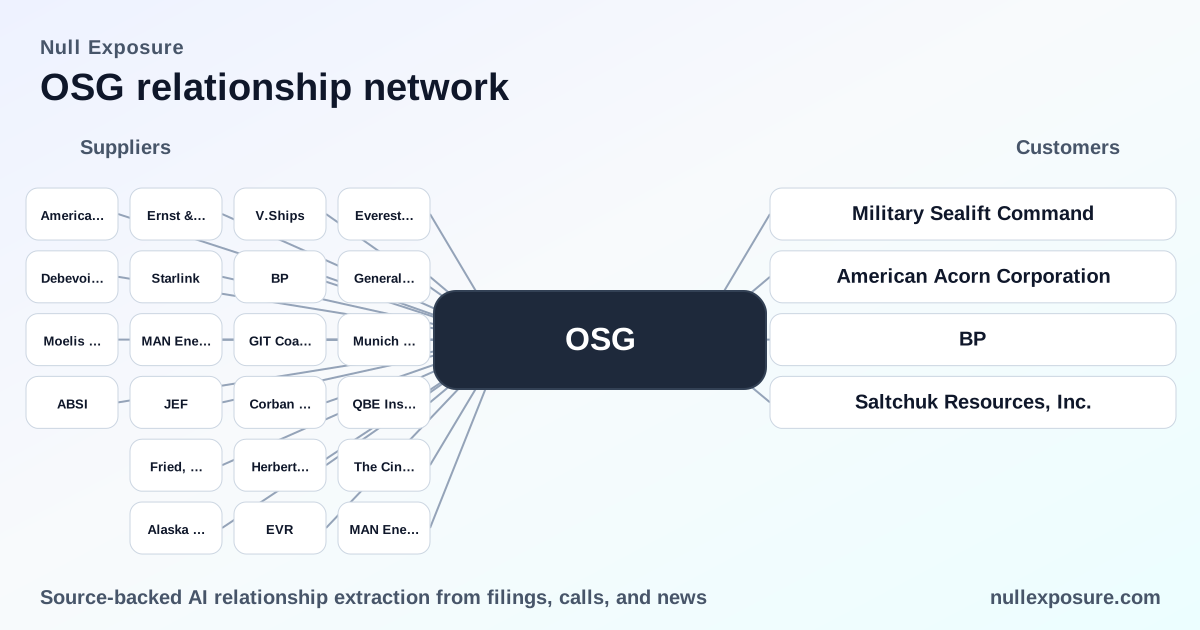
OSG customer relationships — who pays, who partners, and what that means for investors
Octave Specialty Group (ticker: OSG) monetizes through insurance underwriting and distribution after a strategic pivot away from legacy financial-guarantee assets; revenue derives from premiums, distribution fees, and commissions tied to specialty insurance product lines. Historically associated with overseas shipping assets under the OSG name, the company completed material portfolio and branding changes following the sale of legacy guarantee businesses and now operates with a concentrated book of distribution and specialty insurance relationships that drive recurring fee economics.
If you want a concise dossier on counterparties and strategic exposures, review the summaries below and visit https://nullexposure.com/ for the underlying tracking and signal layers.
High-level investor takeaways
- Business model shift: The company converted from legacy guarantor/shipping exposures into a specialty insurance/distribution operator, generating recurring commissions and underwriting income.
- Concentration and geography: Operations are strongly North America‑focused with meaningful EMEA touchpoints; this drives regulatory and distribution complexity.
- Counterparty mix: Government contracts and large energy counterparties remain part of the historical footprint and influence cashflow timing and asset utilization.
- Regulatory/maturity signals: Run-off legacy exposures exist in the broader affiliation set, implying that legacy legal and regulatory tail risk persists even as the firm pivots.
A simple map of the relationships the market is citing
The following entries cover every relationship surfaced in public mentions and news tracking for OSG in our collection. Each entry is a plain-English précis with the source and date.
Military Sealift Command — a government charter customer
Overseas Shipholding Group won a time‑charter with the U.S. Military Sealift Command for the Overseas Mykonos to provide ongoing fuel-transport services, reflecting the company’s capacity to secure government logistics work and cash-generative time‑charters. According to MarineLink (March 10, 2026), the Military Sealift Command awarded the contract for fuel transportation (https://www.marinelink.com/news/military-sealift-command-awards-time-506006).
BP — long-standing commercial charter partner with extensions
OSG amended charter agreements with BP for Alaskan tanker vessels (Alaskan Navigator and Alaskan Legend) and added multiple one‑year extension options through agreed rates into 2035, indicating durable counterparty relationships with major energy shippers and predictable charter revenue potential. Splash247 reported these lifecycle upgrades and extension terms in March 2026 (https://splash247.com/osg-lines-up-alaska-tanker-fleet-upgrades/). An earlier disclosure shows a bareboat charter with BP for the Alaskan Frontier, illustrating a multi-year operational relationship (GlobeNewswire, FY2020 release: https://www.globenewswire.com/news-release/2020/03/13/2000274/0/en/OVERSEAS-SHIPHOLDING-GROUP-REPORTS-FOURTH-QUARTER-AND-FULL-YEAR-2019-RESULTS.html).
Oaktree Capital Management — buyer of legacy guarantee assets
The firm sold its legacy financial-guarantee business to funds managed by Oaktree Capital Management for $420 million in September 2025, a transaction that funded a strategic rebrand to Octave Specialty and materially reshaped the company’s asset and risk profile. Insurance Business Magazine covered the sale and subsequent rebranding in May 2026 (https://www.insurancebusinessmag.com/us/news/breaking-news/octave-specialty-posts-sevenfold-revenue-growth-since-mga-pivot-began-571555.aspx).
American Acorn Corporation — third‑party M&A mention in the competitive landscape
News coverage cites American Acorn Corporation’s acquisition of Ambac Assurance Corporation in June 2024 in reports that intersect with industry consolidation and distribution-channel dynamics relevant to Octave Specialty’s market positioning. MarketScreener reported the American Acorn acquisition of Ambac Assurance (June 4, 2024), useful context for market structure discussions (https://www.marketscreener.com/news/american-acorn-corporation-acquired-100-stake-in-ambac-assurance-corporation-from-ambac-financial-g-ce7d5bd8db8aff2c).
Saltchuk Resources, Inc. — buyer in a prior control transaction
A prior sale of Overseas Shipholding Group shares to Saltchuk Resources at $8.50 per share is part of the company’s ownership history and illustrates prior strategic exits and private-control interest in the business. GlobeNewswire coverage of a shareholder action and the transaction (FY2024) records Saltchuk Resources as the buyer at that price point (https://www.globenewswire.com/news-release/2024/05/24/2887962/0/en/SHAREHOLDER-INVESTIGATION-Halper-Sadeh-LLC-Investigates-SQSP-AGR-OSG-SSB.html).
What the counterparty signals say about OSG’s operating model
The public constraints and excerpts we track reveal operational characteristics investors should price into valuation and risk models:
-
Contracting posture — service provider and seller roles dominate: Public excerpts indicate OSG and its affiliates operate as service providers (underwriting, distribution, claims servicing) and sellers of insurance products and, historically, asset sales. This implies contracts are often fee‑for‑service or premium‑based with limited balance‑sheet upside from third parties. Treat revenue as contractually recurring but concentrated in distribution/underwriting flows.
-
Concentration and geography — North America with EMEA links: Multiple excerpts point to a North America core and meaningful operations or regulatory touchpoints in EMEA (notably the UK). This mix increases regulatory complexity and creates currency and legal regime exposures for cross-border business.
-
Criticality — government and energy counterparties remain relevant: The presence of government charters (Military Sealift Command) and major energy counterparties (BP) signals critical, high‑importance contracts for certain fleet assets and revenue lines; these contracts are timing‑sensitive and often have favorable cash collection profiles.
-
Maturity and legacy run‑off exposure: Excerpts document run‑off and regulatory restrictions in affiliated legacy guaranty entities (for example, an Ambac UK run‑off restriction). That history signals that legacy runoff and regulatory tail risks persist even as the firm pursues a new specialty-insurance and distribution strategy.
-
Segment focus — distribution and services: The company now reports material activity in distribution and services segments, which emphasizes commission and fee-based economics over capital‑intensive underwriting gains.
Risks, valuation implications, and where to look next
- Risk of legacy tail: Regulatory run‑off and legal tail from legacy guaranty entities compress optionality and require explicit discounting in valuation models.
- Concentration risk: A small set of charter and distribution clients (e.g., BP, government contracts) implies revenue volatility if a counterparty reduces commitments.
- Repositioning upside: The sale to Oaktree and rebranding to Octave Specialty freed capital and allowed management to sharpen focus on specialty underwriting/distribution; this creates an upside thesis if execution on underwriting margins and distribution growth is demonstrated.
For a deeper, ongoing view on how these customer relationships evolve and to track disclosure‑level signals tied to counterparties and segments, visit our research hub at https://nullexposure.com/.
Bold closing takeaway: OSG today is a restructured specialty-insurance and distribution operator with meaningful legacy and customer ties to government and energy counterparties; investors must price both the recurring distribution economics and the lingering legacy regulatory tail when modeling returns.