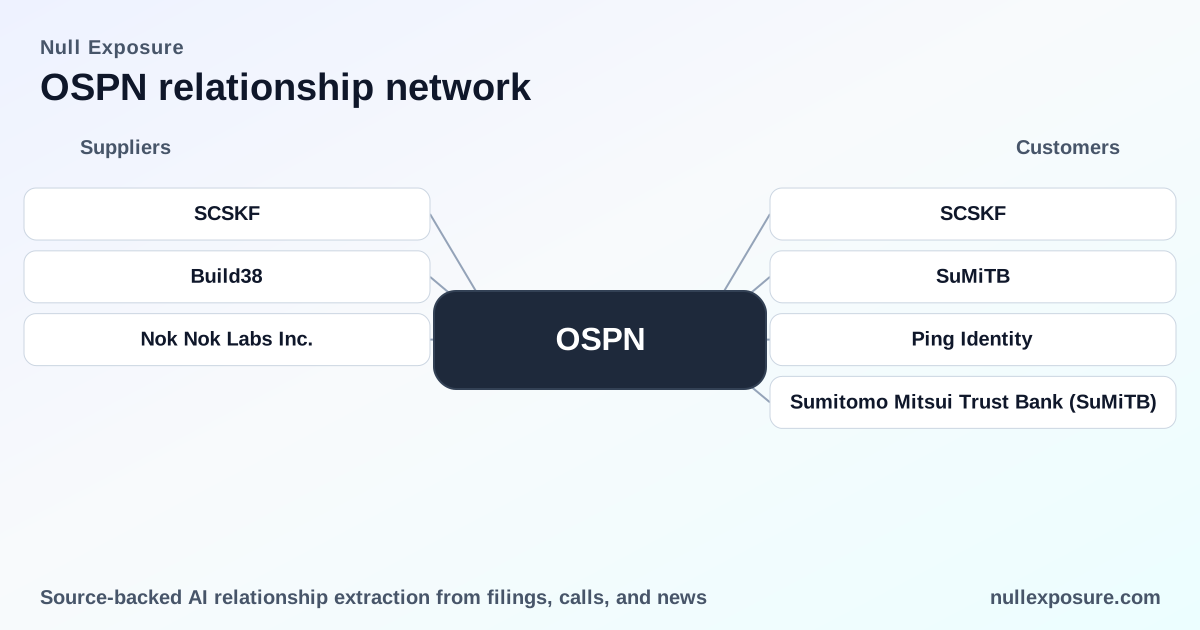
OneSpan (OSPN) — Customer Relationships That Drive Recurring Security Revenue
OneSpan sells identity, authentication and digital-agreement software and complementary hardware to financial institutions, governments and large enterprises, monetizing primarily through subscription licensing and cloud-hosted services alongside device sales and channel partnerships. The business model combines recurring software revenue with installed-base hardware and reseller distribution, producing predictable cash flow from a concentrated set of large customers and geographic diversification across the Americas, EMEA and APAC. For a structured view of signals on OneSpan’s customer footprint and partner relationships, visit https://nullexposure.com/.
Quick investor thesis: durable recurring cash flows with concentrated enterprise risk
OneSpan’s revenue mix and go-to-market create durable recurring revenue driven by cloud authentication and e‑signature subscriptions, supported by hardware device sales and channel distribution. The company is deeply embedded in large financial institutions — a source of pricing power and retention — while downside risk stems from mid‑tier hardware declines, customer concentration and competitive disintermediation. Analysts value the business at a modest multiple today; investors should treat customer renewal cycles and enterprise wins in APAC and EMEA as primary growth signals.
What the commercial patterns look like in practice
- Subscription-first monetization: The company sells cloud and on‑prem licensing and emphasizes subscription models for its digital agreements and authentication suites.
- Large-enterprise customer base: Revenue is concentrated in major banks and financial services, consistent with OneSpan processing billions of authentication transactions globally.
- Global footprint with regional inflection points: EMEA and APAC are material growth vectors while the Americas remain core.
- Hybrid product set: Software (authentication, e‑signing, identity verification) is the growth engine; hardware (Digipass devices) is a declining but still meaningful component.
These patterns generate recurring revenue but create concentration risk tied to the top customers and to institutional buying cycles.
Company-level constraints shaping revenue durability and commercial execution
OneSpan’s public disclosures and product positioning yield several company‑level signals that matter to investors and operators:
- Contracting posture — subscription: The company positions its offerings “primarily through a subscription licensing model,” signaling predictable recurring revenue and multi‑year contract economics.
- Customer concentration — material but manageable: The top 10 customers accounted for roughly 20% of revenue in the most recent reporting periods, indicating concentrated exposure that requires active account management.
- Customer criticality — very large enterprises and governments: OneSpan serves large banks and government customers, a sign that solutions are mission‑critical and thus have higher stickiness.
- Geographic maturity — global with APAC/EMEA momentum: APAC showed double‑digit growth in the latest year for authentication software; EMEA growth is more mixed as hardware volumes decline.
- Channel and GTM complexity: Solutions go to market via direct sales and through distributors, resellers, systems integrators and OEMs, which scales reach but introduces margin and control tradeoffs.
- Product mix — software-led, hardware residual: Digital Agreements and cloud authentication are the scaling segments; Digipass and other devices remain part of Security Solutions but are a lower-growth element.
These signals together describe a classic enterprise‑software vendor that has structured its economics around recurring cloud revenue while retaining legacy hardware lines that compress margin and growth rates.
Customer relationships in the recent record — what each mention means
Below are every customer or partner mention captured in the publicly indexed results, summarized in plain English with source context.
SCSK Corporation
OneSpan is cited as a technology provider alongside SCSK for a project with Sumitomo Mitsui Trust Bank, indicating a regional systems integrator partnership to deliver OneSpan’s authentication solution in Japan. This was reported by Fintech Global on November 19, 2025. (Fintech Global, Nov 19, 2025)
SCSKF (inferred symbol)
The same Fintech Global report is also indexed against the ticker inference SCSKF, reflecting the same SCSK‑related engagement and corroborating that OneSpan’s channel relationship with SCSK is commercially visible in market coverage. (Fintech Global, Nov 19, 2025)
SuMiTB
SuMiTB (Sumitomo Mitsui Trust Bank) publicly teamed with OneSpan and SCSK to enhance mobile banking security, a deployment that highlights OneSpan’s traction selling cloud‑based FIDO authentication into a major Japanese trust bank. The story was covered in the Fintech Global report from November 2025. (Fintech Global, Nov 19, 2025)
Ping Identity
OneSpan entered a strategic partnership with Ping Identity whereby Ping will offer OneSpan’s FIDO‑enabled solutions to eliminate passwords, expanding OneSpan’s channel reach into Ping’s enterprise IAM (identity and access management) customer base. This partnership was described in a March 2026 business update tied to OneSpan leadership moves. (QuantiSnow insight, March 2026)
Sumitomo Mitsui Trust Bank (SuMiTB)
BiometricUpdate reported that Sumitomo Mitsui Trust Bank deployed OneSpan’s cloud FIDO authentication to combat phishing across mobile channels, confirming that the bank’s implementation is live and targeted at high‑risk mobile banking flows. The article is dated November 2025. (BiometricUpdate, Nov 2025)
What these relationships indicate for revenue and risk
The combined mentions create a coherent picture: OneSpan wins high‑profile, mission‑critical deals with large banks via both direct and channel routes, and it leverages partnerships (SCSK, Ping Identity) to accelerate regional and technical distribution. The Ping Identity alliance functions as both a revenue channel and a defensive moat against password‑based credential risk, while SCSK and the SuMiTB engagement demonstrate South‑East Asian and Japanese enterprise penetration.
Investor implications and actionable monitoring
- Revenue durability: Expect recurring subscription cash flow to dominate near‑term growth; monitor subscription mix and cloud seats as the best leading indicators.
- Concentration risk: Top‑10 customer contribution around 20% requires active monitoring of renewal notices and large customer churn.
- Regional growth watch: APAC authentication expansions and further EMEA software conversions will determine whether OneSpan surpasses low‑double‑digit organic targets.
- Channel leverage: Partnerships like Ping Identity increase addressable market and reduce direct‑sales cadence; track pipeline attributable to these alliances.
- Product transition: Watch the ratio of software ARR to hardware revenue; accelerating software adoption reduces margin volatility.
If you want continuous monitoring of customer‑level signals and partner disclosures for strategic diligence, explore the structured signals available at https://nullexposure.com/.
Bottom line
OneSpan’s commercial signals show a software‑led, subscription monetization model selling into very large, mission‑critical customers with a global footprint. The company’s growth trajectory depends on converting hardware customers to cloud subscription models, scaling channel partnerships (for example Ping Identity), and expanding in APAC and EMEA while defending top customer relationships that collectively represent a meaningful share of revenue. Investors should prioritize renewal cadence, ARR expansion, and partnership pipeline as the primary drivers of the next inflection in valuation.