One Stop Systems (OSS): How customer relationships drive revenue and risk
One Stop Systems designs, manufactures, and sells rugged, enterprise‑class high‑performance compute, switch fabric and storage hardware for edge AI, sensor processing and autonomy, monetizing primarily through hardware sales and engineering services to defense primes, government agencies and industrial OEMs. Concentration with a handful of large customers, a growing defense program pipeline, and a recent strategic divestiture of its European reseller shape near‑term cash generation and margin dynamics. For a focused read on counterparty risk and customer concentration, visit https://nullexposure.com/.
What investors need to know up front
One Stop Systems’ go‑to‑market is transactional and program‑driven: the company sells under supply agreements and purchase orders, wins multi‑year platform awards from defense primes and the U.S. Navy, and supplements hardware sales with engineering and services. That mix produces high revenue volatility tied to discrete awards and a clear dependency on defense platforms and select commercial customers.
Customer roster: what filings and press releases report
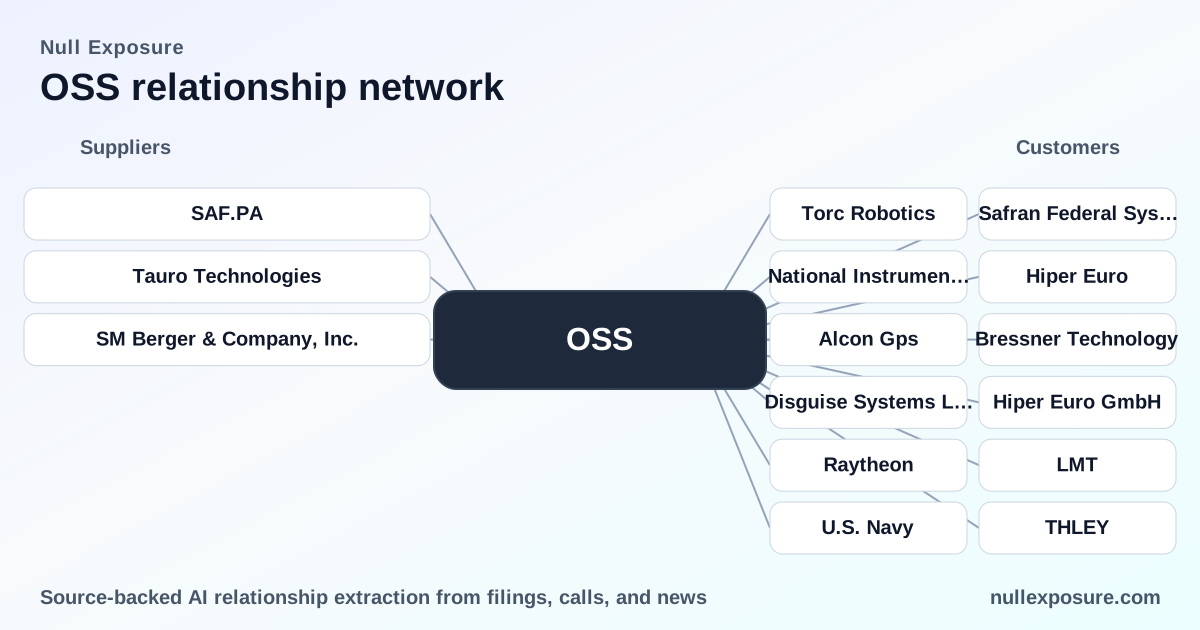
Below are every customer relationship called out in OSS filings and recent press coverage, summarized in plain English with source citations.
Torc Robotics
OSS disclosed in its FY2024 10‑K that Torc Robotics was one of three customers that collectively accounted for 20.2% of consolidated revenues in 2024, signaling material revenue concentration. Source: OSS FY2024 10‑K (reporting FY2024).
Disguise Systems Limited
In its FY2024 10‑K discussion of prior years, OSS reported that Disguise Systems Limited was among three customers that represented 25.4% of consolidated revenue for the year ended December 31, 2023. Source: OSS FY2024 10‑K (reporting FY2023).
Alcon Gps
The FY2024 10‑K lists Alcon Gps as one of three customers responsible for 20.2% of consolidated revenue in 2024, underscoring customer concentration outside of defense as well. Source: OSS FY2024 10‑K (reporting FY2024).
U.S. Navy
OSS announced aggregate new awards of $10.5 million tied to the P‑8A Poseidon program and related prime‑contract activity in public releases and news coverage in early 2026, indicating deeper program participation with multi‑year platform exposure. Source: GlobeNewswire press release (Feb–Mar 2026) and related news coverage.
National Instruments
OSS’s FY2024 10‑K identifies National Instruments as an example of a current customer with significant in‑house resources, implying OSS supplies components or subsystems to customers that also perform internal integration. Source: OSS FY2024 10‑K (reporting FY2024).
Raytheon
Raytheon is repeatedly cited in OSS’s FY2024 10‑K as a major customer and as one of the top customers contributing material revenue across reporting periods. Source: OSS FY2024 10‑K (reporting FY2023–FY2024).
Safran Federal Systems
OSS disclosed a $1.2 million follow‑on production order from Safran for rugged 4U short‑depth servers supporting naval and aircraft applications in Q4, reinforcing recurring program business with defense primes. Source: Q4 2025 earnings transcript and related press coverage (The Globe and Mail; also reported in earnings call transcripts, Q4 2025).
Hiper Euro / Hiper Euro GmbH
OSS completed the sale of its Bressner Technology subsidiary to Hiper Euro for approximately $22 million, transferring a European reseller and systems integrator business to Hiper Euro and reshaping OSS’s EMEA footprint. Source: San Diego Business Journal and multiple news reports (sale completed Dec 30, 2025).
Bressner Technology
OSS sold Bressner Technology (its German VAD and systems integrator) at the end of 2025, a transaction cited as generating roughly $22.4 million in proceeds and triggering analyst commentary about capital allocation and focus on profitability. Source: OSS press disclosures and market coverage (Dec 30, 2025 – Jan 2026).
Lockheed Martin (LMT)
The FY2024 10‑K lists Lockheed Martin among customers that have significant in‑house resources, placing OSS in a supplier role to large aerospace and defense integrators. Source: OSS FY2024 10‑K (reporting FY2024).
Thales (THLEY)
OSS identified Thales as one of the top customers in the year ended December 31, 2024, and as part of the top three customers that together accounted for 39.7% of segment revenues in 2024, indicating meaningful concentration at the segment level. Source: OSS FY2024 10‑K (reporting FY2024).
How the customer signals translate into operating constraints
The filings and news coverage together reveal several company‑level operating characteristics investors must price into the equity:
- Contracting posture: short‑term and framework sales. OSS sells primarily under supply agreements and purchase orders, which supports repeat business but also produces unpredictable revenue timing between awards and production orders.
- Counterparty mix: heavy government and defense exposure. OSS explicitly targets major defense contractors and military services, and public awards (U.S. Navy, Safran) show a deliberate shift into defense platform programs—a higher‑certainty but procurement‑timed revenue stream.
- Geographic concentration and distribution. OSS historically had substantial EMEA revenue through its Bressner segment (Germany accounted for ~55% of consolidated sales in 2024), and the company serves global customers across the U.S., EMEA and APAC; the Bressner sale materially changes this footprint.
- Relationship role and revenue mix: manufacturer and seller of hardware with services. OSS’s revenue base is hardware first (rugged compute, switch fabrics, storage), supplemented by engineering services and modest software/maintenance revenue, which impacts gross margins and predictability.
- Relationship stage diversity: active programs and ongoing prospecting. OSS reports repeat business and expanding interest in some pockets while concurrently investing in defense sales leadership to pursue new prime and military opportunities—indicating a pipeline‑driven growth posture.
- Segment implications: hardware and manufacturing dominate; services and proprietary software are additive. The business model is capital‑intensive in production engineering and benefits from scaling long‑lived platform wins.
Investment implications and risk/reward
- Growth driver: rising defense program awards and follow‑on production orders (U.S. Navy, Safran) create a path to higher recurring platform revenue and better capacity utilization.
- Key risk: customer and program concentration. A small number of customers and platform awards represented a material share of revenue in recent years (20–40% buckets cited in filings).
- Margin dynamics: divesting Bressner reduces lower‑margin reseller revenue and concentrates OSS on higher‑margin hardware and engineering services, which supports the company’s pivot to profitability.
- Catalysts to watch: follow‑on production orders, new prime awards tied to P‑8A and similar platforms, and the pace at which engineering services scale into long‑term support contracts.
For a concise, investor‑grade dossier on OSS counterparty exposure and contract profile, see our homepage at https://nullexposure.com/ — the portal hosts stratified summaries for active defense suppliers and program risk.
Bottom line
One Stop Systems is a hardware‑centric, supplier‑to‑defense‑prime company whose near‑term revenue and margin trajectory is driven by discrete program awards and a concentrated customer base. The company’s recent divestiture of its European reseller business clarifies management’s move to prioritize profitability and defense platform exposure, but investors should continue to underwrite revenue volatility from award timing and customer concentration.