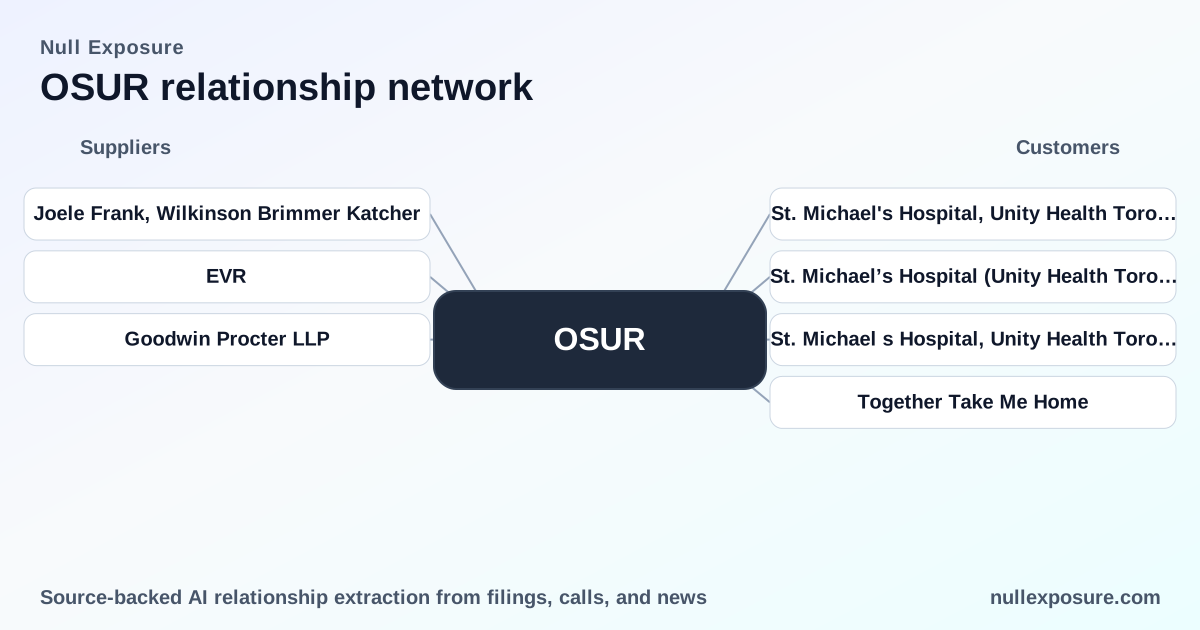
OraSure (OSUR) customer map: who buys, who distributes, and what it means for investors
OraSure Technologies sells and distributes oral-fluid diagnostics, sample-collection devices, and laboratory services to a mix of hospitals, public-health programs, distributors and government buyers. The company monetizes through product sales (retail and professional channels), government and institutional contracts, distributor agreements in international markets, and fee-for-service laboratory testing — a hybrid model that combines recurring product revenue with programmatic public-health partnerships. For a consolidated view of customer relationships and disclosure signals, visit https://nullexposure.com/.
How OraSure’s commercial engine works in practice
OraSure is a product-led diagnostics business with a layered go-to-market approach. Direct sales dominate in the U.S., while international expansion relies on distributors; revenue is also supplemented by laboratory services that produce higher-margin recurring service fees. Company disclosures indicate a mix of long-term strategic contracts and shorter, transactional payment arrangements — a structure that supports scale in pandemic-era test production while exposing the firm to concentration and working-capital dynamics.
Key operating signals from company filings and public reports:
- Long-term government contracts are part of the base case. The company maintained expanded U.S. production capacity through 2024 to meet capacity targets set in a 2021 contract with the U.S. Department of Defense, indicating multi-year government demand and capacity commitments.
- Payment terms are variable (30–120 days). This creates typical working-capital pressure in the medical-products sector and makes receivable management important to cash flow.
- Material customer concentration exists at the company level. One non-commercial customer accounted for roughly 24% of consolidated net revenues in 2024, a meaningful single-buyer risk that investors should monitor.
- Geographic footprint is global but weighted to North America. The firm sells across the U.S. and internationally and uses distributors in many foreign markets, while U.S. retail channels (Walmart, Amazon) carry select consumer products.
- Business mix is shifting. The company has exited material parts of its substance-abuse testing business, signaling portfolio reallocation toward diagnostics and services.
These are company-level signals drawn from OraSure’s public disclosures and investor communications; they define the contracting posture (mixed long-term and short-term), concentration, and maturity of its revenue streams rather than any single customer tie.
Customer relationships that matter today
St. Michael’s Hospital / Unity Health Toronto — exclusive distributor in Canada
OraSure named St. Michael’s Hospital (Unity Health Toronto) as the exclusive distributor of the OraQuick HIV Self-Test in Canada, positioning the hospital network as the market-facing channel for what the company describes as Canada’s first oral HIV self-test. This is an exclusive-distribution working relationship aimed at national rollout and public‑health reach. According to OraSure’s February 2026 press release of fourth-quarter 2025 financial results, St. Michael’s Hospital is the appointed distributor for Canada (GlobeNewswire, Feb 25, 2026).
Together Take Me Home — renewed federally funded mail-order program
OraSure renewed its partnership with Together Take Me Home, a federally funded U.S. program that distributes HIV self-tests by mail, continuing a channel that routes self-tests directly into communities via public-health funding and outreach. This renewal retains a programmatic, non-retail distribution channel that supports volume and public-health positioning in the U.S. market. The relationship was reported in a March 2026 local news summary referencing OraSure’s filings and program activity (Eastern Progress, March 2026).
(For a full customer and contract map for OSUR, see https://nullexposure.com/.)
What these relationships imply for revenue and risk
St. Michael’s and Together Take Me Home are examples of two distinct distribution strategies that OraSure employs: exclusive national distribution through a hospital system in Canada, and programmatic, federally funded distribution in the U.S. Together they underscore a deliberate focus on public-health channels for self-testing products rather than purely retail expansion.
Investor implications:
- Channel diversification reduces single-channel exposure but does not eliminate concentration risk. Exclusive national distributors can accelerate adoption but create single-point-of-failure if adoption or reimbursement assumptions change.
- Government and public-health programs support volume but compress pricing. Programmatic channels like Together Take Me Home generate volume and public visibility but typically operate under constrained margins and fixed budgets, forcing the company to balance scale with unit economics.
- Receivables and payment terms matter. With payment windows ranging from 30 to 120 days across customers and jurisdictions, cash conversion cycles will be sensitive to large program shipments and distributor invoicing practices.
- Operational maturity is mixed. Long-term production commitments to government buyers indicate industrial-scale capability, while the company’s exit from substance-abuse testing suggests active portfolio management to refocus resources on core diagnostics and services.
Practical takeaways for investors
- Monitor revenue concentration metrics and receivable aging in quarterly reports; with one non-commercial customer representing ~24% of 2024 revenue, shifts in that buyer’s demand or funding would materially affect top-line performance.
- Track distributor rollouts and regulatory adoption (for example, the commercial launch timing with St. Michael’s in Canada) as near-term catalysts for incremental revenue. Public-health program renewals such as Together Take Me Home are leading indicators of sustained volume in the U.S. self-test market.
- Assess margin mix between product sales and laboratory services. Service revenues provide recurring cash flows but represent a different margin profile and operational cadence than high-volume test sales.
Final assessment
OraSure operates a hybrid commercial model that blends direct sales, distributor partnerships, government contracts, and service revenues. The company’s public disclosures reveal both the benefits of scale — long-term production relationships and program renewals — and the classic risks of the diagnostics space: customer concentration, payment-term exposure, and dependence on distributor/ programmatic channels for international and public-health reach. For active investors and operators, the focus should be on customer concentration trends, distributor performance (especially in new markets like Canada), and cash-cycle management.
Explore a consolidated view of OSUR customer relationships and sourcing at https://nullexposure.com/ to align investment signals with operational risk and opportunity.