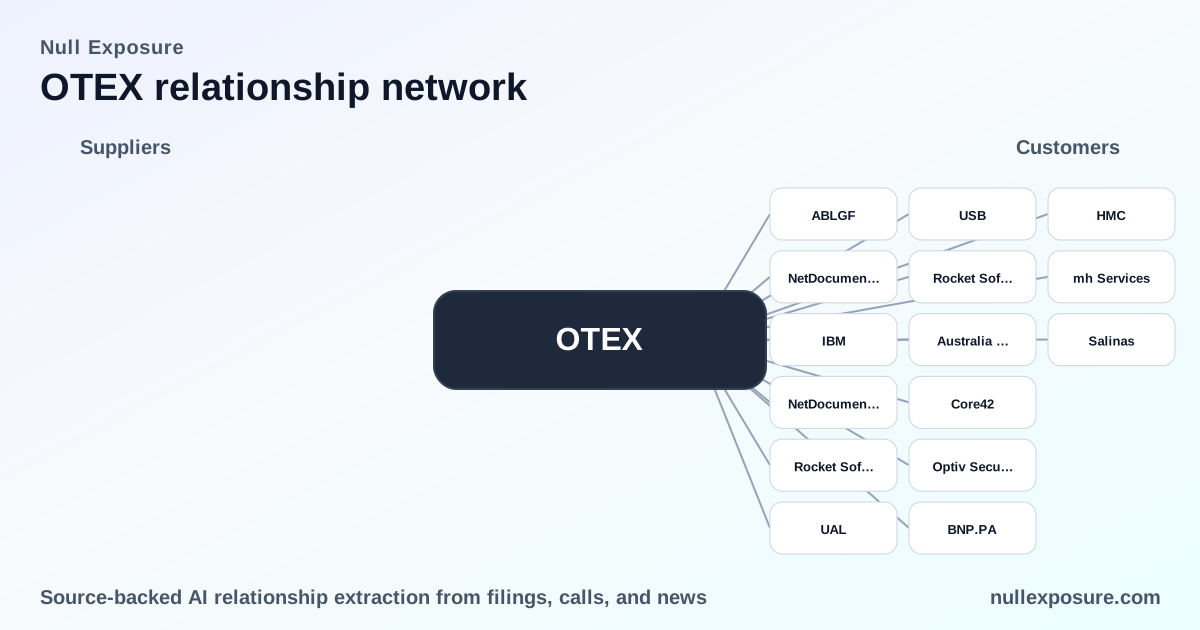
OpenText (OTEX) — customer map and commercial implications for investors
OpenText sells enterprise information-management software and related services and monetizes through a mix of perpetual licensing, term/subscription contracts, hosted/cloud subscriptions and professional services; its revenue profile combines high-margin software and sticky recurring cloud/support fees with lower-margin services and periodic product divestitures that reshape product mix and cash flows. For investors, the core thesis is simple: OpenText is executing a tilt from non-core on‑prem assets toward cloud subscription and managed offerings while preserving enterprise-grade relationships that sustain renewal economics. For more on how this analysis is produced, visit https://nullexposure.com/.
How OpenText contracts and where revenue comes from
OpenText operates a hybrid commercial model that blends traditional software licensing with modern cloud monetization. Company-level signals from filings indicate:
- Contracting posture: a mix of perpetual licenses, term licenses and subscriptions, supported by hosting arrangements and usage-based billing for some cloud services.
- Customer mix and concentration: customers span Global 10,000 enterprises, mid-market, SMBs and government agencies, indicating both scale clients and distributed revenue sources.
- Geographic footprint: material revenue across North America, EMEA and APAC — global sales and delivery are intrinsic to the model.
- Revenue stickiness and maturity: cloud net renewal rates are high (96% in the FY2025 disclosure excluding certain acquisitions), while support/maintenance traditionally underpins recurring revenue.
- Delivery model: software plus services — OpenText sells software and executes channel/reseller arrangements, and provides managed services and outsourcing for B2B integration.
These company-level constraints explain why OpenText sustains predictable recurring flows even as it divests legacy assets and repositions for cloud subscribers.
Portfolio rationalization and cash recycling
OpenText is actively shedding non-core on‑prem assets and redeploying capital. The company finalized the divestiture of its eDOCS on‑premise solution and the Vertica analytics database in early 2026, generating cash and simplifying product scope; those moves accelerate the push toward cloud and managed offerings and improve free cash flow available for investment or de‑leverage.
For a fuller view of the customer list and counterparties cited on recent calls and releases, see the relationship brief below. If you want ongoing flags on customer wins and divestitures, check https://nullexposure.com/ for updates.
Customer relationships on record — what investors should know
NetDocuments / NetDocuments Software, Inc.
OpenText sold its eDOCS on‑premise solution to NetDocuments for US$163 million in cash, completing the transaction in FY2026 after a FY2025 definitive agreement. This is a strategic divestiture of a legacy on‑prem asset and a cash recycling event. (PR Newswire, FY2025–FY2026; Quantisnow/PR Newswire announcement, March 2026)
Rocket Software / Rocket Software Inc.
OpenText divested its Vertica analytics database to Rocket Software for approximately US$150 million in cash, a sale completed in early FY2026 that reduces OpenText’s exposure to standalone analytics infrastructure. (Western Investor / BNN Bloomberg reporting, FY2026)
IBM
IBM is referenced as using OpenText content management and “content aviator” support across its large global workforce, indicating a high-scale application of OpenText software within a major enterprise environment. (Earnings call transcript, Q2 FY2026 — InsiderMonkey)
United Airlines (UAL)
United Airlines selected OpenText’s ITOM platform and ITOM Aviator to reduce critical incident resolution time, representing a mission‑critical operational deployment for an airline-scale IT operations use case. (Earnings call transcript, Q2 FY2026 — InsiderMonkey)
Honda (HMC)
Honda adopted OpenText’s business network trading grid and Business Network Aviator for autonomous supply chain issue resolution, signaling use of OpenText software in global manufacturing supply‑chain orchestration. (Earnings call transcript, Q2 FY2026 — InsiderMonkey)
U.S. Bank (USB)
U.S. Bank completed a full migration from on‑premise licensing to a hosted architecture with OpenText, including cybersecurity components — a move that shifts revenue from maintenance/licensing to hosted/subscription and services revenue. (Earnings call transcript, Q2 FY2026 — InsiderMonkey)
BNP Paribas (BNP.PA)
BNP Paribas selected OpenText for an integrated application security stack after evaluating major vendors, representing a significant cybersecurity win within large‑cap European banking. (Earnings call transcript, Q2 FY2026 — InsiderMonkey)
Australia Department of Health
OpenText reported a key win with the Australia Department of Health, reflecting government/public sector traction for its information‑management and security offerings. (Earnings call transcript, Q1 FY2026 — InsiderMonkey)
ALTEN (ABLGF)
ALTEN is listed among quarter wins; this reflects OpenText’s mid‑to‑large enterprise GTM success in professional services/engineering accounts. (Earnings call transcript, Q1 FY2026 — InsiderMonkey)
Core42
Core42 is recorded as a customer win in the quarter, indicating continued uptake among service providers and digital transformation partners. (Earnings call transcript, Q1 FY2026 — InsiderMonkey)
Optiv Security
Optiv Security was cited as a key win, confirming OpenText’s traction in security services and channel ecosystems. (Earnings call transcript, Q1 FY2026 — InsiderMonkey)
mh Services
mh Services was named as a customer win in the quarter, consistent with OpenText’s broad enterprise and services customer base. (Earnings call transcript, Q1 FY2026 — InsiderMonkey)
Salinas
Salinas integrated OpenText Extended ECM with SAP to streamline global document management processes, illustrating system integration work alongside large ERP platforms. (Earnings call transcript, Q2 FY2026 — InsiderMonkey)
What these relationships imply for investors
- Enterprise-critical deployments: wins at airlines, banks, auto OEMs and large cloud integrators show that OpenText lands on the critical path for operational resilience and supply‑chain continuity. These are high‑value use cases that support recurring support/subscription economics.
- Transitioning revenue mix: the U.S. Bank migration and other hosted deployments evidence the shift from on‑prem perpetual licensing to hosted/subscription and professional services. That transition supports higher recurring revenue but also requires upfront services investment.
- Portfolio simplification: divestitures to NetDocuments and Rocket Software crystallize cash and reduce legacy on‑prem exposure, improving clarity of core growth vectors (cloud, security, business networks).
Risks and watch‑items for management execution
- Execution on cloud migration: sustaining high renewal rates while migrating large on‑prem customers to hosted models is execution‑intensive and capital‑consuming.
- Concentration in enterprise relationships: while the customer base is broad, individual large wins are material to pipeline perception and revenue conversion cadence.
- Portfolio timing risk from divestitures: cash generation is positive, but the exits remove revenue lines that supported historical margins; investors must track how cloud subscriptions and services replace that lost revenue.
Bold takeaway: OpenText is re‑shaping its product footprint to prioritize cloud subscriptions, managed services and security — supported by durable enterprise customers — while using selective divestitures to fund the transition. For ongoing customer‑level monitoring and alerts, visit https://nullexposure.com/.