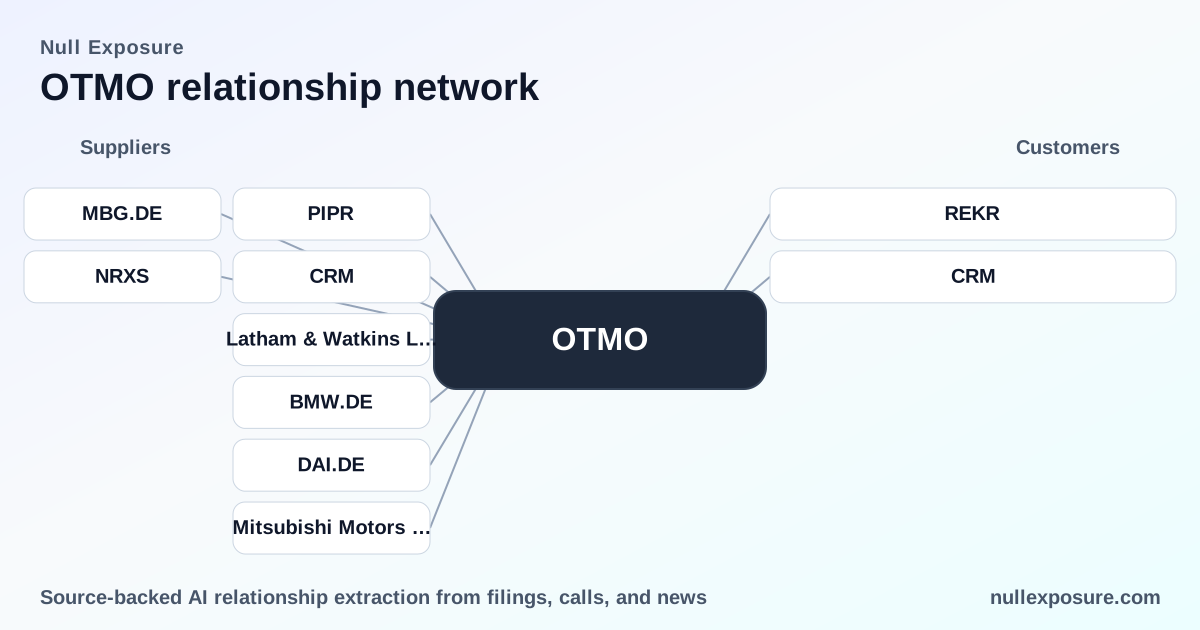
Otonomo (OTMO) — Customer Relationships That Drive the Mobility Data Platform
Otonomo operates a vehicle data marketplace and integration platform that aggregates connected-vehicle telemetry from OEM integrations and commercial partners, then monetizes that data through multi-year OEM agreements, enterprise platform integrations, and downstream licensing to analytics and safety vendors. For investors, the core thesis is simple: revenue growth depends on scaling OEM vehicle hookups and converting those raw streams into recurring enterprise contracts that pay for analytics, safety and operational use cases. Learn more about how we capture partnership intelligence at https://nullexposure.com/.
How the customer list maps to Otonomo’s business model and go-to-market
Otonomo’s customer relationships reflect a deliberate, two-sided commercial posture. On the supply side it secures OEM integrations that provide telemetry at-scale; on the demand side it signs enterprise and systems integrator contracts to monetize that feed. From an operating-model perspective, key signals are clear:
- Contracting posture — enterprise and OEM contracts skew multi-year and integration-heavy. The public references identify long-standing OEM integrations and multi-year commercial agreements with safety and data customers, indicating negotiated, contract-managed revenue rather than ad-hoc one-offs.
- Concentration and diversity — OEMs anchor scale; enterprise partners broaden monetization. The roster mixes legacy automakers (OEMs) with enterprise data consumers (SAP, Salesforce integrators, Rekor, Michelin), showing a deliberate balance between supply concentration risk and diversified buyers.
- Criticality — platform is positioned as a core data layer for safety, mapping and dealership workflows. Contracts emphasize safety, EV charging, mapping and dealer CRM use cases, signaling that Otonomo’s data is a functional input, not a peripheral add-on.
- Maturity — relationships span multiple years and public announcements dating back to 2019–2022, indicating established commercial traction.
Customer-by-customer read (each documented relationship)
Daimler AG — FY2020
Otonomo entered an agreement with Stuttgart-based Daimler in January 2019 to onboard vehicle data from Daimler’s fleet and enable third-party services, a strategic OEM integration that supplies raw telemetry to Otonomo’s platform. This relationship was reported by Calcalist Technology in the context of early OEM partnerships.
REKR (Rekor Systems) — FY2022 (entry 1)
Rekor Systems and Otonomo expanded an existing collaboration into a multi-year contract focused on improving road and driver safety by delivering connected-vehicle telematics to Rekor’s road-safety and analytics solutions. The expansion was announced in an industry press release covered by IoT Now in August 2022.
Rekor Systems — FY2022 (entry 2)
A separate listing of Rekor Systems reiterates the same August 2022 multi-year supply and analytics arrangement, confirming that Otonomo supplies telematics feeds to Rekor for traffic-safety and enforcement applications. The coverage appeared in IoT Now’s August 2022 report.
MICHELIN DDi — FY2023
MICHELIN DDi selected Otonomo to advance road-safety solutions, positioning Otonomo’s platform as a data source for Michelin’s digital initiatives in vehicle and infrastructure safety. This customer selection was noted in market news coverage during FY2023.
Salesforce (CRM) — FY2022 (entry 1)
During an earnings-call transcription from Q3 2022, Salesforce’s relationship with Otonomo was discussed as a new go-to-market avenue targeting dealership workflows, indicating that Salesforce is evaluating Otonomo-powered data to extend CRM capabilities into vehicle-centric dealer services. The point originates from the Q3 2022 earnings-call transcript published on InsiderMonkey.
CRM / Salesforce — FY2022 (entry 2)
A duplicate transcript reference reinforces the same observation: Salesforce is exploring Otonomo data to penetrate dealership and aftersales markets, implying potential channel expansion through a leading CRM provider. The insight again comes from the Q3 2022 call transcript coverage.
SAP SE — FY2022
Otonomo integrated its Smart Mobility Data Platform with SAP’s Digital Vehicle Hub, enabling SAP enterprise customers to consume vehicle data inside SAP workflows and applications; the integration frames Otonomo as a supply partner into SAP’s enterprise ecosystem. This integration was announced on October 18, 2022 via a GlobeNewswire press release.
Mitsubishi Motors — FY2020
Mitsubishi agreed to integrate Otonomo’s data collection and distribution technology into its vehicles, enabling in-vehicle data to be shared with mapping, EV charging, parking and preventative-maintenance service providers — a classic OEM supply agreement that broadens Otonomo’s vehicle coverage. This arrangement was reported by Calcalist Technology in the same FY2020 context as other OEM disclosures.
What these relationships collectively imply for revenue pathway and risk
- Revenue pathway: OEM integrations (Daimler, Mitsubishi) provide the raw supply that enables downstream monetization to enterprise customers (SAP, Salesforce channel potential, Michelin, Rekor). The SAP integration is a high-leverage enterprise channel because it embeds Otonomo feeds directly into large ERP and mobility workflows. The Salesforce engagement suggests Otonomo could monetize dealer and aftersales data flows via an existing CRM distribution network.
- Customer concentration and realism: OEM deals are defensible but take time to scale; enterprise integrations accelerate revenue per connected vehicle but depend on commercial uptake inside large vendors’ ecosystems.
- Contractual posture: Public disclosures point to multi-year and integrated contracts, not transient pilot arrangements, which increases revenue visibility when contracts are executed and scaled.
- Criticality and defensibility: Relationships tied to safety, mapping, and dealer operations create stickiness because those use cases are operational rather than discretionary.
- Maturity and cadence: Documented interactions date from 2019 through 2022, indicating multi-year commercial progress rather than nascent one-off proofs.
Investor takeaways and headline risks
- Positive: Otonomo’s model converts OEM-scale telematics into recurring enterprise revenue via platform integrations with SAP and potential channel expansion through Salesforce. These partnerships represent the primary lever to convert vehicle supply into monetizable products.
- Risk: Revenue realization depends on scaling OEM hookups and enterprise adoption; long lead times and integration complexity could slow recognitions. OEM concentration on a few large automakers increases supply risk until vehicle coverage is broad.
- Operational risk: Privacy and regulatory oversight of vehicle data can affect product scope and monetization terms. Contracts that emphasize safety and mapping help mitigate but do not remove regulatory exposure.
- Near-term signal set to watch: new OEM announcements, SAP adoption metrics, and any commercial rollouts via Salesforce or Michelin that demonstrate downstream licensing or recurring revenue expansion.
For a succinct briefing and ongoing monitoring of partner disclosures and commercial signals, visit https://nullexposure.com/ — we track partnership disclosures and market implications that matter to investors.
In sum, Otonomo’s customer roster shows a clear two-sided play: OEM integrations supply scale while enterprise partnerships unlock per-vehicle monetization. For investors, the path to durable revenue is visible but contingent on executing multi-year integrations and converting those into recurring commercial contracts.