Ouster (OUST): Customer relationships as the revenue engine
Ouster designs and sells digital lidar sensors and related perception software, monetizing through product sales, multi‑year licensing and service arrangements, and targeted infrastructure deployments (BlueCity). Revenue mixes across direct sales and distributor channels, with pockets of long‑term contracts and high customer concentration that both accelerate scale and increase execution risk. For a concentrated, capital‑intensive technology vendor, customer durability and channel depth are the clearest levers to move value — investors should track contract cadence, pilot conversion, and a handful of strategic customers. For additional context on how we collect and report relationship signals, see Null Exposure at https://nullexposure.com/.
Why customers drive valuation here
Ouster’s unit economics hinge on two things: product scale (sensor ASPs and margin leverage) and recurring/contract revenue (software and multi‑year commitments). The company signals movement up the value stack with perception software (BlueCity) and long‑term supply deals that reduce sales cyclicality. At the same time, the balance sheet and P&L remain sensitive to pilot‑to‑production conversion and a small number of material customers that drive quarterly volatility.
Customer relationships at a glance — who buys Ouster today
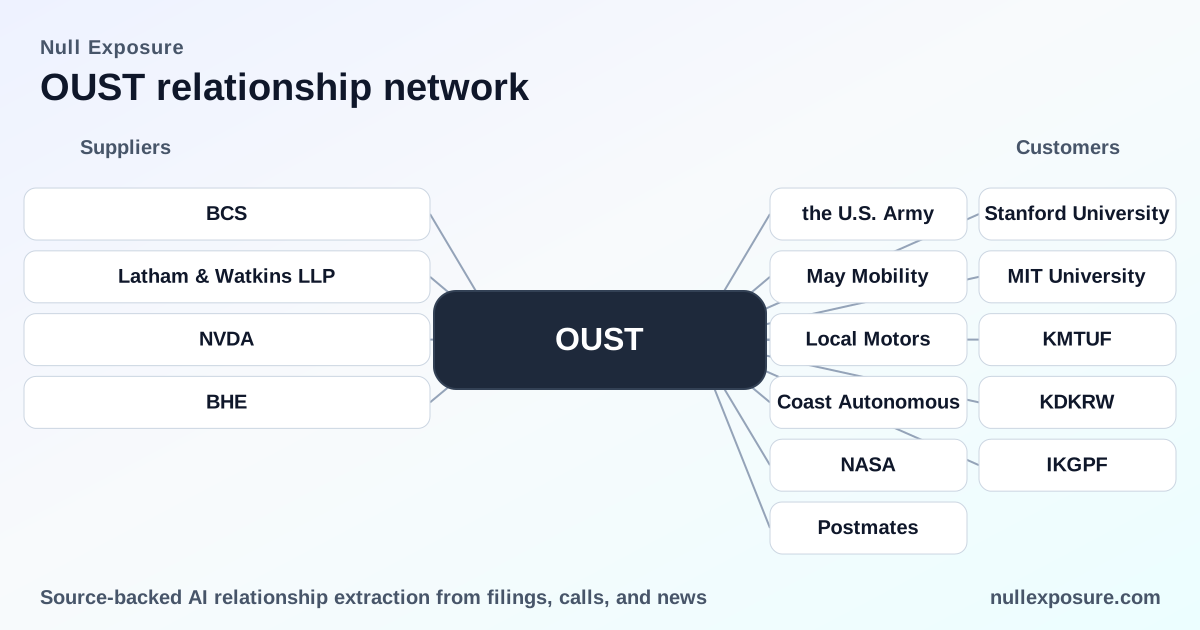
Below are every customer mentioned in the source set, with one‑ to two‑sentence plain‑English summaries and source citations.
Serve / SERV
Ouster supplies Serve Robotics with digital lidar and has an expanded supply agreement to outfit Serve’s delivery fleet with REV7 sensors; the relationship was reiterated on SERV’s 2025 Q3 earnings call and in a June 2024 industry report. According to a Serve earnings call (2025 Q3) and a RetailTechInnovationHub article (June 28, 2024), Serve will continue using Ouster lidar across its robotic delivery fleet.
Postmates
Postmates was listed as an early customer for Ouster’s lidar sensors during fundraising coverage, indicating historical adoption in delivery‑robot pilots and trials. The Robot Report cited Postmates among Ouster’s early customers (FY2020).
Ike (IKGPF)
Ike (ticker IKGPF in the dataset) appears in Ouster’s early customer list, suggesting Ouster’s sensors have been used in last‑mile or robotics experiments. The Robot Report included Ike in Ouster’s FY2020 customer roster.
May Mobility
May Mobility is a long‑time customer that Ouster management highlights in earnings updates when announcing end‑customer wins for May’s autonomous shuttles. An earnings‑call transcript referenced May Mobility’s public announcements (FY2025).
Kodiak Robotics
Kodiak Robotics was named among early adopters of Ouster lidar, pointing to usage in long‑haul autonomy programs during Ouster’s Series B era. The Robot Report listed Kodiak Robotics as a customer (FY2020).
Coast Autonomous
Coast Autonomous is another early robotics customer cited by Ouster in fundraising coverage, reflecting adoption in autonomous vehicle prototypes. The Robot Report included Coast Autonomous in its FY2020 customer list.
The U.S. Army
The U.S. Army is referenced among institution‑level customers, indicating defense or government sensor applications for research or field programs. The Robot Report documented the U.S. Army as a named customer (FY2020).
NASA
NASA appears in Ouster’s earlier published customer lists, signaling use in research and aerospace sensing projects. The Robot Report cited NASA (FY2020).
Stanford University
Stanford University is on Ouster’s cited list of academic customers, indicating research and prototyping use. The Robot Report included Stanford University (FY2020).
MIT University
MIT University is noted alongside other academic adopters in early press, confirming Ouster’s penetration into academic research. The Robot Report listed “MIT University” (FY2020).
Postmates / re‑mention
Postmates is re‑listed in the same fundraising coverage; its repeat presence underscores Ouster’s early deployment footprint in robotized delivery pilots. See The Robot Report (FY2020).
Local Motors
Ouster announced a strategic customer agreement with Local Motors for electric autonomous vehicles, reflecting OEM or fleet integration work (FY2021 announcement). Samoa Observer carried the announcement describing the strategic agreement (FY2021).
Sandvik
Ouster lidar powers Sandvik’s autonomous underground mining loader, showing industrial‑grade deployment in mining equipment and a conversion to production use cases. TradersUnion reported on Ouster enabling Sandvik autonomous loaders (May 3, 2026).
Komatsu (KMTUF)
Ouster’s management highlights how critical lidar is for customers like Komatsu, indicating potential OEM partnerships or qualification activity with major industrial equipment makers. An earnings‑call transcript referenced Komatsu’s typical reliance on lidar (FY2025).
BlueCity
BlueCity is Ouster’s smart‑infrastructure solution and is reported to be deployed at scale across Intelligent Transportation Systems (ITS) sites, with more than 700 global sites cited. TradersUnion covered Ouster’s expansion of BlueCity deployments (FY2026).
UDOT
Ouster expanded its BlueCity traffic management solution in Utah under a five‑year contract to cover over a hundred intersections, demonstrating recurring revenue from municipal contracts and multi‑year service arrangements. SimplyWall reported the UDOT five‑year contract supporting BlueCity expansion (FY2026).
(Each relationship citation is drawn from the referenced article or transcript in the dataset: Serve earnings call (2025 Q3), RetailTechInnovationHub (June 28, 2024), The Robot Report (Series B coverage, FY2020), Samoa Observer (FY2021), TradersUnion (May 3, 2026), InsiderMonkey transcript excerpts (FY2025), and SimplyWall coverage (FY2026).)
What the constraints tell investors about Ouster’s operating model
-
Contracting posture: a mix of product sales and multi‑year licensing. Company filings report deferred revenues “from multi‑year licensing contracts” and specific contract liabilities, signaling that Ouster is transitioning some revenue to longer‑dated, performance‑based arrangements. The filing language shows deferred revenues tied to multi‑year licensing ($10,922 in the excerpt).
-
Concentration and materiality are real. For FY2024, one customer accounted for more than 10% of product sales, indicating material single‑customer risk that can swing quarterly results and negotiating leverage.
-
Global footprint with regional diversity. Revenue breakdowns show meaningful dollars across Americas, Asia‑Pacific, and EMEA, supporting a global go‑to‑market for sensors and BlueCity ITS deployments.
-
Channel mix: direct and distributor sales. The company sells both directly and through distributors internationally, which lowers sales cost in some geographies but adds complexity to margin capture and customer relationship ownership.
-
Customer lifecycle: pilots to production. Filings articulate a sales funnel where many customers progress from evaluation to pilot to pre‑production and production; pilot conversion is the single most important operational metric for revenue scaling.
-
Product + software positioning. Ouster is selling sensors and perception software platforms for smart infrastructure, which elevates lifetime value per customer when software and managed services attach to hardware sales.
Investment implications — risks and upside
-
Upside: Strong named customers across defense, mining, OEMs, logistics and smart cities validate cross‑industry applicability; BlueCity and long‑term municipal contracts create recurring revenue potential and margin expansion through software.
-
Risk: Customer concentration and pilot‑conversion execution are the primary near‑term risks; multi‑year contracts and distributor complexity can compress near‑term margins if product mix shifts or pricing concessions are required.
For a concise, machine‑readable view of these relationships and to track new customer signals in real time, visit Null Exposure at https://nullexposure.com/.
Overall, Ouster’s valuation will be driven by its ability to convert pilots to production, diversify top customers beyond the one that exceeded 10% of product revenue in 2024, and expand software and recurring license revenue from BlueCity and ITS deployments.