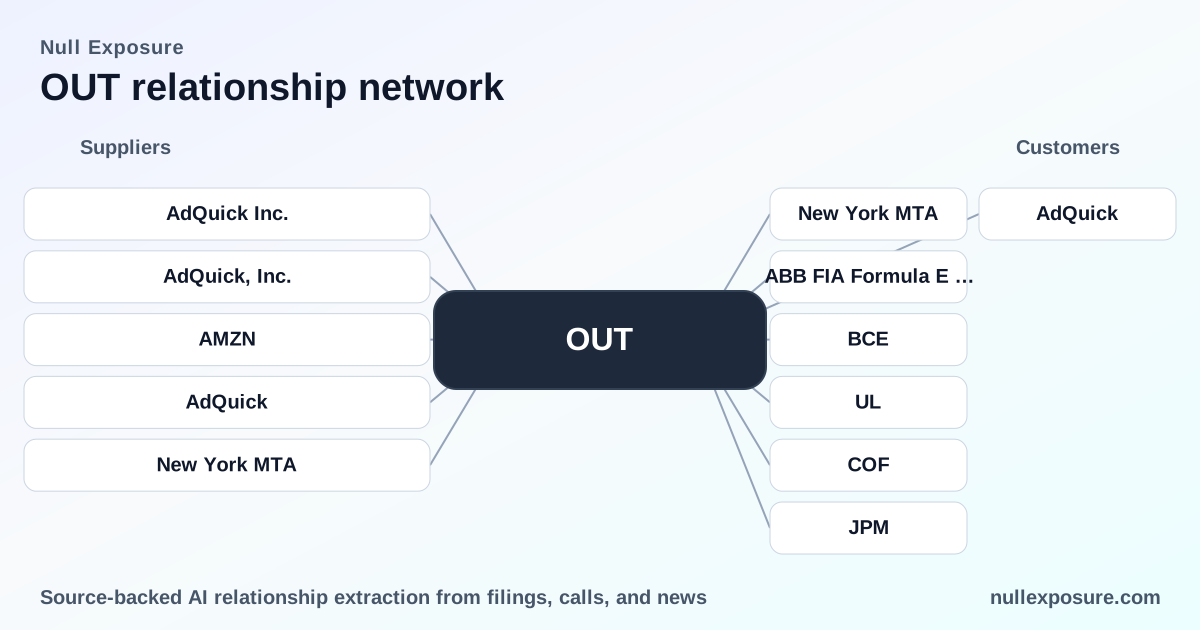
OUTFRONT Media: customer map and what it means for investors
OUTFRONT monetizes fixed-location and transit advertising real estate by selling display time and value‑added services to brands, agencies and municipalities across North America. The business combines short-term, impression-priced spot sales with exclusive, multi‑year municipal transit contracts, and supplements core billboard and transit inventory with creative, production and measurement services—generating recurring cash flow from long-term rights while preserving pricing and yield through short-term spot inventory. Visit https://nullexposure.com/ for more on how we track operator-customer exposures.
The distilled investment thesis for customer risk and upside
OUTFRONT’s model blends annuity-like municipal revenues with high-margin, flexible spot sales to advertisers. This mix delivers steady cash conversion while leaving upside from digital impressions and premium transit placements. Key investor levers are transit contract renewals in major metros (notably New York and Washington), the ability to monetize impressions programmatically and through partnerships, and capital redeployment such as the Canadian divestiture.
- Positive drivers: recurring municipal contracts, ramping transit revenue, partnerships to improve measurement and yield.
- Key risks: renewal and political risk on municipal contracts, concentrated geographic exposure to large transit systems, and variability in quarterly spot demand.
Explore company coverage and models at https://nullexposure.com/ — we track relationship-level signals that matter to holders.
How OUTFRONT structures customer relationships — what the contract signals mean
OUTFRONT operates with a dual contracting posture that combines long‑term rights and short‑term spot sales. Company disclosures describe exclusive, multi‑year transit contracts with municipalities that underpin its transit inventory, while traditional billboard and campaign contracts typically run four weeks to one year and are billed every four weeks. Revenue recognition is impression‑based for certain sales, allocating revenue pro rata to impressions delivered. Collectively, these signals imply:
- Contracting posture: A hybrid of long‑term municipal concessions that deliver stable revenue and short‑term, high‑turnover campaigns that enable price discovery and yield management.
- Concentration and geography: The business is North America‑centric, with the U.S. as the core market; transit revenues are a material growth vector.
- Criticality and counterparty type: Municipal and transit counterparties are government entities that require periodic renewals and create political/renewal risk.
- Revenue recognition and maturity: Usage‑based (impression) recognition for campaign sales supports closer alignment to audience delivery and measurement sophistication.
- Customer concentration: Company filings report no single customer greater than 2% of Billboard and Transit revenues, indicating broad customer diversification despite headline concentration on a handful of large transit partners.
- Commercial role: OUTFRONT reports revenues on a gross basis and acts as the principal seller of advertising space while also providing services such as creative, print production and post‑campaign analytics.
Every reported customer relationship in the public record
ABB FIA Formula E World Championship
OUTFRONT was named the Official Out‑Of‑Home Advertising Partner for the 2026 ABB FIA Formula E Miami E‑Prix and an associate partner for a related live event, reinforcing the company’s sports and experiential OOH footprint. Source: PR Newswire press release (March 10, 2026): https://www.prnewswire.com/news-releases/outfront-expands-sports-marketing-footprint-as-official-out-of-home-media-partner-of-the-abb-fia-formula-e-world-championship-302677715.html
BCE (in connection with Canadian sale)
OUTFRONT finalized the sale of its Canadian business to Bell Media, a subsidiary of BCE Inc., for C$410 million in cash—executing a divestiture that reduces geographic scope and frees capital. Source: Signmedia report on the transaction (March 2026): https://www.signmedia.ca/bell-media-closes-c410-million-acquisition-of-outfront-media-canada/
Bell Media Inc.
Bell Media Inc., a BCE subsidiary, is the buyer of OUTFRONT’s Canadian business for C$410 million, representing a strategic exit from Canadian operations and a concentration shift back to U.S. assets. Source: Signmedia coverage of the closing (March 2026): https://www.signmedia.ca/bell-media-closes-c410-million-acquisition-of-outfront-media-canada/
COF (Capital One referenced on earnings call)
Management cited Capital One among large client names when describing recent client work, illustrating OUTFRONT’s engagement with major national advertisers for billboard and transit campaigns. Source: OUTFRONT Q3 2025 earnings call transcript (first reported March 7, 2026): out-2025q3-earnings-call
Unilever
Unilever was called out on the same earnings call as an example of significant brand work executed across OUTFRONT’s platforms, reflecting relationships with large packaged‑goods advertisers. Source: OUTFRONT Q3 2025 earnings call transcript (March 7, 2026): out-2025q3-earnings-call
New York MTA (transit revenue driver — earnings call commentary)
Company commentary and Q4 2025 reporting highlighted nearly 20% revenue growth from New York MTA placements, identifying the agency as a near‑term driver of transit performance and revenue growth. Source: Intellectia.ai summary of Q4 2025 earnings highlights (March 2026): https://intellectia.ai/news/stock/outfront-media-q4-2025-earnings-call-highlights
Capital One (client mention on call)
Capital One was spoken of as a client in the earnings call context, underscoring OUTFRONT’s roster of large financial advertisers that buy both national and local OOH campaigns. Source: OUTFRONT Q3 2025 earnings call transcript (March 7, 2026): out-2025q3-earnings-call
Washington Metropolitan Area Transit Authority (WMATA)
OUTFRONT secured a long‑term advertising contract with WMATA, adding another major transit concession that expands the company’s municipal footprint in a key U.S. metro. Source: TradingView item reporting the WMATA contract award (May 3, 2026): https://www.tradingview.com/symbols/DUS-76C0/ideas/
Chase (JPM client mention on call)
Chase was listed by management among the company’s client examples, reflecting sustained demand from large banking advertisers across OUTFRONT’s inventory. Source: OUTFRONT Q3 2025 earnings call transcript (March 7, 2026): out-2025q3-earnings-call
AdQuick
OUTFRONT entered an exclusive multi‑year commercial partnership with AdQuick and agreed to invest up to $20 million to improve planning, buying and measurement for OOH, accelerating digital measurement and monetization of impressions. Source: MarketBeat summary of the partnership announcement and investment (2026): https://www.marketbeat.com/instant-alerts/filing-fox-run-management-llc-takes-813000-position-in-outfront-media-inc-out-2026-02-27/
New York MTA (investor commentary)
Independent market commentary warned that Q4 strength and transit gains are heavily tied to New York MTA exposure—flagging investor sensitivity to transit concentration despite company assertions of broad customer diversification. Source: SimplyWallSt analysis and investor commentary on Q4 2025 (May 2026): https://simplywall.st/stocks/us/real-estate/nyse-out/outfront-media/news/outfront-media-out-is-up-91-after-strong-q4-results-and-main
Investment implications: what the customer map means for returns
OUTFRONT sells two kinds of revenue streams: durable municipal concessions and variable short‑term campaigns. The municipal contracts create predictable baseload revenue but introduce renewal and political risk; the short‑term campaigns and emerging impression measurement provide margin expansion and upside in ad cycles. The Canadian divestiture to Bell Media strengthens the company’s U.S. focus and provides liquidity for reinvestment.
- Balance sheet and capital allocation: The C$410M sale to Bell Media is an explicit capital redeployment that reduces non‑core exposure and increases optionality.
- Monetization upside: The AdQuick partnership and impression‑based recognition point to improved measurement and higher CPM realization on digital/transit inventory.
- Risk to model: Large transit partners (New York MTA, WMATA) are critical to growth narratives; political or procurement delays around renewals will have outsized effects relative to the many small campaign customers—despite filings that no single customer exceeds 2% of revenue.
Bottom line
OUTFRONT combines annuity‑like municipal contracts with flexible spot inventory and service offerings, positioning the company to capture steady cash flow and cyclical upside. Monitor transit contract renewals, the pace of impression monetization, and execution on partnerships such as AdQuick; these elements will determine whether OUTFRONT converts transit momentum into durable EBITDA growth. For ongoing tracking of operator-customer exposures and relationship shifts, visit https://nullexposure.com/.