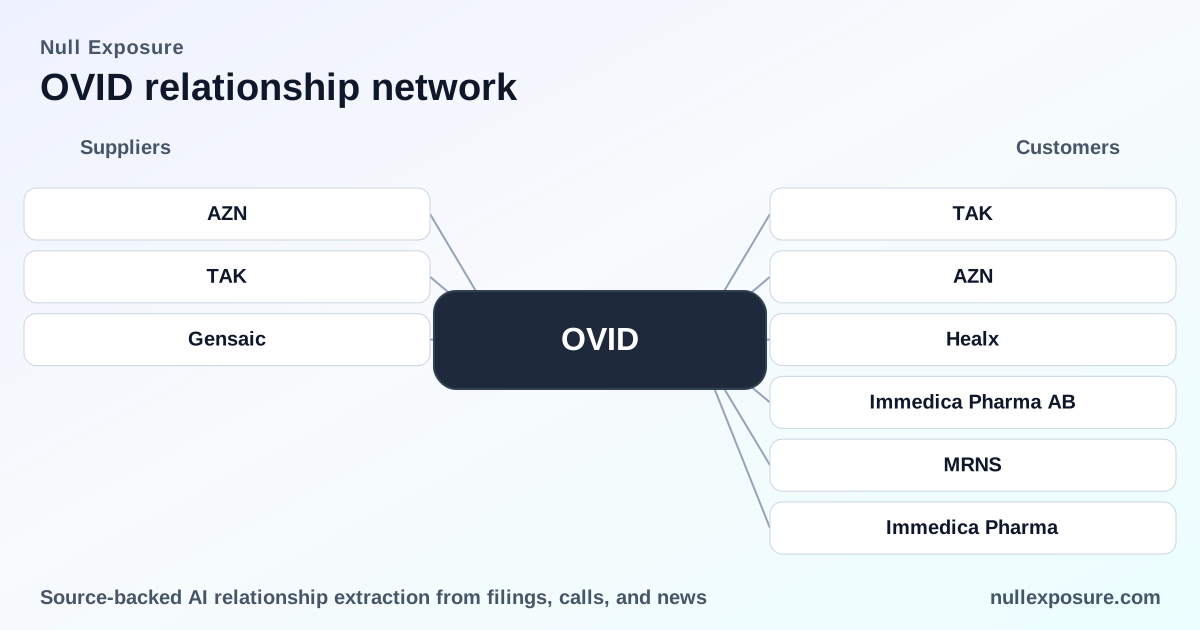
OVID Therapeutics: Licensing-heavy model, royalty economics, and a concentrated partner map
Ovid Therapeutics operates as a small-cap biopharma that builds value primarily by discovering or acquiring early-stage CNS assets and monetizing them through licenses, royalty sales and milestone-backed divestitures rather than large-scale commercial operations. Investors should view OVID as a rights-holder and cash-management company: it generates revenue from royalties and license/termination agreements while intermittently raising capital through equity placements to fund pipeline activity. For primary documentation and news-driven coverage, see https://nullexposure.com/.
How Ovid makes money and why licensing is central to valuation
Ovid’s revenue profile is dominated by royalty streams and one-time transaction proceeds rather than product sales. The company has historically: (1) licensed development and commercialization rights to larger pharma partners for late-stage programs; (2) sold or monetized future royalties for near-term cash; and (3) raised equity when clinical or runway events required capital. That mix produces lumpy, counterparty-dependent cash flows and ties future upside to partner execution and third-party payor coverage. For recent market coverage and PIPE detail, visit https://nullexposure.com/.
Counterparty map: every partner and what they mean for investors
Below are the company relationships surfaced in public filings and press coverage. Each entry includes a concise plain-English description and a source citation.
-
Takeda Pharmaceutical (TAK) — Ovid licensed soticlestat (a cholesterol 24‑hydroxylase inhibitor) to Takeda in a deal that included a $196 million up‑front payment and ongoing milestone/royalty arrangements; Ovid retains rights to certain commercial milestones and low double‑digit royalties up to specified caps. Source: FierceBiotech (FY2024) — https://www.fiercebiotech.com/biotech/ovid-halts-preclinical-work-iv-seizure-program-wake-soticlestats-phase-3-stumble and MedCityNews (FY2022) — https://medcitynews.com/2022/01/ovid-therapeutics-adds-to-epilepsy-drug-pipeline-with-new-astrazeneca-alliance/
-
AstraZeneca (AZN) — Ovid granted AstraZeneca exclusive access to a library of early‑stage KCC2 transporter modulators, including lead candidate OV350, positioning AstraZeneca for further development while OVID monetizes through licensing. Source: BioSpace (FY2022) — https://www.biospace.com/ovid-therapeutics-astrazeneca-sign-exclusive-deal-for-new-epilepsy-drug-ov350
-
Healx — Healx secured an exclusive option to license Ovid’s rights to gaboxadol for Fragile X, transferring development responsibility while Ovid preserves option economics. Source: BioSpace / GlobeNewswire (FY2022) — https://www.biospace.com/healx-and-ovid-therapeutics-enter-partnership-for-fragile-x-therapy and https://www.globenewswire.com/news-release/2022/02/08/2380797/0/en/Healx-and-Ovid-Therapeutics-to-Enter-Strategic-Partnership.html
-
Immedica Pharma AB — Ovid entered a definitive agreement to sell future royalties on ganaxolone sales outside China to Immedica, converting a future revenue stream into near‑term proceeds. Source: GlobeNewswire (FY2025) — https://www.globenewswire.com/news-release/2025/06/25/3105008/0/en/Ovid-Therapeutics-Enters-Agreement-with-Immedica-Pharma-AB-for-Sale-of-Future-Ganaxolone-Royalties.html
-
Marinus Pharmaceuticals (MRNS) — Ovid previously held licensing arrangements tied to ganaxolone use in CDKL5 deficiency disorder, under which Ovid was eligible for royalties in the U.S. and Europe before later monetization steps. Source: GlobeNewswire (FY2025) — https://www.globenewswire.com/news-release/2025/06/25/3105008/0/en/Ovid-Therapeutics-Enters-Agreement-with-Immedica-Pharma-AB-for-Sale-of-Future-Ganaxolone-Royalties.html
-
Point72 — Point72 led a March 2026 PIPE financing that provided Ovid with immediate capital; the placement also signals institutional support for near‑term funding needs. Source: GlobeNewswire (FY2026) — https://www.globenewswire.com/news-release/2026/03/18/3257973/0/en/Ovid-Therapeutics-Announces-Pricing-of-60-Million-Private-Placement.html
-
Adage Capital Management — Participated in the March 2026 PIPE, contributing to the $60 million gross financing that extends Ovid’s cash runway. Source: GlobeNewswire (FY2026) — https://www.globenewswire.com/news-release/2026/03/18/3257973/0/en/Ovid-Therapeutics-Announces-Pricing-of-60-Million-Private-Placement.html
-
ADAR1 Capital Management — Listed as a PIPE participant in the company’s March 2026 financing round, representing another institutional backer. Source: GlobeNewswire (FY2026) — https://www.globenewswire.com/news-release/2026/03/18/3257973/0/en/Ovid-Therapeutics-Announces-Pricing-of-60-Million-Private-Placement.html
-
Affinity Asset Advisors, LLC — Participated in the PIPE financing; inclusion indicates continued interest from specialized asset managers. Source: GlobeNewswire (FY2026) — https://www.globenewswire.com/news-release/2026/03/18/3257973/0/en/Ovid-Therapeutics-Announces-Pricing-of-60-Million-Private-Placement.html
-
Ally Bridge Group — Named as an investor in the March 2026 PIPE, signaling crossover participation from life‑science oriented investors. Source: GlobeNewswire (FY2026) — https://www.globenewswire.com/news-release/2026/03/18/3257973/0/en/Ovid-Therapeutics-Announces-Pricing-of-60-Million-Private-Placement.html
-
Balyasny Asset Management — Listed among PIPE participants; provides additional capital market validation for the financing. Source: GlobeNewswire (FY2026) — https://www.globenewswire.com/news-release/2026/03/18/3257973/0/en/Ovid-Therapeutics-Announces-Pricing-of-60-Million-Private-Placement.html
-
Coastlands Capital — Included in the PIPE syndicate, reflecting smaller hedge/credit participation in Ovid’s funding. Source: GlobeNewswire (FY2026) — https://www.globenewswire.com/news-release/2026/03/18/3257973/0/en/Ovid-Therapeutics-Announces-Pricing-of-60-Million-Private-Placement.html
-
Eventide Asset Management — Named PIPE participant, representing ESG‑tilted or values‑oriented asset management interest. Source: GlobeNewswire (FY2026) — https://www.globenewswire.com/news-release/2026/03/18/3257973/0/en/Ovid-Therapeutics-Announces-Pricing-of-60-Million-Private-Placement.html
-
Janus Henderson Investors (JHG) — Participated in the PIPE; institutional involvement from Janus Henderson supports liquidity for the placement. Source: GlobeNewswire (FY2026) — https://www.globenewswire.com/news-release/2026/03/18/3257973/0/en/Ovid-Therapeutics-Announces-Pricing-of-60-Million-Private-Placement.html
-
RA Capital Management — Listed among investors in the March 2026 private placement, showing continued biotech specialist support. Source: GlobeNewswire (FY2026) — https://www.globenewswire.com/news-release/2026/03/18/3257973/0/en/Ovid-Therapeutics-Announces-Pricing-of-60-Million-Private-Placement.html
What these relationships collectively reveal about Ovid’s operating posture
-
Contracting posture: Ovid is an outward‑facing licensor and royalty seller; its strategy is to de‑risk science through partner development and monetize intellectual property early. The Takeda and AstraZeneca deals are examples of transferring development and commercialization responsibilities to larger sponsors in exchange for cash, milestones, and royalties (MedCityNews; BioSpace).
-
Concentration: Revenue and upside are concentrated in a small number of material counterparties and specific programs (notably soticlestat and ganaxolone), generating partner concentration risk if a single program underperforms. Source: TradingView SEC 10‑Q commentary (FY2025) — https://www.tradingview.com/news/tradingview:29f6ddb60a2f6:0-ovid-therapeutics-inc-sec-10-q-report/
-
Criticality: For valuation, third‑party execution (Takeda, AstraZeneca) and payor coverage determine whether royalty streams materialize; Ovid has limited direct control over late‑stage development outcomes. Source: multiple licensing announcements (BioSpace; FierceBiotech).
-
Maturity: The company portfolio is mixed: some assets are late‑stage or already licensed (soticlestat), others are early discovery (KCC2 modulators), and the firm converts older royalty positions (ganaxolone) to cash, indicating an active capital‑management approach. Source: GlobeNewswire (FY2025) and BioSpace (FY2022).
Investment implications and headline risks
- Upside is levered to partner success and royalty realization. Takeda’s development progress and AstraZeneca’s early‑stage advancement are principal value drivers.
- Cash runway is managed through structured financings and royalty sales. The March 2026 PIPE and the ganaxolone royalty sale to Immedica demonstrate a pattern of monetizing future flows to fund ongoing operations. Source: GlobeNewswire (FY2026; FY2025).
- Policy and payor exposure is a material execution risk. Government and managed‑care reimbursement dynamics in the U.S. and other jurisdictions can compress realized royalties and market access for partner‑commercialized drugs. This is a company‑level exposure cited in Ovid’s public disclosures.
For an investor evaluating partner execution risk versus transactional upside, Ovid represents a licensing‑centric thesis: limited commercial execution on Ovid’s balance sheet, but concentrated leverage to a few high‑impact partner programs. For ongoing tracking of partner announcements and financing activity, visit https://nullexposure.com/.
If you want a companion checklist for monitoring upcoming milestones (partner trial readouts, milestone receipts, royalty sale activity, and payor/regulatory updates), I can prepare a tailored watchlist keyed to OVID’s partner map and the timelines implied by public filings.