Ovintiv’s customer footprint: asset sales, concentrated receipts, and what that means for investors
Ovintiv operates as an upstream oil and gas producer that converts hydrocarbon reserves into cash by producing and selling oil, natural gas liquids and natural gas to refiners, marketers and utilities, while periodically monetizing non-core acreage through asset sales. The company monetizes primarily through commodity sales under predominantly short-term pricing arrangements, supplemented by periodic strategic divestitures that accelerate debt paydown and reprice the portfolio. For a quick company profile and relationship analytics, visit https://nullexposure.com/.
Recent transactions that redefine counterparty exposure
Ovintiv’s customer and counterparty map shifted in early 2026 through two notable asset-sale related relationships that materially affect counterparties and short-term cash flows.
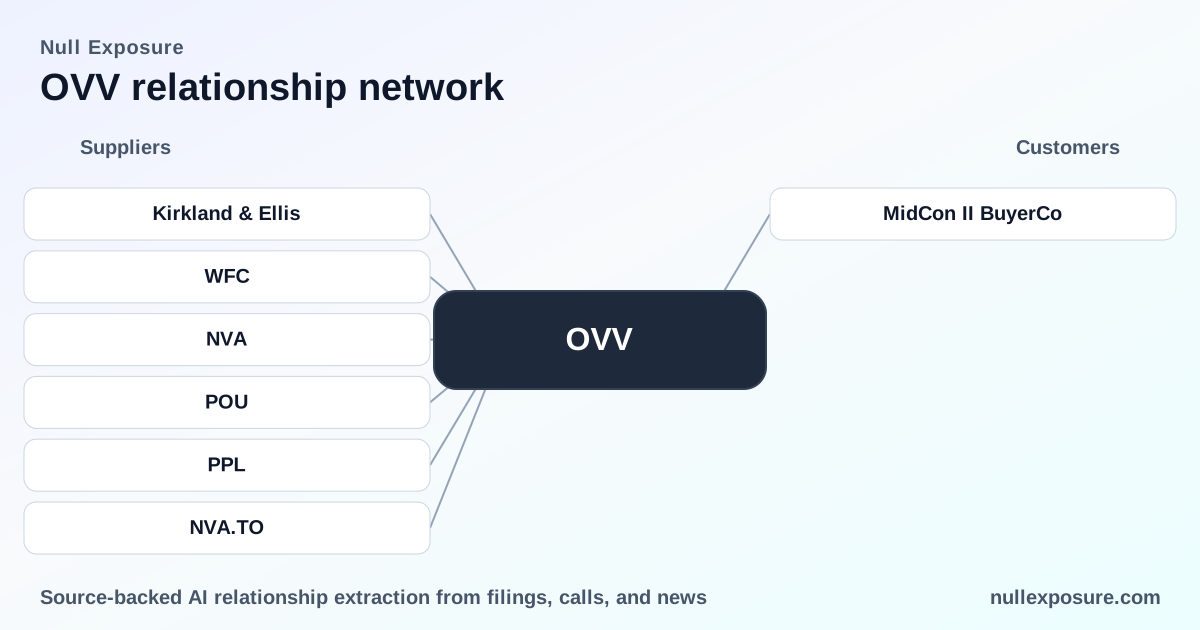
MidCon II BuyerCo — $3.0 billion Oklahoma asset sale
Ovintiv entered into a Purchase and Sale Agreement to sell certain Oklahoma oil and gas assets to MidCon II BuyerCo for $3.0 billion in cash, a transaction that immediately reduces Ovintiv’s asset base in the Mid-Continent while delivering substantial liquidity for balance-sheet management (TradingView, March 10, 2026). Source: TradingView coverage of the March 10, 2026 transaction announcement.
Anadarko — asset sale to accelerate debt reduction
Ovintiv advanced its debt reduction program through an asset sale linked to Anadarko, highlighting management’s active use of divestitures to deleverage the company and refine its operating footprint (The Globe and Mail, May 3, 2026). Source: The Globe and Mail press reporting on analyst commentary regarding Ovintiv’s asset sale program and debt reduction in May 2026.
How Ovintiv contracts and collects — signals that shape counterparty risk
Ovintiv’s commercial posture is best understood as a mix of short-term transactional sales with pockets of longer commitments and dedication agreements, producing a customer profile that is both liquid and operationally flexible. The following company-level signals matter for investors evaluating Ovintiv’s customer relationships:
- Contracting posture: predominantly short-term — Receivables are short dated, with payment terms generally within 30–60 days and product sold largely under contracts shorter than one year priced at fixed or market indices; the company also uses limited long-term contracts that can extend up to two years or dedication agreements where appropriate. This structure delivers rapid cash conversion but leaves revenue exposed to near-term commodity price movements (company filings, FY2024–FY2025).
- Geographic concentration: North America — Operations are concentrated in the United States and Canada, with a non-trivial portion of revenues and costs denominated in Canadian dollars, making FX and regional market dynamics relevant to customer economics.
- Revenue concentration: material single-customer exposure — Ovintiv historically reported one customer that accounted for more than 10% of product revenues in recent years, indicating meaningful counterparty concentration that investors must monitor for credit and negotiation risk.
- Role dynamics: both buyer and seller — Ovintiv functions principally as a seller of produced hydrocarbons while also engaging as a buyer in product optimization and third-party processing, creating two-way commercial flows with midstream and marketing counterparties.
- Commercial maturity and spend scale: core production relationships exceed $100M — The presence of at least one large counterparty band of $100M+ underscores the strategic importance of major contracts and the potential impact of contract re-pricing or loss.
These signals combine into a cash-conversion-focused commercial model that prioritizes short receivable cycles and operational flexibility, balanced by concentrated counterparty exposure and periodic portfolio-level asset sales.
Why the MidCon and Anadarko moves matter to an investor
The March and May 2026 transactions are not routine divestments; they are portfolio management levers. The $3.0 billion Oklahoma sale to MidCon II BuyerCo immediately supplies liquidity that management has earmarked for debt reduction, improving leverage ratios and freeing up cash flow for maintenance capex and potential shareholder returns (TradingView, March 2026). Similarly, the Anadarko-linked sale is explicitly framed by management and analysts as debt paydown, which reduces interest burden and credit exposure (The Globe and Mail, May 2026).
- Balance-sheet effect: Large one-time proceeds accelerate deleveraging and improve financial flexibility, lowering counterparty credit sensitivity at the corporate level.
- Revenue composition effect: Asset sales shift production volumes away from legacy counterparties and can reduce near-term revenue, increasing the relative weight of remaining customers — a dynamic that reinforces the importance of the reported >10% customer concentration signal.
- Operational effect: Selling region-specific assets alters the geographic footprint and index exposure of future sales, reshaping which marketing counterparties and pipelines become critical.
Practical implications for risk-adjusted valuation
Investors should incorporate three model adjustments when valuing Ovintiv’s customer relationships and cash flows:
- Commodity sensitivity is elevated by short-term contracting — With most sales priced to prevailing regional indices and receivables collected within 30–60 days, earnings will track price moves quickly; risk-adjust short-term cash flow forecasts accordingly.
- Counterparty concentration is a material idiosyncratic risk — One large buyer historically represents >10% of product revenues; model stress tests should include scenarios where that counterparty’s purchasing profile changes or credit terms tighten.
- Balance-sheet improvements from disposals are immediate but non-recurring — Use proceeds to de-risk debt curves in base-case cash-flow models, but do not treat asset-sale proceeds as sustainable operating revenue.
For an investor focused on credit quality and counterparty dynamics, the combination of short collection cycles, North American geographic concentration and high-spend counterparties creates a profile that is operationally nimble but exposed to concentrated customer shifts.
Actionable takeaways and where to look next
- Key takeaway: Ovintiv monetizes primarily through fast-turnover commodity sales and uses strategic asset sales to improve leverage; the March 2026 MidCon II BuyerCo transaction ($3.0B) and the Anadarko-related disposal are central to the company’s near-term deleveraging plan (TradingView, March 2026; The Globe and Mail, May 2026).
- Investor focus: Monitor counterparty concentration metrics, the identity and credit of the >10% revenue customer, and any reallocation of volumes post-divestiture that could elevate other counterparties to material status.
- Credit outlook: Expect improving leverage metrics in the quarters immediately following these transactions, but retain conservatism on recurring cash-flow forecasts given the short-term pricing posture.
For a consolidated view of Ovintiv’s counterparty exposures and transaction chronology, see the NullExposure profile: https://nullexposure.com/.
Bottom line
Ovintiv delivers monetization through a high-frequency commodity-sales engine supplemented by strategic asset sales that materially affect customer maps and leverage. Investors should trade off improved balance-sheet metrics from disposals against ongoing revenue concentration risk and short-term commodity price exposure.