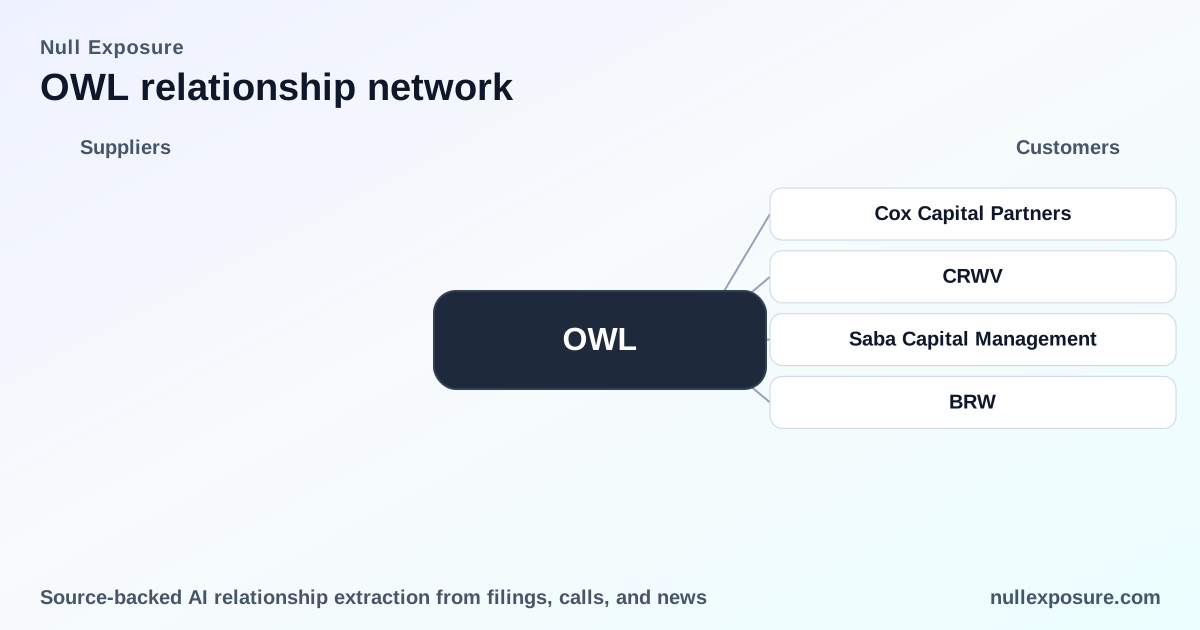
Blue Owl (OWL) — Customer Relationships and Strategic Bearings
Blue Owl is a global alternative asset manager that monetizes primarily through management and performance fees on permanent and long-dated capital, plus credit facility origination and direct lending arrangements that generate interest and spread income. The firm’s business model anchors on private credit and GP strategic capital, supplying capital and lending solutions to corporate borrowers, fintech platforms and specialty finance partners while distributing products through Blue Owl Securities. For a concise briefing and dataset access for investor due diligence, visit NullExposure.
Why customers and counterparties matter for OWL’s valuation
Blue Owl’s economics flow from fee-bearing, long-duration capital relationships rather than transactional brokerage. Roughly 91% of management fees are generated by Permanent Capital vehicles, which produces a fee base that is both recurring and sensitive to asset valuation and deployment. That structure creates concentration in fee sources and a high dependency on credit origination and direct lending to upper-middle-market borrowers, which amplifies both the franchise value and downside from borrower distress or reputational events.
- Contracting posture: long-term, lock-up oriented capital with limited redemption pressure supports predictable fee streams and underwriting horizons measured in years.
- Counterparty profile: credit activity is weighted toward upper‑middle‑market borrowers and growth-stage corporates, matching Blue Owl’s private credit strategy.
- Geography and scale: U.S./Canada-centric fundraising and revenue generation, layered with a global distribution footprint and $251.1bn AUM (Dec 31, 2024), which supports both domestic lending and selective international exposure.
- Role set: Blue Owl acts as manager, lender, distributor and occasional direct investor, producing layered cashflows (management fees, interest income, origination fees) and cross‑product exposures.
For structured access to these relationship signals and how they feed investment models, see NullExposure.
Mapping every recent customer relationship in the coverage
Below are the relationships surfaced in recent reporting, each summarized in plain English with source context.
Century Capital Partners
Blue Owl held the riskiest junior tranche of Century Capital Partners’ debt and, after uncovering financial irregularities and a director’s dismissal, accelerated repayment which pushed the lender into administration, indicating direct credit positioning and active remediation. (Sahm Capital, March 17, 2026).
OBDC (Blue Owl Capital Corporation / BDC)
A shareholder lawsuit filed April 27, 2026 alleges Blue Owl Credit Advisors inflated portfolio marks to extract roughly $414 million in fees for the BDC’s adviser, placing advisory valuation governance at legal and reputational risk. (InvestmentNews, April 2026).
SoFi (SOFI)
SoFi’s lending platform sources capital through partnerships with private credit providers, and Blue Owl is explicitly named as a provider of capital to SoFi loan originations, reflecting Blue Owl’s role as an institutional funding partner to fintech lenders. (Yahoo Finance, May 2026).
Finance of America (FOA)
Funds managed by Blue Owl expanded a $2.5 billion strategic partnership with Finance of America to accelerate home‑equity product innovation and distribution, demonstrating large-scale balance-sheet commitments into specialty consumer finance. (AIjourn press release, first reported May 2, 2026; FY2025 context).
TG Therapeutics (TGTX)
TG Therapeutics entered a five‑year, $750 million senior secured credit facility with funds managed by Blue Owl — refinancing an earlier $250M line, raising $500M of incremental non-dilutive capital and leaving an additional $250M at mutual option. This is a clear example of Blue Owl’s role as an anchor lender to biopharma. (GlobeNewswire press release; March 19, 2026).
Cox Capital Partners
Cox Capital participated in an unsolicited tender offer for shares of a Blue Owl-managed private credit fund (Blue Owl Capital Corp. II), signaling secondary-market activity and investor activism around valuations of Blue Owl fund shares. (Intellectia.ai, March 10, 2026).
CoreWeave (CRWV)
Following a setback in securing large-scale data center debt, CoreWeave received a temporary $500 million bridge loan from Blue Owl, illustrating the firm’s willingness to provide short-term bridge financing in stressed infrastructure financings. (MLQ.ai, March 10, 2026).
XOMA Royalty Corporation (XOMA)
XOMA reports interest expense associated with a Blue Owl loan established December 2023, indicating an ongoing borrower relationship where Blue Owl is a lender to royalty/biotech financing structures. (QuiverQuant / company filings discussing Q3 2025 results).
Assured Guaranty (AGO)
Assured Guaranty acquired Warwick Re from a consortium that included Blue Owl GP Stakes V and Blue Owl Capital, a transaction that demonstrates Blue Owl’s use of GP stakes and balance-sheet interest in insurance/reinsurance assets and strategic dispositions. (MarketScreener, March 9, 2026; TradingView transactional notice).
ADC Therapeutics (ADCT)
ADC Therapeutics disclosed indebtedness that includes facilities provided by Blue Owl, and the company cited covenant and operational restrictions tied to that capital, underscoring how Blue Owl financing can influence borrower flexibility. (BioSpace press release, FY2026 corporate update).
LC (loan originator / fintech)
Public commentary on LC highlights large funding commitments from Blue Owl and structured certificates with BlackRock used to underwrite originations, showing Blue Owl’s role in wholesale financing for consumer and small business lending platforms. (Finviz summary, March 2026).
Madrigal Pharmaceuticals (MDGL)
Madrigal entered a senior secured credit facility of up to $500 million with funds managed by Blue Owl to progress its pipeline, reflecting Blue Owl’s activity in growth-stage biotech lending. (Yahoo Finance Singapore coverage, March 10, 2026).
Caris Life Sciences (CAI)
Caris filed an SEC disclosure noting a new credit agreement involving Blue Owl and Blackstone, indicating co-lending arrangements with other large alternative managers to support life sciences capital needs. (MarketScreener note, SEC filing reference).
Saba Capital Management
Saba Capital joined Cox Capital in the unsolicited tender offer for shares of Blue Owl Capital Corp. II, signaling parallel activist/ARB pressure on Blue Owl‑managed fund valuations and liquidity. (Intellectia.ai, March 10, 2026).
BRW
BRW is referenced in coverage of the same tender offer activity for Blue Owl Capital Corp. II, listed in public notices around the unsolicited offer; the mention underscores market interest and trading in Blue Owl’s managed-fund shares. (Intellectia.ai, March 10, 2026).
How these relationships inform credit and franchise risk
Collectively the list shows Blue Owl operates across direct lending, structured financings and permanent-capital products. Key investment implications:
- Blue Owl is both a capital provider and an adviser; this duality amplifies fee capture but concentrates reputational and valuation risk when borrower stress, activist pressure, or litigation intersect (see OBDC litigation and Century Capital administration).
- The firm underwrites mid‑market to growth-stage borrowers and participates in strategic partnerships with fintech and consumer-lending platforms; that diversifies revenue sources but equally distributes exposure across sectors sensitive to macro credit cycles.
- Permanent Capital dominance (91% of management fees) means management-fee resilience but also sensitivity to AUM performance and mark governance — the OBDC suit highlights the governance vector.
Final read and action items
Blue Owl’s customer footprint is large, diversified by sector but concentrated in long‑dated, fee‑driven capital relationships that are material to the firm’s economics. For investors and operators, watch legal and valuation governance matters (BDCs and fund-level NAVs), large single-credit exposures (bridge and direct lending), and activist activity in managed-fund shares.
For more structured relationship intelligence and ongoing monitoring of Blue Owl’s commercial exposures, explore the research offerings at NullExposure.