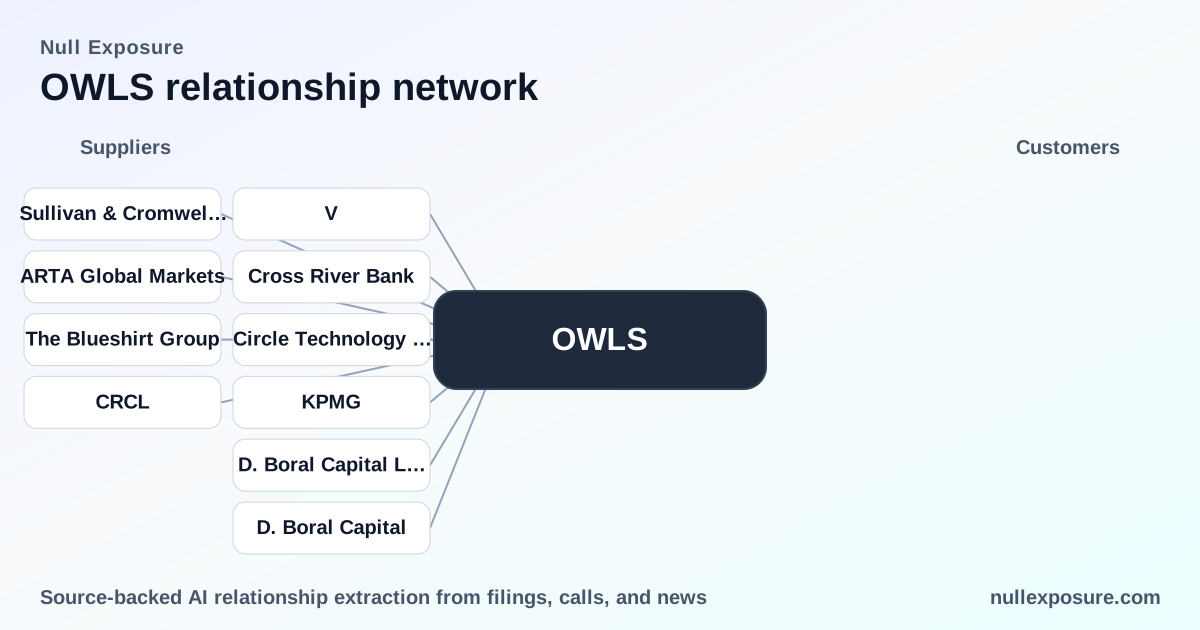
OWLS (OBOOK Holdings) — Customer map and commercial signals
OBOOK Holdings (ticker OWLS) operates a cross-border blockchain payments and infrastructure platform branded around OwlPay Harbor and related services; the company monetizes primarily through transaction and platform fees charged to onboarding payment platforms and enterprise clients that use its payment corridors. Recent customer wins signal a shift from pilot deployments toward commercial client penetration across North America, Latin America, Africa, the Middle East and APAC, which is the operational vector investors should monitor for revenue scaling and unit economics improvement. For more background on the platform and commercial positioning, visit https://nullexposure.com/.
Why the newest customers matter to investors
OBOOK’s public disclosure in early May 2026 reveals a group of clients that open broad geographic payment corridors rather than single-market pilots. That commercial pattern translates into three investor-relevant characteristics of the operating model:
- Contracting posture — platform-anchored, recurring-fee orientation. The announced customers are payment platforms and nonprofits receiving integrated payment corridors through OwlPay Harbor; that evidence points to recurring transaction flows rather than one-off professional services engagements.
- Concentration — improved diversification at the client level. The roster mixes commercial payment platforms and nonprofit partners across multiple regions, reducing single-client revenue concentration risk if these relationships scale.
- Criticality — payments infrastructure that customers will treat as mission-critical. Owning cross-border corridors into underbanked corridors elevates OwlPay Harbor from optional add-on to operational dependency for client cash flows.
- Maturity — early commercial traction, not enterprise scale yet. These are meaningful names to demonstrate product-market fit, but OBOOK’s public financials show limited revenue scale to date, so these wins represent early-stage commercialization rather than large, proven monetization.
No formal constraints or third‑party caveats were returned in the customer relationship data collection; this absence is a company-level signal that public constraint disclosures tied to customer performance, concentration limits, or contract cliffs are currently not available.
Client roster: what was announced and why it matters
The company announcement published on May 3, 2026, named three new customers that OBOOK onboarded to OwlPay Harbor in Q1 2026; each is summarized below with source attribution.
Dexpay
OBOOK has onboarded Dexpay to OwlPay Harbor, expanding payment corridors and enabling Dexpay to route transfers across multiple regions using OBOOK’s infrastructure. According to the company announcement carried by TipRanks on May 3, 2026, Dexpay is one of the platforms opening corridors from the United States to Latin America, Africa, the Middle East and Asia‑Pacific. (TipRanks company announcement, May 3, 2026 — https://www.tipranks.com/news/company-announcements/obooks-owlting-onboards-5-billion-scale-clients-to-owlpay-harbor-in-q1-2026)
Graph (Oval Technologies)
Graph, referenced as Oval Technologies in the announcement, is listed as a platform client now using OwlPay Harbor to route cross‑border payments; this relationship positions OBOOK within platform payment stacks that service high‑volume flows. The same TipRanks release on May 3, 2026 notes Graph (Oval Technologies) as part of the multi‑client roster onboarding to OwlPay Harbor. (TipRanks company announcement, May 3, 2026 — https://www.tipranks.com/news/company-announcements/obooks-owlting-onboards-5-billion-scale-clients-to-owlpay-harbor-in-q1-2026)
Hope for Haiti
OBOOK’s announcement also names nonprofit Hope for Haiti as a client leveraging OwlPay Harbor to open payment corridors between the United States and international regions, indicating adoption outside purely commercial fintech ecosystems. TipRanks’ May 3, 2026 report lists Hope for Haiti among the newly onboarded organizations, highlighting non‑commercial use cases for OBOOK’s corridors. (TipRanks company announcement, May 3, 2026 — https://www.tipranks.com/news/company-announcements/obooks-owlting-onboards-5-billion-scale-clients-to-owlpay-harbor-in-q1-2026)
What these relationships imply for revenue and risk
The client list is strategically meaningful: onboarding multiple “5‑billion‑scale” clients into OwlPay Harbor in Q1 2026, as characterized by the company release, creates the potential for materially higher transaction volumes if these platforms route meaningful payments through OBOOK. At the same time, OBOOK’s public financials require discipline when translating customer wins into valuation upside:
- Scale vs. current financial base. OBOOK’s TTM revenue is approximately $7.9 million with gross profit of roughly $0.2 million and negative EBITDA; these metrics show limited current monetization relative to market capitalization (~$531 million). Any valuation rerating requires demonstrable, sustained volume growth and margin expansion from these and future clients.
- Execution risk concentrated on on‑ramping and retention. The business model converts client onboarding into revenue through transaction fees; therefore, onboarding speed, uptime, settlement reliability, and regulatory compliance are the primary execution levers.
- Revenue diversification potential. Having both platform customers and a nonprofit customer suggests multiple revenue vectors—commercial fees and institutional/NGO payment flows—reducing a single‑market dependency profile once volumes scale.
Near-term signals investors should monitor
- Daily and weekly transaction volume disclosures or client‑specific volume milestones tied to these relationships. Public confirmation of sustained transaction throughput will be the cleanest lead indicator of monetization.
- Contract types and fee schedules disclosed in future filings or investor briefings, which will determine realized margins.
- Customer retention and geographic expansion metrics indicating whether the initial corridors convert to repeat flows.
For a concise investor briefing and ongoing tracking of OBOOK’s commercial traction, visit https://nullexposure.com/.
Bottom line: pragmatic optimism with execution gating
OBOOK’s Q1 2026 customer announcements move the company from proof‑of‑concept toward commercial deployments in strategically valuable corridors. The mix of payment platforms and an NGO client broadens the use case set and reduces single‑client concentration risk should volumes follow. However, valuation upside is contingent on turning these onboarding wins into sustained transaction volumes that materially alter current revenue and margin dynamics. Investors should weigh the signal of expanding corridor coverage against the company’s current revenue base and negative EBITDA when sizing exposure.