Owlet (OWLT): Distribution relationships that determine scale and risk
Owlet commercializes infant health hardware (the Owlet Smart Sock, Dream Sock, Owlet Cam and Monitor Duo) and supplements hardware revenue with a recurring software/subscription element and expanding durable medical equipment (DME) distribution for prescription products. The company monetizes primarily through direct-to-consumer and retail hardware sales, subscription services for ongoing monitoring, and growing institutional/DME channels that enable insurance-supported purchases for BabySat; these channels together drive unit velocity and the path to recurring revenue. For investors, the key question is whether retail reach and new payor channels scale quickly enough to offset a hardware-heavy margin profile and concentrated customer exposures. Learn more at https://nullexposure.com/.
How Owlet sells: a concise commercial map investors should know
Owlet’s operating model blends three commercial postures in practice: direct-to-consumer retailing, large-box and online retail partnerships, and DME / healthcare distribution. Payment and contract signals are consistent with this mix: the company reports short-term payment terms for product sales while also operating subscription-based services that introduce recurring revenue and associated regulatory considerations around cancellations and renewals. The revenue base is hardware-dominant, with the company stating that it generated substantially all revenues from hardware products; that shapes margins, working capital cadence, and sensitivity to unit demand cycles.
Geographically, Owlet’s business is U.S.-centric for its subscription service footprint (Owlet360 is available to U.S. users) while maintaining an expanding international distribution presence across Canada, Australia, the U.K., and the EU. Concentration is material: Owlet disclosed that its top three customers represented 58% of revenue for the year ended Dec 31, 2024, which elevates counterparty and channel risk. Finally, the company is shifting parts of its GTM toward DME distributors and healthcare channels to access payors and prescription-required products, which increases sales complexity but improves addressable market for regulated devices.
Customer relationships: who moves product to families and payors
Amazon — retail reach on two fronts (FY2021 and FY2026 mentions)
Amazon serves as a major online retail channel for Owlet hardware, historically driving strong consumer traction for premium-priced products such as the Dream Sock. According to a 2026 report, Owlet’s Dream Duo 3 is available on Amazon and other major retailers, an availability decision that expands consumer purchasing convenience (Intellectia.ai, May 3, 2026). Earlier coverage in 2021 noted the Dream Sock was a best-selling smart baby monitor on Amazon, demonstrating durable consumer demand on the platform (SimplyWallSt, 2021/coverage cited May 3, 2026).
Walmart — big-box distribution for broader penetration (FY2026)
Walmart is cited as a major retailer now carrying Owlet’s Dream Duo 3, a placement that increases point-of-sale exposure to price-sensitive and mainstream consumers and supports unit volume growth across the mass-market channel (Intellectia.ai, May 3, 2026).
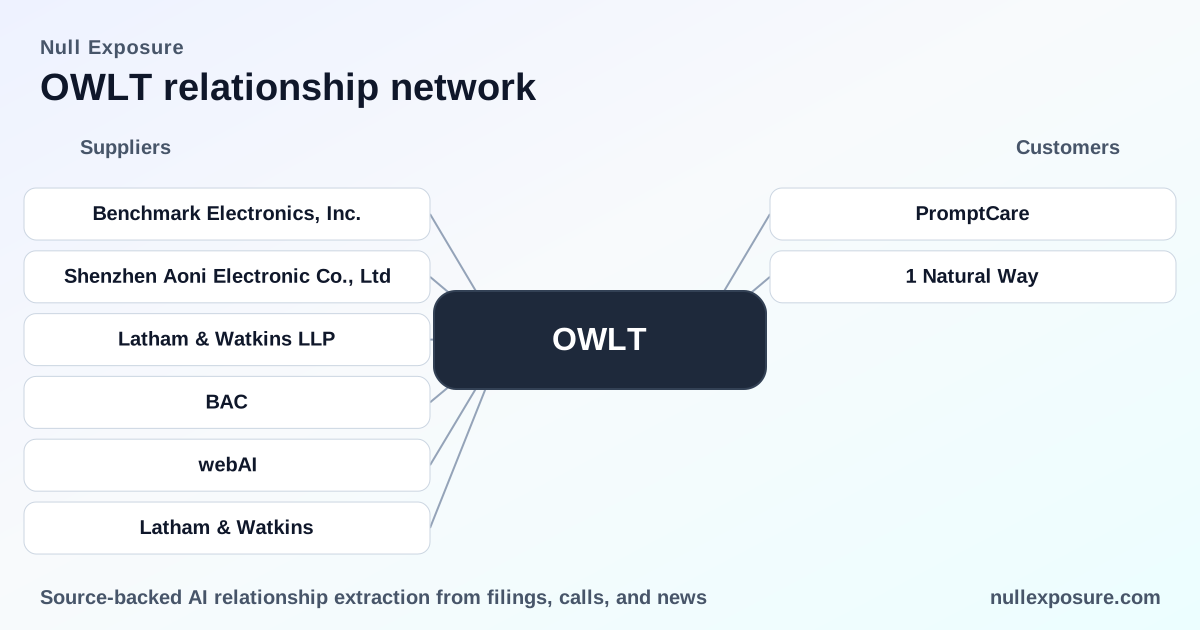
PromptCare — strategic DME partner to reach payors (FY2025–FY2026)
Owlet has executed a strategic DME partnership with PromptCare to expand distribution of its pediatric pulse oximeter and related devices; the partnership is described as expected to contribute to incremental unit shipments as pilot programs scale (MarketScreener, Feb–Mar 2026). This relationship advances Owlet’s objective to penetrate payer channels and to move certain products into reimbursable prescription pathways.
1 Natural Way — insurance-supported DME distribution (FY2025)
Owlet announced a DME partnership with 1 Natural Way to broaden insurance-supported access to the BabySat infant pulse oximeter, positioning the company to reach patients through reimbursable channels beyond retail storefronts (MarketScreener, Dec 18, 2025).
What these relationships mean for revenue and risk
- Distribution breadth versus concentration: Owlet has expanded retail distribution into Amazon and Walmart while adding DME partners such as PromptCare and 1 Natural Way to access payors. That dual approach increases TAM access but does not eliminate concentration risk, because the company reported top-three customers accounted for 58% of revenue (company filings, FY2024).
- Revenue quality is mixed: hardware sales continue to drive the majority of topline — Owlet stated it generated substantially all revenues from hardware products — while subscription offerings introduce recurring revenue upside and legal/regulatory complexity around cancelation and auto-renewal rules. Short-term payment terms for sales keep working capital cycles tight but predictable, while subscription elements create longer-term customer lifetime value if retention holds.
- Channel maturity differences: retail distribution brings scale quickly but is margin-pressured; DME and prescription channels are higher complexity and longer sales cycles but deliver payor-backed revenues that improve ASP resilience. Owlet is actively executing on both fronts, shifting some emphasis toward institutional distribution to diversify revenue mix.
- Geographic posture: the company runs a U.S.-centric subscription service and reported stronger U.S. revenue dollars, while international distribution is growing and should incrementally reduce geographic concentration over time.
Financial and governance context investors should weigh
Owlet reported revenue TTM of about $105.7M and gross profit of $53.5M, but remains loss-making on an EPS basis (diluted EPS TTM: -2.29) and shows negative operating leverage in recent periods (company filings, Latest Quarter 2025-12-31). Institutional ownership is high (about 71%) which supports liquidity but also means sentiment from a concentrated investor base will move the stock. Price-to-sales and EV multiples reflect growth ambitions but also the market’s assessment of execution risk; current market capitalization sits near $137.7M.
For deeper commercial diligence on channel dynamics and counterparty exposures, review the company’s filings and these reporting items; for a concise monitoring feed on ownership and partner announcements visit https://nullexposure.com/.
Bottom line — actionable investor view
Owlet’s retail partnerships with Amazon and Walmart deliver distribution scale, while DME alliances with PromptCare and 1 Natural Way create a credible path to reimbursable sales for prescription devices. The company’s business model balances fast-moving consumer hardware economics against the strategic, higher-value opportunity of payor-backed device sales and subscriptions. Investors should treat channel concentration and hardware dependence as principal risks, and value any evidence of sustained subscription retention or expanding payor reimbursement as the clearest pathway to durable margins and valuation re-rating.
For ongoing monitoring of partner updates and customer-risk signals, visit https://nullexposure.com/ for curated relationship intelligence and rolling analysis.