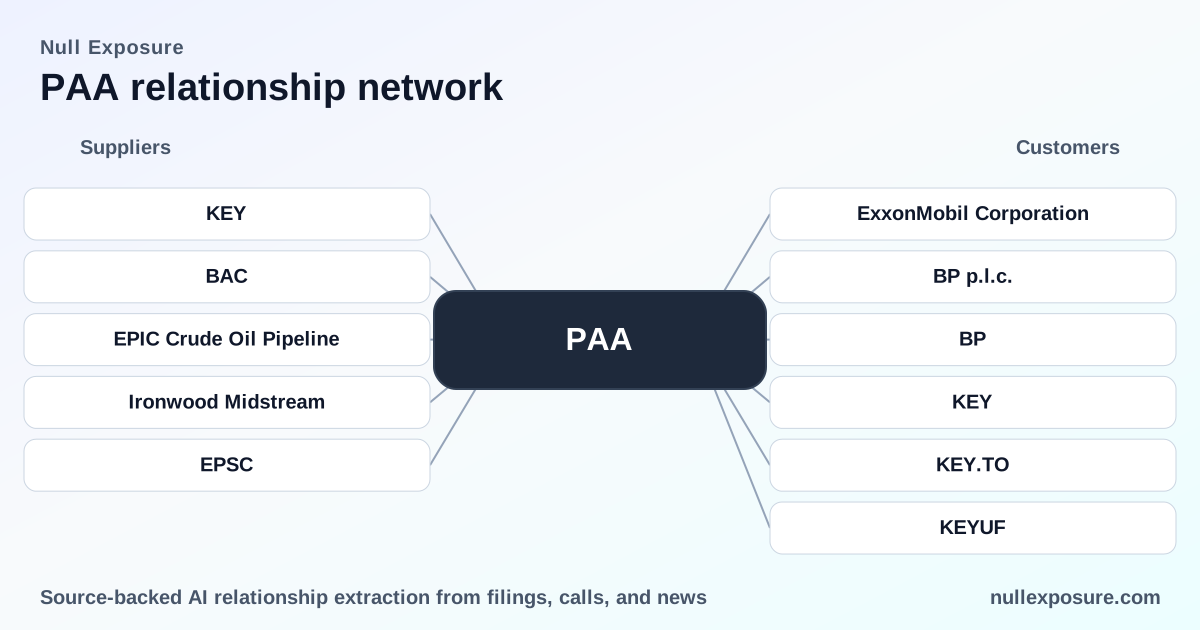
Plains All American Pipeline (PAA): customer relationships that drive cash flow — and concentration risk
Plains All American Pipeline operates an extensive North American crude oil and NGL midstream network and monetizes through a mix of fee-based transportation, storage and terminalling services plus merchant crude trading and sales. Its business model is built for durable fee streams from long-term contracts in key basins while retaining merchant exposure that lifts margins in favorable commodity cycles. For investors, the critical lens is customer concentration, geography, and the ongoing portfolio shift away from Canadian NGL assets — factors that will shape free cash flow and counterparty risk going forward. Learn more at https://nullexposure.com/.
Why customer mix matters: the structure behind the revenues
Plains publicly discloses that a handful of major energy companies account for a substantial portion of revenue, and its operating playbook emphasizes long-term contract coverage and infrastructure-led cash generation. The company operates primarily in North America and increasingly positions its asset base as fee-generating infrastructure rather than commodity exposure — a strategic posture visible in announced divestitures of its Canadian NGL business. These dynamics create both stability in fee income and concentrated counterparty risk where a single major customer can meaningfully move top-line receipts.
Customer line-item summaries (document-level citations for every result)
ExxonMobil Corporation
ExxonMobil and its subsidiaries accounted for 30% of Plains’ revenues in FY2024, up from 26% in FY2023 and 20% in FY2022, making ExxonMobil the dominant single customer for Plains’ revenue stream. This concentration is disclosed in Plains’ 2024 Form 10‑K and represents a primary customer exposure to monitor for contract renewal and credit risk. (Plains 2024 10‑K)
BP p.l.c. (10‑K entry)
Plains’ 10‑K states that BP p.l.c. and its subsidiaries accounted for 10% of revenues for the year ended December 31, 2023, marking BP as a material but secondary major customer in the historical mix. (Plains 2024 10‑K)
BP Plc (internal mapping entry)
An internal mapping in Plains’ filings references BP Plc and its subsidiaries in the customer concentration disclosures for 2023, reinforcing BP’s role as a material purchaser in Plains’ customer roster. (Plains 2024 10‑K mapping)
BP (alternate filing entry)
A separate index entry for BP in the same 10‑K extraction confirms the company’s presence in Plains’ customer-concentration discussion and supports the 10% revenue attribution noted for 2023. (Plains 2024 10‑K mapping)
Keyera Corp. (SimplyWall/press mentions)
News coverage reports that Keyera agreed to acquire Plains’ Canadian Midstream operations (Plains Midstream Canada ULC) for CAD 5.2 billion, reflecting Plains’ strategic disposition of Canadian NGL assets to Keyera. That sale materially reshapes Plains’ customer and asset exposure in Canada. (SimplyWall / June 2026 press coverage)
KEY.TO (TradingView note on NGL sale)
TradingView commentary notes Plains entered a definitive agreement to sell its Canadian NGL business to Keyera, aligning with Plains’ stated objective to focus on core crude midstream operations and lower commodity-price sensitivity. (TradingView, March 2026)
Keyera (SahmCapital regulatory note)
A SahmCapital report highlights that the Canadian Competition Bureau escalated its review of Keyera’s proposed purchase of Plains’ Canadian NGL business, introducing regulatory timing and conditionality into the transaction close. (SahmCapital, April–May 2026)
KEY (The Globe and Mail coverage)
The Globe and Mail flagged the sale of the Canadian NGL business to Keyera as classified as discontinued operations in Plains’ reporting, indicating management expects the transaction to complete near the end of Q1 2026 and to materially change the company’s segment mix. (The Globe and Mail / Plains press release, March 2026)
Keyera Corp. (GlobeNewswire press release)
Plains and its GP parent issued an update on expected timing for completion of the Canadian NGL divestiture to Keyera, signaling formal coordination between Plains and Keyera on close timing and public disclosure. (Plains / GlobeNewswire press release, March 30, 2026)
Coffeyville Resources Refining & Marketing
Historical news reporting documents a pipeline transportation service agreement between Plains (through Plains Pipeline L.P.) and Coffeyville Resources to construct and operate a 100‑mile crude pipeline linking Cushing, OK to Broom Station, Kan., demonstrating Plains’ role as a contracted midstream service provider to refiners. (Petroleum News, May 2004 historical coverage)
PRT (Boaz Energy reporting entry)
A third‑party 2024 filing recorded that Plains accounted for 20.23% of Boaz Energy’s oil and gas revenues for the year ended December 31, 2024, indicating Plains can be a material customer for smaller upstream counterparts as well. (PRT 2024 10‑K excerpt)
Keyera Corp. (GlobeNewswire duplicate)
A duplicate GlobeNewswire press release entry reiterates Plains’ public update on timing for the Canadian NGL divestiture to Keyera, underscoring management’s repeated market communications around the transaction. (Plains / GlobeNewswire, March 2026)
KEYUF (Earnings‑call note on asset acquisition)
In Q4 2025 remarks, Plains disclosed a bolt‑on purchase of the Wild Horse Terminal in Cushing, Oklahoma from Keyera for roughly $10 million, showing that the corporate relationship with Keyera includes both divestitures and smaller tactical asset trades. (Plains 2025 Q4 earnings call)
Keyera (earnings‑call repeat)
The earnings‑call dataset also explicitly referenced Keyera as the counterparty in that January transaction for the Wild Horse Terminal, confirming on‑the‑record operational interactions beyond the large Canadian sale. (Plains 2025 Q4 earnings call)
Operating-model constraints investors should price in
- Contracting posture — long‑term orientation. Plains states it builds long‑term relationships and holds long‑term transportation and acreage dedication contracts that underpin fee-based cash flows, implying a deliberate tilt toward contract stability over transient spot exposure. (Plains 2024 10‑K disclosures)
- Geographic concentration — North America focus. The company’s revenue breakdown is heavily weighted to the United States, with Canada as a secondary market; Plains reported roughly US$44.1 billion in U.S. revenue versus US$5.9 billion in Canada for 2024, confirming regional concentration. (Plains 2024 10‑K geographical tables)
- Materiality and concentration risk. Management acknowledges several customers accounted for double‑digit revenue shares historically, producing single‑counterparty sensitivity that is material to revenue volatility. (Plains 2024 10‑K)
- Multi‑role economics. Plains operates as buyer, seller and service provider — collecting receivables from purchasers and shippers, purchasing volumes for merchant activities, and providing third‑party transportation and storage — creating mixed credit and commodity exposures across the business. (Plains 2024 10‑K)
- Business segment orientation. The firm’s principal strategy is midstream infrastructure and logistics services, with discrete merchant activities in its Crude Oil segment; the Canadian NGL divestiture signals further focus on core crude infrastructure. (Plains 2024 10‑K and March 2026 press releases)
Investment implications and risk checklist
- Upside: Fee-based cash flows from long-term contracts and strategic asset sales (e.g., Canadian NGL) reduce commodity sensitivity and can support distributions if execution proceeds as guided.
- Risks: Customer concentration (ExxonMobil at ~30% of revenue in FY2024) and regulatory uncertainty around the Keyera sale are the primary near‑term credit and execution risks. (Plains 2024 10‑K; SahmCapital / regulatory reporting, 2026)
For a deeper look at counterparty exposures and to track updates to the Keyera transaction and customer concentration shifts, visit https://nullexposure.com/ for ongoing coverage and structured summaries.