Pan American Silver’s customer ecosystem: asset sales, streams and junior financing as working capital
Pan American Silver (PAAS) operates and monetizes a classic diversified precious‑metals producer model: it extracts and sells silver and gold from a global portfolio of mines, and supplements operating cash flow through targeted asset sales, streaming/royalty arrangements and opportunistic credit to juniors. Those non‑core transactions convert exploration upside and mature deposits into near‑term liquidity while transferring development risk to smaller counterparties—an approach that supports capital allocation to higher‑return projects and dividends. For investors, the customer relationships observed in FY2026 reveal a deliberate capital‑recycling posture and a mix of short‑term monetization and longer‑dated cash‑flow commitments. For more coverage of provider‑customer dynamics across the mining sector, see https://nullexposure.com/.
The operating posture behind the deal flow
Pan American’s deal activity in FY2026 shows distinct commercial patterns rather than random disposals. The company is pruning peripheral assets and using structured financing—streams, royalties and credit facilities—to accelerate cash conversion while retaining upside where useful. This posture reduces operating complexity and shifts development risk to juniors or specialized buyers. At the same time, streaming agreements create recurring, price‑sensitive obligations that are contractually fixed and therefore matter for forward cash‑flow modelling.
Company‑level constraints to factor into any valuation model:
- Contracting posture: Opportunistic seller and lender — the firm deliberately uses asset sales and credit facilities when they improve liquidity or deliver strategic outcomes.
- Revenue concentration: Sales and financing counterparties are numerous and transactional; no single buyer in FY2026 is material to overall metal revenues, but streaming partners represent enduring off‑take commitments.
- Criticality and counterparty credit: Many counterparties are junior miners whose operational and financing risk is higher than the company’s core of own mines; this increases the importance of contractual protections.
- Maturity of relationships: Transactions in FY2026 are a mix of one‑off asset disposals and longer‑term streams/financial instruments, requiring different modelling approaches for cash flow permanence.
Deal‑by‑deal: who bought what (and under what terms) in FY2026
Below are every customer/partner relationship surfaced in the FY2026 reporting window, with concise summaries and source references.
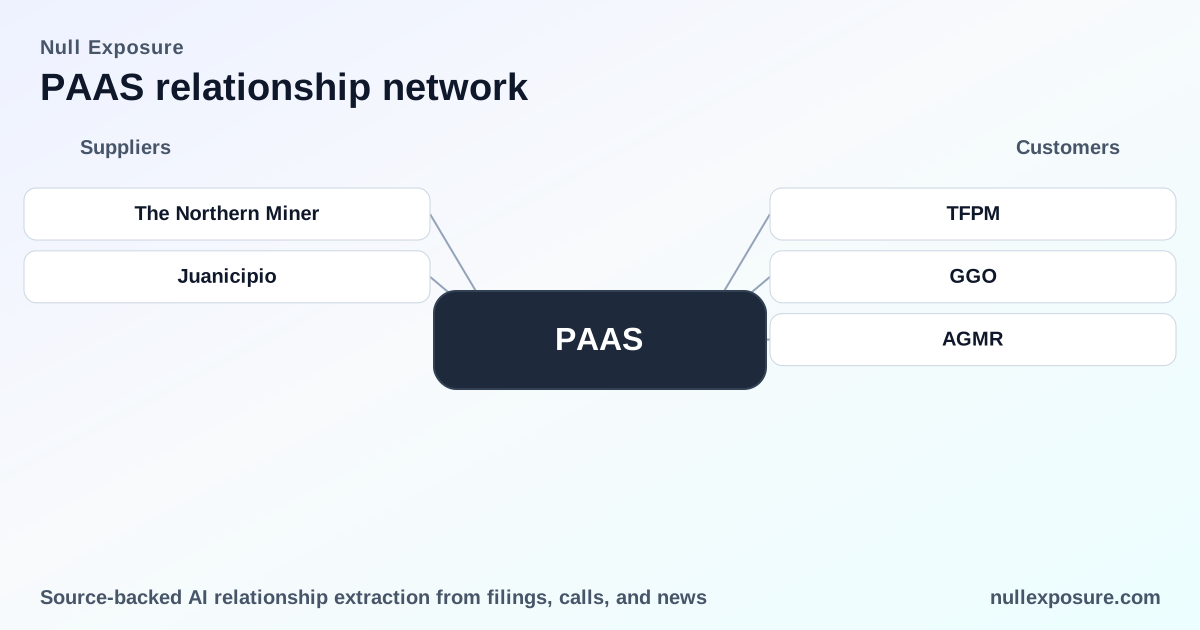
- Silver Mountain Resources Inc. (AGMR) — Pan American sold the Lira de Plata project (a package of 14 mining concessions) to Silver Mountain under a purchase agreement. This transaction transfers a prospective land package to a junior explorer and converts non‑core exploration holdings into cash or consideration. According to a press release on March 10, 2026 from Junior Mining Network, Silver Mountain confirmed the 100% acquisition of Lira de Plata from Pan American.
- Triple Flag Precious Metals (TFPM) — Triple Flag holds a 100% gold stream on the La Colorada mine at a fixed delivery price of $650 per ounce, establishing a long‑dated cash‑flow obligation tied to future gold production. Market commentary on March 5, 2026 noted this streaming position on La Colorada and the fixed per‑ounce pricing that governs deliveries.
- Xali Gold Corp. (XGC) — Xali entered a Share Purchase Agreement to buy Minera Calipuy S.A.C. from Pan American and Aquiline Resources for $17.5 million, moving a Peruvian asset into a smaller operator’s hands and converting Pan American’s local exposure into immediate consideration. SimplyWall.St reported the transaction details and the October 25 agreement in FY2026.
- Galleon Gold (GGO) — Pan American provided a credit facility of up to $46 million to Galleon Gold, with interest at 12‑month prime plus 7% and an initial $11 million draw earmarked to repurchase a 3% net smelter return royalty on the West Cache project. Financial press coverage on March 10, 2026 described the structure and the targeted use of proceeds to buy back an NSR.
- Jinteng (Singapore) Mining Pte. Ltd — Jinteng acquired La Arena S.A. from Pan American for approximately $300 million, a sizeable closed‑sale that materially reduces Pan American’s asset base in the relevant jurisdiction while generating significant liquidity. SimplyWall.St summarized the December 4 FY2026 sale.
- Unico Silver Limited (USL) — Unico purchased the Joaquin and Cerro Puntudo projects from Pan American for $12 million, signaling Pan American’s continued disposition of smaller or non‑core project holdings to focused silver juniors. SimplyWall.St recorded the October 11 transaction in FY2026.
- Mineros Chile SpA — Mineros Chile agreed to acquire an 80% stake in Minera Cavancha S.A. from Pan American for $40 million, reflecting a partial divestment that retains some Pan American exposure while mobilizing outside capital into local development. SimplyWall.St reported the August 12 FY2026 agreement.
How these relationships change the cash‑flow and risk profile
- Capital recycling is the dominant theme. The mix of transactions—small project sales, a large asset sale (~$300m), and a partial stake sale—represents active portfolio management that strengthens near‑term liquidity without relying solely on spot metal revenues. That improves flexibility for buybacks, development capital or sustaining operations.
- Streaming creates durable obligations. The Triple Flag stream at $650/oz is a fixed, long‑dated contractual commitment that reduces future per‑ounce revenue upside on La Colorada; model this as a reduction to marginal project cash flow rather than a one‑time charge.
- Credit exposure to juniors increases counterparty risk. The Galleon facility and multiple junior buyers concentrate Pan American’s non‑operational credit exposure on smaller, higher‑volatility counterparties; covenant protections and security interests are an important part of downside mitigation and should be reviewed where filings are available.
- Portfolio simplification reduces operational complexity but cuts future optionality. Large disposals such as La Arena accelerate cash generation at the expense of future operating scale in that jurisdiction; treat proceeds as non‑recurring unless management indicates a repeatable program.
Investment implications and watchlist items
- Positive: These transactions strengthen free‑cash flexibility and demonstrate management discipline in monetizing non‑core assets. With a market capitalization and profitability profile consistent with a major producer, Pan American is converting optionality into deployable capital.
- Negative: Repeated reliance on asset sales to fund growth is non‑recurring and can mask underlying operating volatility; streaming agreements create contractual tails that suppress upside from higher metal prices.
- Monitor: counterparty credit quality on junior financiers, contractual terms of streams/royalties, and whether proceeds are deployed into high‑IRR projects or used to smooth distributions.
For deeper comparative analysis of strategic counterparty relationships across miners, visit https://nullexposure.com/ for proprietary synthesis and sector briefs.
Bold takeaway: Pan American’s FY2026 customer relationships are an intentional mix of liquidity generation and strategic financing—supportive of near‑term cash strength but introducing counterparty and structural considerations that alter the company’s longer‑term throughput of metal price upside.