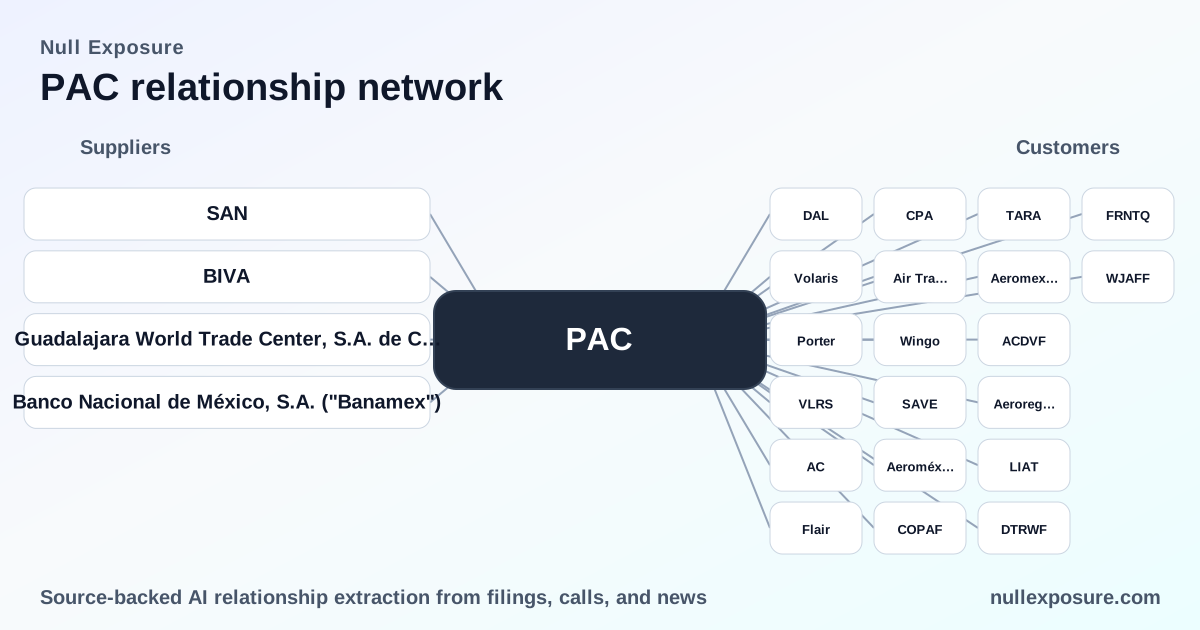
Grupo Aeroportuario del Pacífico (PAC): Customer Map and Commercial Exposure
Grupo Aeroportuario del Pacífico (PAC) operates and monetizes a portfolio of airports in Mexico’s Pacific region through regulated aeronautical charges, terminal concessions and ancillary commercial revenues tied to passenger volumes and airline route networks. Revenue drivers are route additions, carrier mix shifts and ancillary spend per passenger, while cost and cash-flow visibility come from long-term concession frameworks and high operating margins reported in recent filings. For investors, the question is not whether PAC earns from airlines, but how its airline roster and route cadence translate into revenue concentration and growth optionality. Learn more at https://nullexposure.com/.
How airline relationships translate to cash flow
PAC’s operating model is that of a regulated airport concessionaire: it collects fees tied to passenger movements and leases commercial space to carriers and service providers. Contracting posture is typically long-dated concession agreements with airport regulators and operators, making aeronautical revenues relatively predictable while commercial revenues track discretionary travel demand. Airline relationships are therefore both strategic (route launches, frequency) and operational (slot and terminal commitments). No explicit constraints on customer relationships were reported in the provided materials, which signals no flagged contractual bottlenecks in the sourcing set.
Investors should watch three cross-cutting characteristics:
- Concentration: route-level announcements show dependence on a mix of low-cost and legacy carriers; route cancellations or cuts by major partners would be visible quickly in traffic releases.
- Criticality: carriers drive the core passenger base; airport infrastructure is indispensable to carriers but airports are exposed to carriers’ network decisions.
- Maturity: many named carriers are established North American and Latin American operators; some entries reflect low-cost carriers expanding leisure routes, which supports passenger growth but increases sensitivity to pricing and seasonal demand.
Detailed customer relationships and source notes
Below I list every customer relationship cited in PAC’s recent releases and transcripts. Each entry is a concise, plain‑English summary with the source and reporting period.
-
Southwest — GlobeNewswire noted Puerto Vallarta–San Diego service operated by Southwest in its March/April 2026 passenger traffic release (FY2026).
Source: GlobeNewswire release on PAC traffic (FY2026), April 2026. -
DAL — PAC’s December 2025 traffic release references Los Cabos–Austin routed to Delta (reported under ticker DAL in the release, FY2026).
Source: GlobeNewswire traffic release (FY2026), January 2026. -
Delta — PAC cited a Los Cabos–Austin connection for Delta in the December 2025 traffic summary (FY2026).
Source: GlobeNewswire traffic release (FY2026), January 2026. -
Volaris — Multiple releases list Volaris route activity including Guadalajara–Mazatlán and other new Guadalajara links; Volaris is repeatedly highlighted in Q4/2025 and March 2026 traffic commentary (FY2025–FY2026).
Source: GlobeNewswire Q4 results and traffic releases (FY2025–FY2026), Feb–Apr 2026; Investing.com earnings transcript (Q1 2026). -
Porter — The company cited Porter’s Puerto Vallarta–Hamilton and Puerto Vallarta–Toronto services in PAC’s FY2025–FY2026 reporting.
Source: GlobeNewswire traffic releases (FY2025–FY2026), Oct 2025–Jan 2026. -
AC — Air Canada was referenced under the ticker AC for Guadalajara–Toronto flights in November 2025 traffic commentary (FY2025).
Source: GlobeNewswire traffic release (FY2025), Dec 2025. -
Air Canada — PAC’s results mention Air Canada operating Guadalajara–Toronto in late 2025, contributing to cross-border connectivity (FY2025–FY2026).
Source: GlobeNewswire releases (FY2025–FY2026), Dec 2025–Feb 2026. -
VLRS — The VLRS ticker appears in PAC releases tied to Volaris route deployments such as Guadalajara–Bogotá and other routes in late 2025 (FY2025–FY2026).
Source: GlobeNewswire releases (FY2025–FY2026), Oct 2025–Mar 2026. -
Aerus — PAC traffic commentary referenced Aerus operating Morelia–Santa Lucía routes in the March 2026 traffic release (FY2026).
Source: GlobeNewswire traffic release (FY2026), April 2026. -
Wingo — Wingo routes such as Montego Bay–Bogotá were cited in PAC’s Q4/2025 reporting (FY2026).
Source: GlobeNewswire Q4 2025 results (FY2026), Feb 2026. -
Copa Airlines — PAC cited Copa operating Los Cabos–Panama City in December 2025 route listings (FY2026).
Source: GlobeNewswire traffic release (FY2026), Jan 2026. -
CPA — The CPA ticker appears in the same December 2025 routing notes for Copa (Los Cabos–Panama City) in PAC’s reporting (FY2026).
Source: GlobeNewswire traffic release (FY2026), Jan 2026. -
Air Transat — PAC referenced Air Transat operating Guadalajara–Montreal service in the December 2025 summary (FY2026).
Source: GlobeNewswire traffic release (FY2026), Jan 2026. -
SAVE — Spirit (SAVE) was noted in PAC’s Q3/2025 results for routes such as Montego Bay–Baltimore–Washington during the summer schedule (FY2025).
Source: GlobeNewswire Q3 2025 results (FY2025), Oct 2025. -
Spirit — PAC named Spirit in route listings supporting leisure international flows to and from Guadalajara and other airports in Q3/2025 (FY2025).
Source: GlobeNewswire Q3 2025 results (FY2025), Oct 2025. -
Flair — Flair appears in Q4/2025 route notes for Montego Bay–Toronto services that feed PAC airports’ international leisure traffic (FY2026).
Source: GlobeNewswire Q4 2025 results (FY2026), Feb 2026. -
Aeroméxico — Aeroméxico is listed operating Guadalajara–Seattle in PAC’s December 2025 route schedules (FY2026).
Source: GlobeNewswire traffic release (FY2026), Jan 2026. -
Copa — The Copa brand (listed separately in some entries) appears in PAC’s Q4 reporting for Los Cabos–Panama City service (FY2026).
Source: GlobeNewswire Q4 2025 results (FY2026), Feb 2026. -
COPAF — COPAF is shown as a ticker variant for Copa in PAC’s Q4/2025 route notes for Los Cabos–Panama City (FY2026).
Source: GlobeNewswire Q4 2025 results (FY2026), Feb 2026. -
TARA — TAR/TARA were cited in PAC’s Q3 2025 notes for regional domestic connections like La Paz–Los Mochis (FY2025).
Source: GlobeNewswire Q3 2025 results (FY2025), Oct 2025. -
TAR — The TAR ticker also appears in the same July 2025 routing entries for domestic regional services (FY2025).
Source: GlobeNewswire Q3 2025 results (FY2025), Oct 2025. -
LIAT — LIAT Air was listed in Q3/2025 route tables for Montego Bay–Kingston connections that touch PAC’s leisure outbound flows (FY2025).
Source: GlobeNewswire Q3 2025 release (FY2025), Oct 2025. -
Aeroregional — Aeroregional shows up in the summer 2025 route annotations for Montego Bay–Quito connections (FY2025).
Source: GlobeNewswire Q3 2025 release (FY2025), Oct 2025. -
Interjet — An earnings-call transcript mentions Interjet reducing some Guadalajara services, signaling capacity adjustments affecting PAC’s domestic footprint (Q1 2026).
Source: Investing.com earnings-call transcript (Q1 2026). -
Foxconn — The Q1 2026 earnings-call transcript references a large movement by Foxconn into Guadalajara related to an initial plant, indicating potential non‑airline passenger demand from corporate projects (FY2026).
Source: Investing.com earnings-call transcript (Q1 2026). -
DTRWF — DTRWF appears as a ticker variant in PAC’s Q4/2025 route listings tied to Delta’s Los Cabos–Austin and similar services (FY2026).
Source: GlobeNewswire Q4 2025 results (FY2026), Feb 2026. -
Frontier — PAC’s December 2025 and Q4 releases detail Frontier launching Los Cabos–Atlanta, Los Cabos–Las Vegas and Puerto Vallarta–Atlanta routes, supporting leisure frequency (FY2026).
Source: GlobeNewswire traffic and Q4 releases (FY2026), Jan–Feb 2026. -
FRNTQ — FRNTQ is the ticker variant for Frontier noted in multiple December 2025 route entries in PAC’s reporting (FY2026).
Source: GlobeNewswire traffic release (FY2026), Jan 2026. -
AERUS — AERUS as a ticker shows up with the Morelia–Santa Lucía route reference in March 2026 traffic reporting (FY2026).
Source: SahmCapital/GlobeNewswire traffic release (FY2026), Apr 2026. -
WestJet — WestJet is cited operating Guadalajara–Calgary and Montego Bay–Quebec services listed in PAC’s Q4/2025 reporting (FY2026).
Source: GlobeNewswire Q4 2025 results (FY2026), Feb 2026. -
WJAFF — WJAFF, a ticker variant for WestJet, appears in the same December 2025 route lists for Guadalajara–Calgary and Montego Bay–Quebec (FY2026).
Source: GlobeNewswire traffic release (FY2026), Jan 2026. -
ACDVF — ACDVF appears as a ticker variant for Air Canada in PAC’s Q4/2025 results describing Guadalajara–Toronto service in November 2025 (FY2026).
Source: GlobeNewswire Q4 2025 results (FY2026), Feb 2026.
What this customer map means for investors
PAC’s revenue profile is a direct function of route mix and carrier frequency. The company’s references span legacy network carriers (Delta, Air Canada, Copa) and multiple low-cost and leisure operators (Volaris, Frontier, Spirit, WestJet), which provides a balanced mix of business and leisure flows. Route launches from carriers like Volaris and Frontier contribute to incremental passenger volume and commercial income, while corporate traffic potential (e.g., Foxconn) creates non-airline demand that can meaningfully lift ancillary revenues.
Because the constraints field in the provided material is empty, there are no documented red flags in the customer relationship constraints set — a neutral signal that places emphasis back on route execution, seasonality and network decisions from major carriers as the primary risk drivers.
For further proprietary mapping of carrier revenue exposure and route economics, visit https://nullexposure.com/.
Key takeaway: Monitor Volaris, Frontier and major legacy carriers closely — they drive the marginal growth and downside risk in PAC’s traffic and commercial revenue streams.