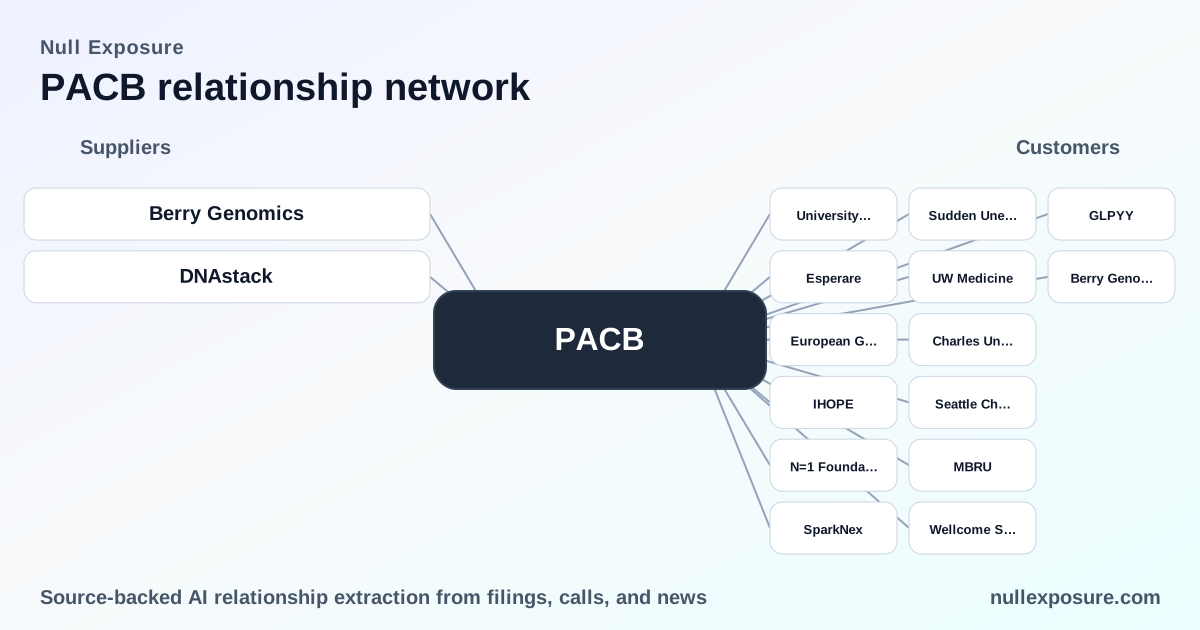
PacBio customer map: who buys HiFi, why it matters for revenue and risk
Pacific Biosciences (PACB) sells high-accuracy long-read sequencing systems, consumables and services — monetizing through instrument sales, recurring consumable chemistry and service/maintenance contracts, plus partnerships that drive sequencing volume on its Revio/HiFi platform. Revenue is driven by a mix of hardware sales and repeat consumables, with research and clinical customers generating volume through project-based purchases and service lab relationships. Explore the partnership footprint and commercial constraints that drive both growth opportunities and near-term revenue volatility. For a quick reference to PACB relationship intelligence, visit https://nullexposure.com/.
How PacBio makes money and why customers matter
PacBio’s product revenue derives from instrument sales and proprietary consumables; service revenue comes from maintenance and application support, and strategic collaborations expand installed base and throughput for HiFi whole-genome sequencing. The company reported roughly $160 million revenue TTM with negative operating margins and a high price-to-book multiple, reflecting investor expectations around adoption of long-read sequencing and conversion of research projects into sustained consumable demand.
Operating model signals investors need to weigh
Several company-level constraints shape PacBio’s commercial profile:
- Contract posture — short-term and spot-driven. PacBio discloses that most performance obligations are satisfied within one year and that a large share of revenue comes from purchase-order style transactions, signaling a business that depends on recurrent, transactional buys rather than long-term locked-in contracts.
- Concentration — historically variable but largely immaterial recently. No single customer accounted for ≥10% of revenue in 2023–2024, although a 2022 customer did exceed that threshold, indicating occasional concentration episodes.
- Counterparty mix — research, academic and government-heavy. Customers include governmental and academic research institutions, hospitals, public health labs and CROs, creating a mix of grant-funded and institutional buying cycles.
- Geography — international exposure with APAC relevance. Sales have an increasing concentration in Asia‑Pacific while still maintaining Americas and EMEA footprints.
- Segment split — hardware plus consumables and services. Product sales (instruments and consumables) drive top-line, while maintenance and services provide lower-margin recurring revenues.
- Criticality and maturity — high scientific value but project-driven adoption. HiFi is positioned as a technique-shifting technology for complex genomes, but customer adoption often begins as targeted studies or pilot programs rather than immediate, broad clinical replacements.
These characteristics together imply revenue upside from adoption but near-term volatility tied to project timing, purchase orders and geographic cycles.
For deeper relationship signals and to track updates on PACB partnerships, see https://nullexposure.com/.
Relationship roll call — who PacBio is selling to and partnering with
Below are the customer and partner relationships mentioned in PACB’s recent public reporting and the press coverage that investors should track. Each entry includes a concise plain-English summary and the source.
-
European Genomics UK — PacBio disclosed that its service partner European Genomics UK is scheduled to sequence 1,000 samples using PacBio technology starting April 2026, indicating volume-driven service partnerships that generate consumable demand (PacBio 2025 Q4 earnings call, March 7, 2026).
-
Esperare — In collaboration with the N=1 Foundation and Esperare, PacBio’s HiFi sequencing is being used to comprehensively characterize genomes of patients with dozens of ultra‑rare diseases to support antisense oligonucleotide therapy development (PacBio 2025 Q4 earnings call, March 7, 2026).
-
IHOPE — PacBio announced the addition of HiFi to the IHOPE initiative, bringing long‑read genomic sequencing into a large equitable rare‑disease testing network and expanding clinical research reach (PacBio 2025 Q4 earnings call, March 7, 2026).
-
N=1 Foundation — The N=1 Foundation partners with PacBio to deploy HiFi sequencing for ultra‑rare disease cohorts, supporting precision‑medicine therapeutic development (PacBio 2025 Q4 earnings call, March 7, 2026).
-
SparkNex — PacBio described SparkNex as its next‑generation consumable chemistry built around multi‑use SMRT Cells, signaling a product roadmap meant to increase per‑instrument throughput and consumable revenue (PacBio 2025 Q4 earnings call, March 7, 2026).
-
Sudden Unexplained Death in Childhood Foundation — PacBio reported sequencing activity supporting 200 families within a larger cohort of >2,000 families, demonstrating engagement in clinically oriented sequencing programs (PacBio 2025 Q4 earnings call, March 7, 2026).
-
University of Washington Medicine (UW Medicine) — UW Medicine is using HiFi to study sudden unexplained death in childhood as a first‑line approach, reinforcing clinical research adoption in major academic medical centers (PacBio press release reported by QuiverQuant, March 2026; PacBio 2025 Q4 earnings call, March 7, 2026).
-
Illumina / Illumina Cambridge, Ltd. (ILMN) — PacBio completed the sale of select short‑read sequencing IP and related assets to Illumina for roughly $48–50 million, monetizing non‑core assets and signaling strategic realignment of PacBio toward long‑read HiFi offerings (asset sale announced March 2026 across QuiverQuant, SimplyWall and TradingView coverage; Illumina comment cited in InsiderMonkey, March 2026).
-
Basecamp Research — Basecamp Research selected PacBio HiFi on the Revio system to support a large Trillion Gene Atlas initiative, an institutional endorsement of HiFi for high‑throughput population-scale projects (Finviz and TradingView reporting, May 3, 2026).
-
Seattle Children’s — PacBio announced that a UW Medicine and Seattle Children’s research effort will employ HiFi whole‑genome sequencing as first‑line for investigating sudden unexplained death in childhood, underlining hospital‑based research adoption (QuiverQuant press release, March 2026).
-
MBRU (Mohammed Bin Rashid University) — MBRU researchers publicly described switching to HiFi sequencing for its consistent quality, indicating adoption by international academic institutions (TradersUnion coverage of presentations, March 2026).
-
Wellcome Sanger Institute — Statements from the Wellcome Sanger Institute signal a move to HiFi sequencing for certain workflows, pointing to center‑level adoption among large genome centers (TradersUnion coverage, March 2026).
-
Charles University — A PacBio case study highlights Charles University increasing publications and reducing project timelines after adopting HiFi long‑read workflows, illustrating research productivity gains that support instrument and consumable demand (PacBio company blog, March 2026).
-
Ambry Genetics (GLPYY) — Ambry Genetics is implementing HiFi in the ONCE study to evaluate diagnostic yield improvements in patients with previously negative exomes/genomes, showing clinical lab pilots that could convert into routine testing (PacBio 2025 Q4 earnings call, March 7, 2026).
-
Berry Genomics — PacBio supported Berry Genomics in achieving the first regulatory approval for clinical long‑read sequencing in China, an important commercialization milestone in APAC markets (GlobeNewswire item cited by Finviz, November 4, 2025).
Investment implications and risks
- Upside: Institutional and large‑scale research commitments (Basecamp, Wellcome Sanger, genome centers, hospital consortia) validate HiFi’s scientific value and increase potential recurring consumable revenue if pilots scale to routine sequencing.
- Risks: The business is transactional and project‑timed, with short‑term contracts and substantial spot PO activity; geographic concentration shifts (APAC) and a customer base dominated by academic/government accounts create revenue cyclicality. The sale of short‑read IP to Illumina both provides cash and reduces PacBio’s optionality in that market segment.
Bottom line
PacBio’s customer footprint spans major genome centers, academic medical centers, specialty clinical labs and research initiatives — the commercial model is a hybrid of instrument-led adoption and project-driven consumable volume, which supports long-term upside but creates near-term revenue variability. Track conversion of pilots (ONCE, IHOPE, Basecamp) into routine throughput and monitor APAC expansion as the primary levers for sustained revenue growth.
For continuous monitoring of PACB partner signals and to benchmark customer concentration trends, visit https://nullexposure.com/.