Penske Automotive Group (PAG): Customer Relationships and What Recent Deal Activity Reveals
Penske Automotive Group is a global automotive and commercial truck retailer that monetizes primarily through vehicle retailing, parts, service, and related financing, with additional revenue from commercial vehicle distribution and full-service truck leasing. The business generates the bulk of cash flow from retail automotive dealerships — roughly $26.2 billion in 2024 — and complements that core franchise with distribution and logistics services. For investors and operators evaluating PAG’s customer and counterpart exposure, recent dealership dispositions illuminate a deliberate portfolio reset that reduces dealer-level operational complexity while preserving exposure to core retail margins. For a concise view of company-level customer relationships and constraints, visit https://nullexposure.com/.
What the recent transactions tell investors about PAG’s customer relationships
PAG has been executing selective divestitures of retail dealerships. These transactions are not minor rollups; they are discrete transfers of operating assets and local customer relationships that change the company’s dealer footprint and the composition of revenue tied to retail operations.
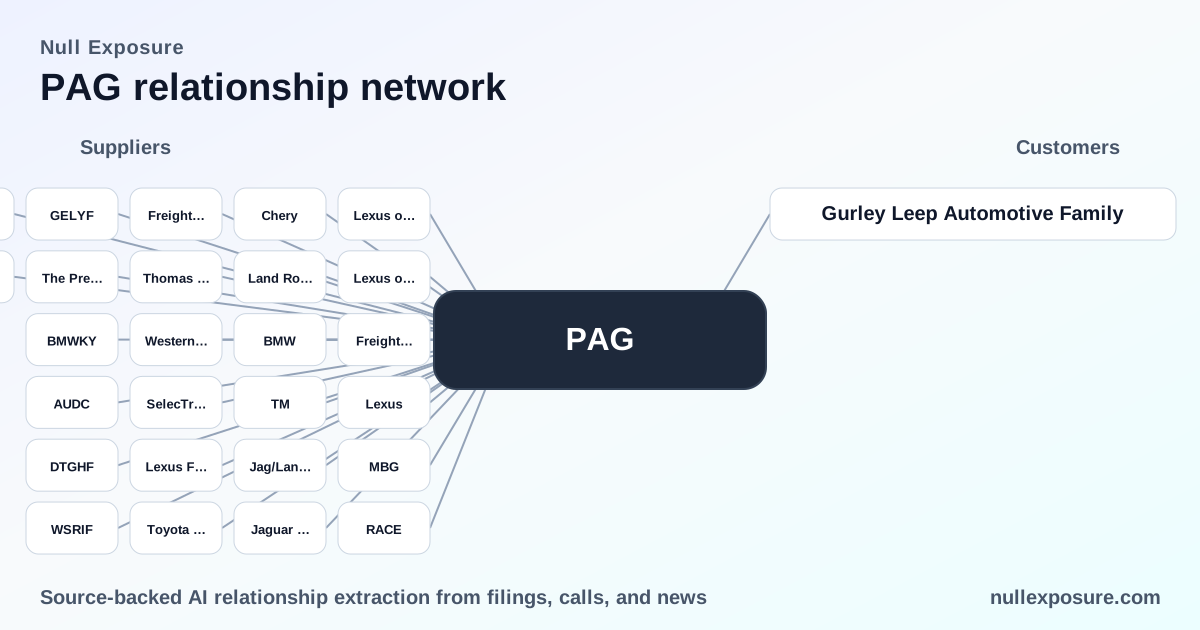
Gurley Leep Automotive Family — Hyundai of Noblesville (closed Nov 24, 2025)
Penske sold its Hyundai of Noblesville franchise in Indiana to the Gurley Leep Automotive Family; the asset transfer closed November 24, 2025 as part of normal portfolio activity. A report from DealershipGuy documenting the sale shows PAG repositioning assets at the local-dealer level while monetizing franchise value. (Source: DealershipGuy post, Nov 28, 2025 — https://news.dealershipguy.com/p/penske-automotive-group-sells-indiana-hyundai-dealership-2025-11-28)
McGee Automotive Family — Lexus of Warwick (sale reported Mar 2026)
PAG sold its Lexus of Warwick store to the McGee Automotive Family, which will continue operating the location as a Lexus franchise; market commentary positions this disposal as part of an ongoing portfolio reset. The sale signals PAG’s continued pruning of retail locations to optimize returns and concentrate capital on higher-margin or strategically aligned assets. (Source: Sahm Capital analysis, Mar 27, 2026 — https://www.sahmcapital.com/news/content/penske-sale-of-lexus-of-warwick-signals-ongoing-portfolio-reset-2026-03-27)
Company-level constraints and what they mean for customer relationships
The relationship-level transactions above must be interpreted against several company-level operating characteristics extracted from PAG’s disclosures and business descriptions. These are not tied to a single buyer or seller transaction but are firm-wide signals that shape how PAG manages customer exposure.
-
Concentration and revenue dependence: Retail automotive dealerships produced 85.9% of PAG’s total revenues and 84.8% of total gross profit in 2024, making dealer-level relationships critical to enterprise economics. This concentration means changes in the dealer roster directly affect top-line stability and margin profile (company filing, 2024 figures).
-
Global footprint with North American dominance: PAG operates across the United States, UK, Canada, Germany, Italy, Japan, and Australia, and generated 56% of retail dealership revenues in 2024 from the U.S. and Puerto Rico. The company therefore manages multi-jurisdictional customer contracts and brand relationships, which increases operational complexity but diversifies geo-risk (company disclosure, 2024).
-
Multi-segment revenue model with strategic distribution roles: The company reports approximately $30.5 billion in total revenue for 2024, split into core retail dealerships (
$26.2B), retail commercial truck dealerships ($3.5B), and commercial vehicle distribution & other (~$777.9M). In Australia, for example, Penske serves as an exclusive importer/distributor for several heavy-duty brands — a role that creates durable distribution relationships distinct from retail franchise sales (company filing). -
Contracting posture and service maturity: Parts of PAG’s truck and logistics operations are run under multi-year contracts — full-service leasing, contract maintenance, and logistics — which yield recurring revenue and require long-term operational commitments. This shifts part of the group’s customer exposure from transactional retail risk to contract-backed, service-oriented relationships.
-
Role diversity across the value chain: PAG functions as seller, distributor, and service provider. That means counterparty risk varies by relationship: retail dealerships are transactional and volume-driven, distributors have manufacturer-dependency and contractual exclusivity, and service/lease contracts are longer-term and operationally intensive.
How these characteristics shape investment and operational risk
PAG’s mix of highly material retail exposure, geographic scale, and a blend of transactionally driven dealer relationships plus contract-backed services creates a distinct risk/return profile.
-
Risk concentration: Because retail dealerships are the primary profit engine, deal dispositions materially reweight revenue concentration and can either improve margin per unit or reduce scale-dependent advantages. Monitoring the pace and economics of disposals is essential.
-
Counterparty and manufacturer dependency: Distribution agreements (e.g., exclusive import rights in Australia) embed single-source risk and require strong manufacturer relationships and compliance with brand standards.
-
Contract maturity and revenue stability: The presence of multi-year service contracts in truck leasing/logistics provides revenue durability, reducing short-term sensitivity to vehicle sales cycles and giving predictable cash flow against which retail cyclicality can be balanced.
-
Execution risk in portfolio resets: Selling retail franchises transfers local inventory, customer contracts, and OEM relationships; transaction execution and the choice of buyer matter for residual earnings volatility and reputational continuity.
Tactical monitoring checklist for investors and operators
- Track the number and type of dealership dispositions per quarter and the proceeds versus book value to assess capital redeployment efficacy.
- Monitor manufacturing/distribution contracts and renewal terms in key regions (Australia, North America, Europe) for signs of exclusivity risk or margin pressure.
- Follow service contract backlog and multi-year commitments within PTS/truck leasing to quantify recurring revenue buffering retail cyclicality.
- Watch OEM relationships and franchise-level performance metrics (same-store sales, parts & service margins) as leading indicators of retail profitability.
For a deeper look at customer relationship signals and transaction-level detail, visit https://nullexposure.com/.
Bottom line
Penske Automotive Group’s customer landscape is dominated by a core retail dealership engine that is both highly material and actively managed through selective dispositions. The company’s global distribution roles and multi-year service contracts provide structural balance to retail cyclicality, but they also introduce manufacturer dependency and execution risk when assets change hands. Investors and operators should evaluate PAG through a dual lens: retail footprint concentration and the stability of contract-based services, with an emphasis on how portfolio transactions are redeploying capital to drive long-term returns.