Plains GP Holdings (PAGP): Customer Footprint, Contracting Posture, and Concentration Risks
Plains GP Holdings (PAGP) operates and monetizes a North American midstream network by charging fees for pipeline transportation, storage, fractionation and related NGL services, while also participating in merchant NGL sales. Revenue is generated through a mix of long‑term minimum volume commitments and fee‑based or usage‑sensitive contracts across the United States and Canada, with periodic asset dispositions that change regional exposure. For investors, the core thesis is straightforward: PAGP’s earnings depend on durable fee contracts anchored to large refiners and producers, but the business carries single‑counterparty concentration and geography sensitivity that materially affect cash flow volatility. For primary research on counterparties and filings visit https://nullexposure.com/.
How PAGP gets paid and why its customers matter
PAGP’s operating model blends infrastructure ownership with service contracts and occasional merchant selling. The company secures predictable cash flows through minimum volume commitments and fixed-fee agreements, while retaining variable revenue from throughput and merchant sales. This hybrid model supports a fee‑based core with incremental commodity exposure from NGL merchant activities and recent strategic portfolio changes, including the sale of its Canadian NGL business.
- Contracting posture: long‑term minimum volume commitments underpin pipeline revenues, but certain pipeline assets are served on short‑term or usage‑based terms, producing a mix of stable and cyclical cash flows.
- Geographic footprint: revenue and assets are concentrated in the United States and Canada; the U.S. dominates revenue.
- Concentration risk: one counterparty contributes a large share of revenue, creating earnings sensitivity to a small number of customers.
- Role breadth: PAGP is primarily a service provider (transportation, storage, fractionation), while also acting as a seller in its NGL merchant business and as a buyer on select market imbalances.
Customer relationships: who pays PAGP, and how material they are
Below are the relationships documented in PAGP’s public disclosures and recent press, with concise, investor‑oriented summaries and source references.
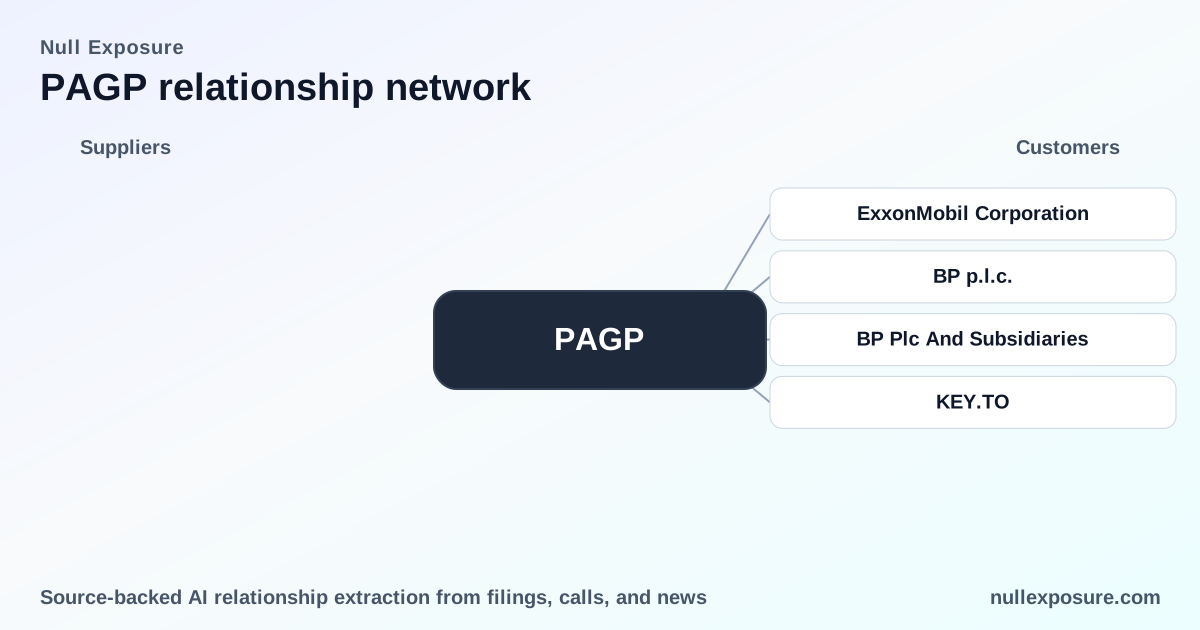
ExxonMobil Corporation
ExxonMobil and its subsidiaries accounted for 30% of PAGP’s revenues in 2024, down from 26% in 2023 and 20% in 2022—evidence of a material, multi‑year revenue relationship that creates single‑counterparty exposure. According to PAGP’s 2024 Form 10‑K, ExxonMobil’s share of revenue is a significant concentration risk to cash flows. (PAGP 2024 Form 10‑K; FY2024)
BP p.l.c.
BP p.l.c. and its subsidiaries are documented as accounting for 10% of PAGP’s revenues in 2023, indicating a meaningful but secondary customer relationship outside the single largest counterparty. This appears in PAGP’s 2024 disclosures referencing 2023 revenue composition. (PAGP 2024 Form 10‑K; FY2023)
BP Plc And Subsidiaries (separate 10‑K listing)
PAGP’s filings also list BP Plc And Subsidiaries as a named customer entry in the 2023 reporting period, reflecting how the company discloses major customers under varying legal names across exhibits and schedules. The duplicate listing underscores the presence of BP as a recurring large customer in prior periods. (PAGP 2024 Form 10‑K; FY2023)
Keyera / KEY.TO (TradingView news)
PAGP entered a definitive agreement with Keyera to sell its Canadian NGL business, with the transaction reported as expected to close by the end of Q1 2026, signaling a structural reduction in Canadian NGL operations and customer exposure. TradingView flagged this pending sale tied to the 10‑K reporting cycle. (TradingView report summarizing PAGP 10‑K; reported March 2026)
KEY.TO (inferred symbol entry)
The same TradingView note is reflected with the KEY.TO symbol inference; the key investment implication is identical — the Canadian NGL business sale to Keyera shifts regional revenue mix and reduces PAGP’s direct NGL asset footprint in Canada. (TradingView report summarizing PAGP 10‑K; reported March 2026)
Keyera Corp. (GlobeNewswire)
PAGP announced on June 17, 2025 a definitive agreement to sell substantially all of its Canadian NGL business to Keyera Corp., a transaction disclosed in Plains All American/Plains GP press releases and earnings materials that crystallizes the company’s exit from that operating segment in Canada. This closing impacts future Canadian revenue and asset balances. (Plains/GlobeNewswire press release; June 17, 2025)
What the constraints tell investors about operating dynamics
The public constraints and narrative excerpts from PAGP’s filings describe an operating model that combines contract diversity with concentration:
- Long‑term fee support: Minimum volume commitment contracts and acreage dedications provide durable fee‑based cash flow on many assets, which is a structural strength for predictability and leverage management.
- Short‑term exposure on select assets: Some long‑haul pipelines rely on short‑term shipper commitments, introducing throughput and margin cyclicality when utilization falls.
- Usage‑based pricing exists alongside fixed fees: Certain agreements include fixed monthly fees plus variable, usage‑based consideration, creating partial revenue sensitivity to activity levels.
- North America focus: Revenues are primarily generated in the U.S. with a smaller Canadian contribution; the recent Keyera transaction accelerates a shift away from Canadian NGL operations.
- Service provider primacy with merchant optionality: PAGP’s core role is transporting, storing and fractionating crude and NGLs for third parties, while merchant NGL sales provide incremental upside and commodity exposure.
- Material concentration to ExxonMobil: ExxonMobil’s 30% revenue share in 2024 is an explicit materiality signal and the single largest counterparty risk in the revenue mix.
Taken together, these constraints define a business that is cash‑flow anchored by fee contracts but exposed to customer concentration and regional shifts when management executes asset sales or when short‑term throughput weakens.
Investment implications and risk framework
- Upside levers: Stable cash generation from minimum volume commitments, a fee‑based backbone, and the ability to monetize non‑core assets (e.g., Canadian NGL sale) enhance balance‑sheet flexibility. Forward EV/EBITDA multiples imply the market recognizes operational scale but also asset and cash‑flow transition.
- Primary risks: High customer concentration (Exxon at 30%), partial short‑term contracting on some pipelines, and geography concentration in North America. Asset dispositions remove certain regional risks but also reduce diversified merchant optionality.
- Operational focus: Monitor contract renewals on major pipelines, throughput trends on short‑term assets, and the closing and integration details of the Keyera sale for near‑term cash and asset implications.
For a consolidated view of PAGP customer disclosures, counterparty concentration and filings, see Null Exposure’s research hub at https://nullexposure.com/. For investors evaluating counterparty credit exposure and contract tenure, weigh the predictable fee base against single‑counterparty risk and shifting regional exposure as PAGP executes strategic disposals.
Bold signals to watch: ExxonMobil = 30% of revenue (2024); Keyera sale reduces Canadian NGL footprint; mix of long‑term minimums and short‑term/usage pricing drives both stability and cyclicality.