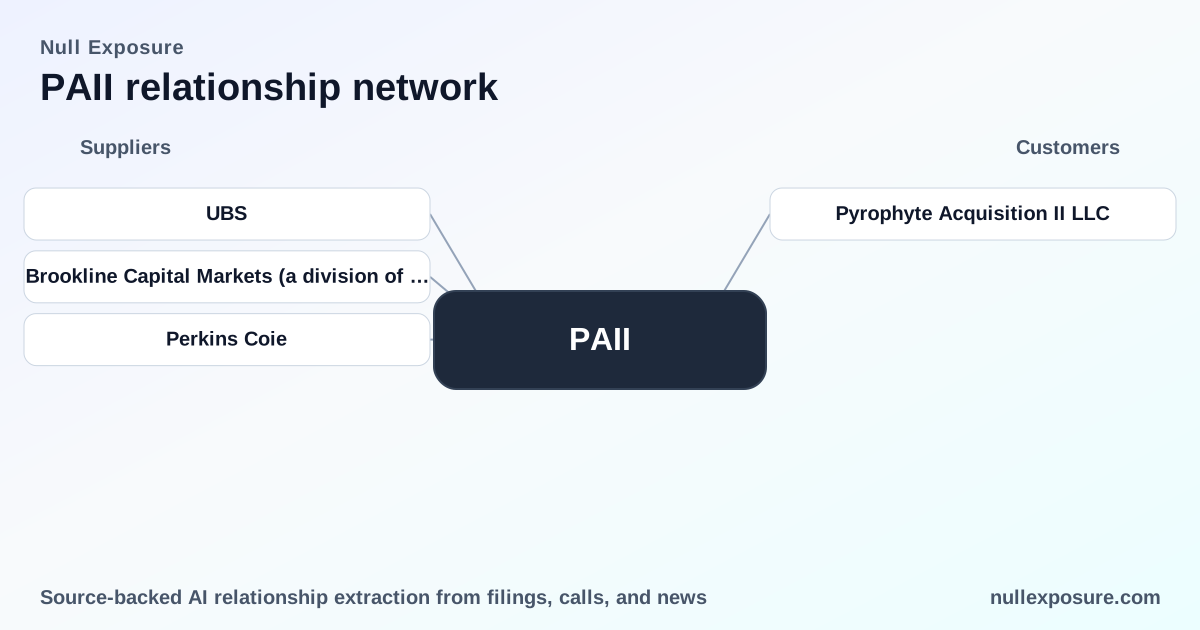
Pyrophyte Acquisition Corp. II (PAII) — Investor brief on customer relationships and sponsor economics
Pyrophyte Acquisition Corp. II is a special-purpose acquisition company focused on sustainability and technology targets; it monetizes by aggregating IPO proceeds, selling sponsor economics (warrants and private placements), and ultimately realizing value through a business combination and aftermarket securities created by that combination. The company's near-term cash flows and governance profile are dominated by sponsor activity and capital transactions rather than operating revenue, so investors should evaluate sponsor commitments, warrant placements, dilution mechanics, and institutional ownership when assessing PAII’s risk/reward.
For a deeper view of how sponsor transactions shape SPAC economics see NullExposure’s coverage: https://nullexposure.com/
Why this matters: SPACs are financial conduits with sponsor-led economics
Pyrophyte II is not an operating company today — it is a shell vehicle that holds IPO proceeds and negotiates a business combination. That structure creates distinct business-model characteristics investors must evaluate:
- Contracting posture: Sponsor-driven. The sponsor (and its affiliated entities) controls key economic levers such as warrants, private placements, and the timeline to a business combination. Contract terms governing sponsor purchases and forward commitments materially affect post-combination dilution and liquidity.
- Concentration: High counterparty concentration. A small number of sponsor and institutional stakeholders typically determine capital commitments and governance outcomes; this increases single-party influence on deal economics.
- Criticality: Low until combination, high for target execution. As a shell, PAII’s value is contingent on successfully completing a merger and the quality of the acquired target; sponsor capital and PIPE investors are critical enablers of that outcome.
- Maturity: Pre-combination lifecycle stage. The entity records zero operating revenue and negligible operating metrics; value realization is binary and tied to transaction execution.
These characteristics are company-level signals that shape how investors should interpret customer/sponsor relationship disclosures and capital transactions.
The customer relationship documented in public results
Pyrophyte’s relationship activity captured in the available results is limited but economically meaningful.
- Pyrophyte Acquisition II LLC — the sponsor completed a private placement of 5,050,000 warrants at $1.00 per warrant, generating $5,050,000 in gross proceeds. According to a Markets.FinancialContent report covering the FY2025 period, the transaction was recorded as a private placement of warrants to the sponsor, strengthening sponsor cash position and locking in additional sponsor economics. (Markets.FinancialContent, report dated July 29, 2025)
This single disclosed transaction is the only customer-scope relationship surfaced in the provided results.
What the sponsor warrant placement means for investors
The sponsor’s purchase of warrants is a conventional SPAC financing move with several concrete implications:
- Capital infusion and alignment: The $5.05 million private placement injects sponsor-level capital into the company and signals the sponsor's willingness to invest additional resources behind the SPAC vehicle. The deal increases the sponsor’s effective economic stake via warrants.
- Dilution dynamics: Issuance of warrants to the sponsor creates future dilution when those warrants are exercised or treated as part of the post-combination capital structure. Investors must model how warrant exercise terms will affect pro forma ownership and earnings per share after a business combination.
- Governance and control: Sponsor-backed financings reinforce sponsor control over transaction timing and structure; sponsors who increase their economic footprint through warrant ownership reinforce downstream negotiating power with potential targets and PIPE investors.
Key takeaway: the sponsor's warrant purchase is simultaneously a cash commitment and a structural lever that affects future dilution and control.
Balance-sheet and ownership signals investors should weigh
Pyrophyte’s public profile through the latest quarter (2025-09-30) supplies context for interpreting sponsor activity:
- Market capitalization roughly $350.4 million with 20,041,200 shares outstanding indicates meaningful public investor appetite despite zero reported operating revenue.
- Institutional ownership at approximately 94.48% is unusually high for a shell vehicle and suggests institutional participation in the IPO and follow-on trading; that concentration in turn stabilizes share liquidity but raises single-party influence.
- Book value per share negative (-0.318) and zero revenue are consistent with pre-combination SPACs and underscore the company’s dependence on transaction completion to generate intrinsic value.
According to the company profile data current through the latest quarter, these figures define the trading backdrop against which sponsor transactions like the warrant placement should be evaluated.
Investment implications and risk checklist
Consider these points when sizing a position or evaluating PAII as a counterparty:
- Sponsor skin-in-the-game: The private placement increases sponsor exposure; that is beneficial for alignment but increases sponsor leverage over deal economics.
- Execution dependency: PAII’s value remains binary: successful, accretive or strategic combination generates upside; failure to combine before SPAC timelines forces liquidation mechanics that can impair returns.
- Dilution and timing risk: Warrants and any additional sponsor instruments create optionality that will dilute public holders when converted; investors must model multiple exercise/timing scenarios.
- Concentration risk: High institutional ownership and sponsor concentration reduce retail influence and can accelerate price moves on transaction news.
Tracking next catalysts and how to use this analysis
Monitor filings and press releases for these specific items:
- Sponsor and PIPE commitments tied to any announced target
- Warrant exercise terms and any subsequent private placements
- Proxy statements and business combination definitive agreements
For a practical next step, review the sponsor private-placement language and pro forma capitalization in any S-4/proxy related to an announced merger. NullExposure provides ongoing transaction-level monitoring and commentary for SPACs; visit our site to subscribe for alerts and transaction analytics: https://nullexposure.com/
Bottom line
Pyrophyte Acquisition Corp. II is a sponsor-driven SPAC whose near-term valuation hinges on sponsor activity and transaction execution. The documented private placement of 5,050,000 warrants for $5.05 million is the primary customer-scope relationship disclosed in the available results and materially shapes dilution, alignment, and execution risk. Investors should prioritize sponsor commitments, institutional ownership patterns, and the terms of any announced combination when forming a view on PAII.