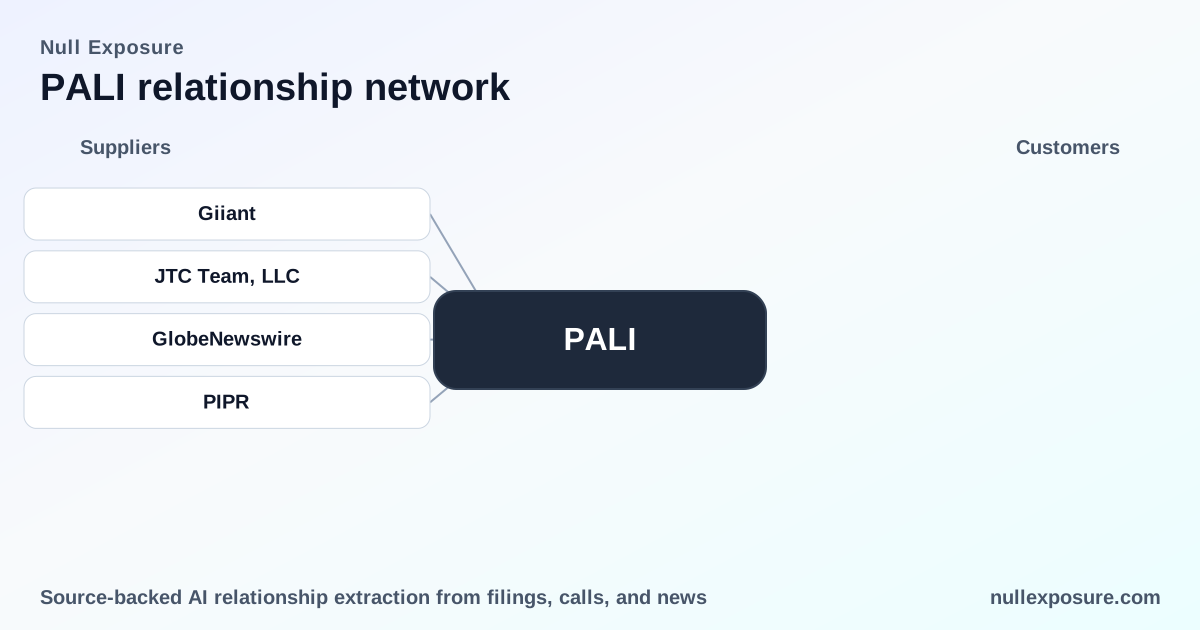
Palisade Bio (PALI) — Customer relationships that reveal strategy and funding dynamics
Palisade Bio operates as an early-stage biotech focused on therapeutic protection of the gastrointestinal mucosal barrier and monetizes through asset transfers/licensing and capital markets activity rather than product revenue. The company’s commercial footprint is characterized by selective asset sales, strategic partnerships, and platform use by financial counterparties, while operating with zero reported product revenue and continued reliance on financing to fund clinical programs. Explore the relationship detail and implications at https://nullexposure.com/.
Quick take: what customer signals tell investors
Palisade’s customer interactions are not classic commercial sales to end users; instead they reflect asset out-licensing, equity purchases by strategic investors, and third-party operational integration. With RevenueTTM at $0 and EBITDA negative, Palisade funds development through monetization of intellectual property and capital raises. Institutional ownership above 80% and recent equity transactions point to concentrated financial support rather than diversified commercial revenue.
How the three observed relationships map to strategy
Below I walk through each counterparty that shows up in public reporting and explain the commercial signal it creates for investors.
Alto Neuroscience (ANRO)
Alto acquired the small molecule ALTO-100 from Palisade, and subsequent Phase 2b trial results for that asset were publicly discussed. This is direct evidence Palisade monetizes R&D via asset transfers/licensing rather than product sales. According to MedCity News coverage from October 2024, ALTO-100 was a novel small molecule Alto acquired from Palisade Bio before Alto’s Phase 2b disclosure (MedCityNews, Oct 2024).
Iterative Health
On March 27, 2026, Palisade sold 1,536,885 shares to an Iterative Health affiliate for $3.0 million at $1.952 per share, an explicit financing transaction rather than a commercial purchase. This transaction reinforces Palisade’s reliance on equity placements to fund operations and illustrates an investor-customer overlap where capital providers obtain position in the company. The sale was reported in a TradingView note summarizing the March 2026 placement (TradingView, May 2026).
Chimera Investment Corporation (CIM-P-C)
Chimera reported integrating its loan data into Palisade’s systems and cited improved legacy portfolio performance as a result. This indicates Palisade’s systems or services are used by non-traditional biotech customers — in this case a structured finance/REIT operator — suggesting a secondary line of operational capability beyond pure drug assets. The integration was described in a Q4 2025 earnings call transcript published on InsiderMonkey (InsiderMonkey, Q4 2025 / published Mar 2026).
What these relationships collectively reveal about the business model
- Contracting posture: Palisade’s contracts tilt toward licensing/out-licensing and transactional equity placements. The Alto transaction is a textbook asset sale; the Iterative Health trade is a financing, and Chimera’s integration points to service/technology contracts. This posture reduces near-term demand for manufacturing or commercialization scale but increases the company’s dependence on discrete counterparties to unlock value.
- Concentration: Observable counterparties are limited and include strategically significant entities (an acquirer of an asset, a buying affiliate, and a financial operator). Combined with institutional ownership around 81%, Palisade’s external support is concentrated among financial and strategic partners rather than a broad commercial customer base.
- Criticality: For Palisade, these relationships are critical in different ways — asset buyers crystallize R&D value, investors supply liquidity, and integration clients like Chimera validate platform utility beyond clinical development. All three types are material to Palisade’s ability to continue funding and extracting value from its pipeline.
- Maturity: The corporate profile is pre-commercial: RevenueTTM is $0, EBITDA negative, and EPS negative, which classifies Palisade as a development-stage biotech that monetizes assets and capital rather than product sales. These relationship types are consistent with a company still building commercial traction.
Risk and value considerations for operators and investors
- Risk — financing dependency: With no reported revenue, Palisade depends on episodic equity placements and asset transactions for runway; the Iterative Health placement is a case in point. That creates dilution risk and execution dependency on continual access to capital markets.
- Risk — concentration of counterparties: A narrow set of counterparties means any disruption in these relationships (or deterioration in investor appetite) would have outsized effects.
- Value driver — asset monetization: Asset sales such as the ALTO-100 transfer to Alto are a direct mechanism to convert scientific progress into near-term cash or de-risked milestones, improving balance-sheet flexibility.
- Value driver — platform utility: Chimera’s integration suggests Palisade has operational or data capabilities with applicability beyond therapeutics, creating optionality for non-traditional revenue streams.
Relationship-by-relationship takeaways (short and actionable)
- Alto/ANRO: ALTO-100 was acquired by Alto from Palisade, demonstrating Palisade’s ability to monetize pipeline assets through transfers. (MedCityNews, Oct 2024)
- Iterative Health: Iterative Health’s affiliate bought 1.54M shares for $3.0M on March 27, 2026, highlighting equity placements as a primary funding mechanism. (TradingView, May 2026)
- Chimera (CIM-P-C): Chimera integrated loan data into Palisade’s systems and reported improved legacy portfolio performance, indicating Palisade’s tech/services have use cases with financial counterparties. (InsiderMonkey transcript, Q4 2025 report)
Investment implications and recommended focus areas
Investors and operators evaluating PALI should prioritize:
- Monitoring capital market access and the cadence of equity or asset monetizations, since cash generation is not coming from product sales.
- Assessing the repeatability and economics of asset transfers (terms, milestone upside, retained royalties) to understand long-term value capture.
- Quantifying platform or service revenues from integrations like Chimera’s to determine whether Palisade can diversify away from pure R&D monetization.
- Watching institutional ownership and insider positions for changes that could alter governance or financing dynamics.
For a deeper dataset-driven review of Palisade’s counterparties and to model dilution scenarios from observed equity placements, visit https://nullexposure.com/.
Bottom line
Palisade’s observable customer relationships are evidence of a development-stage biotech that converts scientific progress into cash through asset transfers and targeted equity transactions while testing platform applicability with financial counterparties. This hybrid model creates pathways to value realization but leaves the company structurally dependent on counterparties for funding and monetization. Investors should weigh those trade-offs against the company’s scientific trajectory and institutional support before sizing exposure.