PAMT Corp: Customer Concentration and Contract Risk — a concise investor read
PAMT Corp operates as a truckload transportation and logistics provider, monetizing through freight-haul contracts, brokerage fees and related logistics services across North America. The company generates the bulk of its revenue from a small set of large shippers, with truckload carrier services representing roughly two-thirds of operating revenue; that concentration drives both the company’s revenue volatility and its valuation sensitivity to a handful of customer relationships.
For investors and operators evaluating PAMT’s customer mix, this note synthesizes the full set of customer disclosures in PAMT’s FY2024 10‑K and translates contractual and geographic constraints into practical risk signals. For the underlying filings and an interactive view, visit https://nullexposure.com/ — our platform consolidates these customer footprints for diligence and peer analysis.
What the customer roster actually looks like
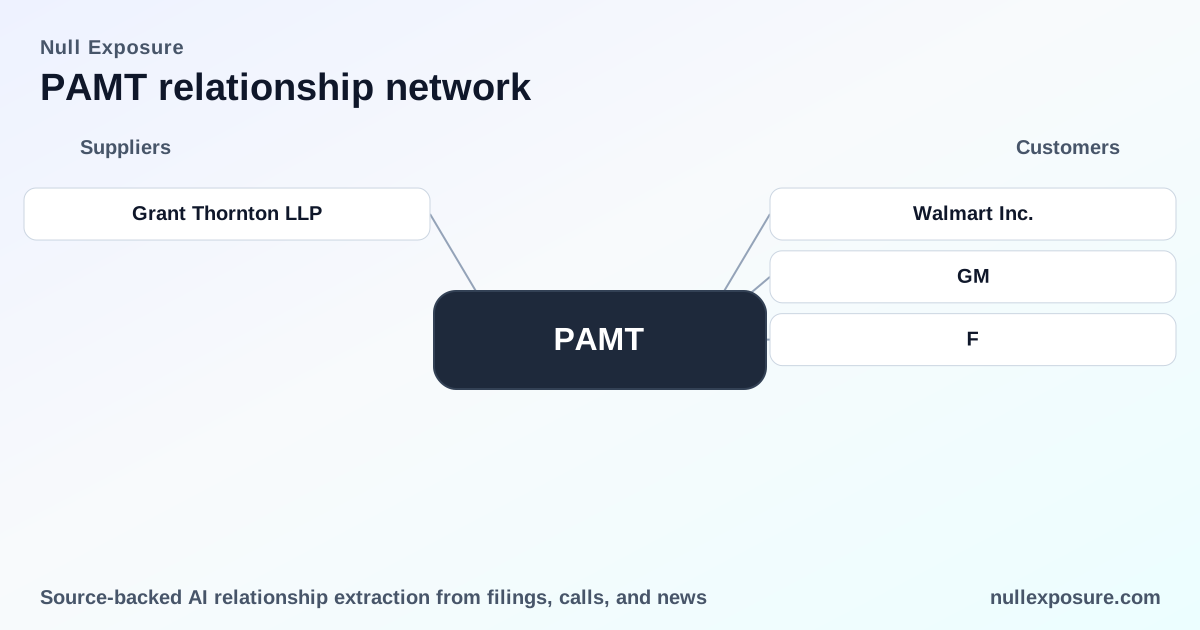
PAMT discloses a short list of customers that are material to annual revenues. Below I summarize every relationship in the FY2024 disclosures and provide the source language investors rely on.
Walmart Inc.
PAMT reports that Walmart accounted for approximately 8% of revenues in 2024, down from 9% in 2022. According to PAMT’s FY2024 Form 10‑K, Walmart is a meaningful customer but not the largest single account.
Source: PAMT 2024 Form 10‑K (customer concentration table, FY2024).
General Motors Company (first mention)
General Motors accounted for approximately 12% of revenues in 2024, consistent with 2023 and slightly lower than 2022, according to PAMT’s disclosures. This places GM among PAMT’s top revenue contributors and a primary driver of revenue concentration.
Source: PAMT 2024 Form 10‑K (FY2024 customer concentration disclosures).
GM (second, duplicate mention)
PAMT’s filing repeats the General Motors contribution in multiple places, underscoring GM’s role as one of the company’s largest and repeat customers across the three-year window. The duplicated disclosure reinforces GM’s standing in PAMT’s revenue mix.
Source: PAMT 2024 Form 10‑K (FY2024; repeated citation of GM’s revenue share).
F (Ford Motor Company, ticker reference)
A disclosure labeled “F” in the filing indicates Ford Motor Company accounted for about 9% of revenues in 2024, up from 5% in prior years, signaling increased business with Ford in the most recent period. The “F” entry reflects the same material customer relationship quoted elsewhere in the filing.
Source: PAMT 2024 Form 10‑K (FY2024 customer concentration statement).
Ford Motor Company (full name, second mention)
The filing restates that Ford accounted for approximately 9% of revenue in 2024, again highlighting Ford’s material and growing contribution relative to 2023 and 2022. The repeated name clarifies that the “F” ticker citation refers to Ford.
Source: PAMT 2024 Form 10‑K (FY2024).
Key patterns and what they mean for investors
- Concentration is material. PAMT reports that its five largest customers accounted for ~39% of total revenues in 2024, up from 34% in 2023, which makes the company sensitive to shifts among a handful of large shippers. This level of concentration is a structural revenue risk and a valuation lever.
- Large OEMs dominate the roster. Two auto OEMs — General Motors and Ford — together represent a substantial share of revenue (single-digit to low-double-digit percentages each), indicating that manufacturing supply chains are a core demand driver for PAMT’s asset utilization.
- Retail exposure through Walmart provides volume diversification but not insulation. Walmart’s single-digit share is meaningful but smaller than the largest OEM accounts; loss or scaling back of any of these names would materially affect utilization and margin.
- Repeated disclosures in the 10‑K reinforce stability of relationships across reporting periods — the company cites three-year comparisons (2022–2024) for each customer percentage, confirming these are not one-off revenue spikes.
Constraints that shape PAMT’s customer economics
PAMT’s 10‑K also contains operational constraints that fundamentally shape its customer relationships. These are company-level signals and not tied to any specific customer unless the excerpt explicitly names the counterparty.
- Contracting posture — short-term orientation. PAMT states it “generally” does not have long‑term contractual relationships with major customers, so customer continuity is not contractually guaranteed and the firm competes to renew lanes and volume frequently.
- Geographic footprint — North America focused. The company emphasizes operations “throughout the continental United States and Mexico, as well as in certain Canadian provinces,” indicating regional concentration in North American freight markets with exposure to cross-border dynamics.
- Materiality and concentration — service revenue dependent. Truckload transportation services (excluding fuel surcharges) represented ~67% of revenues in 2024, and the top five customers made up nearly 39% of revenue, signaling a business model where a few large contracts drive asset utilization and pricing power.
- Role and criticality — service provider on time‑definite lanes. PAMT highlights that many customers “depend on us to deliver shipments on a time‑definite basis,” which makes PAMT a critical logistics partner for just‑in‑time manufacturing and retail supply chains, increasing the operational stickiness of relationships when performance is strong.
- Relationship stage — active, operational partnerships. The filing notes the ongoing operational dependence of customers on PAMT’s services, suggesting current relationships are active and integrated into customer supply chains, though not secured by long-term contracts.
- Segment focus — services-led revenue. PAMT classifies its operations as truckload transportation and brokerage/logistics services, reinforcing that service delivery and network management (not commoditized asset leasing) drive revenue.
Investment implications and risk-reward framing
PAMT’s revenue profile combines healthy top-line scale (roughly $585m TTM) with meaningful concentration and negative near-term profitability metrics (negative EPS and operating margin pressures). For investors, the thesis is straightforward:
- Upside is tied to retaining and expanding volume with a handful of large customers (notably GM and Ford), improving utilization, and translating freight revenue into positive operating leverage.
- Downside centers on contract churn and spot-market cycles because customer relationships are largely short-term; a single large customer scaling back volumes would quickly compress margins.
- Operational execution matters more than product differentiation — on-time performance and lane availability underpin renewal probability and pricing leverage.
For a deeper, interactive view of PAMT’s customer disclosures and to compare these relationship dynamics across peers, explore the broader collection at https://nullexposure.com/.
Final takeaway
PAMT is a North American truckload carrier with concentrated, service‑oriented customer exposure — a profile that offers both leverage to large OEM and retail shippers and distinct contract risk due to short-term commercial arrangements. Investors should underwrite scenarios where top customers either sustain volumes or reallocate lanes, because a handful of counterparties materially determines PAMT’s revenue trajectory.