Pangaea Logistics (PANL): Customer Relationships Drive Revenue — and Concentration Risk
Pangaea Logistics Solutions monetizes a fleet and logistics platform by operating a mix of contracts of affreightment (COAs), time charters and voyage charters for industrial commodity shippers; it collects freight and logistics fees from repeat industrial customers while also offering terminal and stevedoring services. The business model blends recurring, contract-backed revenue from multi-year COAs with opportunistic short-term charters, producing steady cash flow but leaving the company exposed to a small number of large counterparties and global trade cycles. For a focused view of Pangaea’s commercial book and the most material customer names, see more at the NullExposure homepage: https://nullexposure.com/.
How Pangaea contracts, serves customers, and where the business model concentrates value
Pangaea runs a hybrid contracting posture. The company deploys vessels under long-term COAs (commonly one to five years), longer framework arrangements, and shorter time/voyage charters that can run for weeks to months. This mix creates two revenue levers: predictable income from COAs and the margin upside of spot/time charters. According to the company’s FY2024 filing, COAs “typically extend for a period of one to five years” and the firm “employs its vessels under a mix of voyage charters and time charters and COAs,” reflecting a deliberate strategy to balance stability and market exposure.
At the same time, customer concentration is material and operationally relevant. Company disclosures show one customer accounted for 35% of accounts receivable as of December 31, 2024, and the top ten repeat customers represented 47% of revenue for the year—evidence that a handful of relationships drive a large share of cash flow. Pangaea’s accounts receivable balance (net of allowance) was reported at roughly $42.4 million on that date, and the United States and Canada represented 67% of accounts receivable, underscoring important North American billing exposure even as the company sails globally.
- Operational implication: COAs and repeat commercial relationships deliver recurring revenue, but they also create single-counterparty credit and revenue concentration that investors must price into any valuation.
What the filings say about criticality, maturity and service role
Pangaea frames its customer interactions as service-oriented and mature: management describes acting as the ocean logistics department for some customers—providing scheduling, terminal operations and marketing—rather than a one-off carrier. The disclosures flag a critical audit matter around the allowance for credit losses on the significant customer that represented 35% of AR, which confirms both the economic importance and the credit monitoring required for that exposure. The company reported that all of its top ten customers are repeat customers, supporting a contention of relationship maturity and stickiness baked into COAs and framework agreements.
Customer relationships on the public record
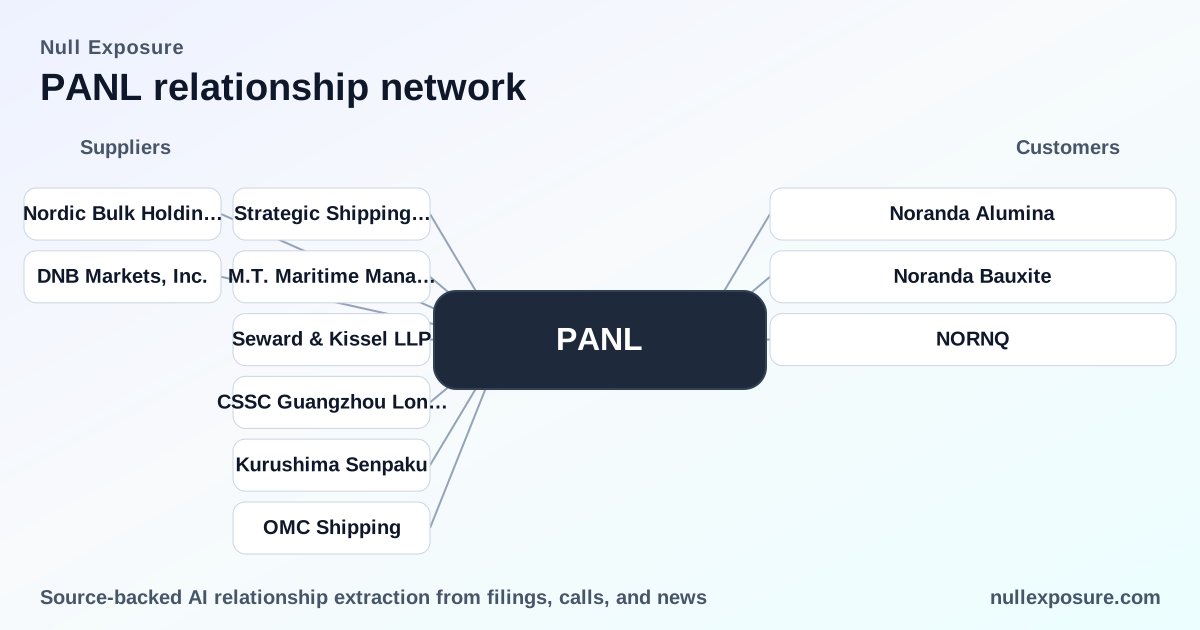
Below are every customer relationship found in the latest external reporting for PANL, with concise plain-English summaries and source notes.
Noranda Alumina
Pangaea announced that a newly acquired Panamax bulker will be renamed and fully utilized in the Noranda trade as a dedicated resource supporting continuous transportation to Noranda Alumina under long‑term contractual arrangements. This signals an operational commitment to route-specific tonnage that underpins recurring freight revenue. Source: MaritimeProfessional news article, March 10, 2026.
Noranda Bauxite
The same vessel addition was described as supporting Pangaea’s continuous transportation capabilities to Noranda Bauxite on a long-term contractual basis, indicating Pangaea is committing fleet capacity to multiple Noranda cargo streams (alumina and bauxite). That allocation reinforces the COA-style commercial structure. Source: MaritimeProfessional news article, March 10, 2026.
Noranda (inferred symbol NORNQ)
Pangaea management stated the new vessel will directly support the growth of its relationship with Noranda, serving as a dedicated resource to the company’s shipping routes, implying the commercial relationship is expanding and being formalized through vessel allocation. Source: MaritimeProfessional news article, March 10, 2026.
NORNQ
A separate mention indexed as NORNQ repeats management’s comment that the new tonnage will be a dedicated resource for Noranda’s routes, reaffirming the same counterparty linkage and that Pangaea’s commercial book includes explicit, route-dedicated assets for this industrial shipper. Source: MaritimeProfessional news article, March 10, 2026.
What these relationships imply for investors
- Revenue durability but single‑counterparty risk: Dedicated vessels and multi-year COAs create durable revenue streams; however, the standalone fact that one customer represented 35% of AR at year-end 2024 makes counterparty performance a corporate-level risk. Company filings treat this as a critical audit area, which increases investor scrutiny on credit exposure and receivable collections practices.
- Contract mix provides optionality: The blend of COAs and short-term charters gives Pangaea the ability to lock-in base revenue while capturing upside when market freight rates rise—an important margin-management lever for an operator with a reported EV/EBITDA of ~6.4 and positive operating margins (company metrics, FY2024).
- Geographic reach and billing concentration: Although Pangaea moves cargo to roughly 225 ports worldwide and averages dozens of vessels in service daily, 67% of AR is concentrated in the U.S. and Canada, so geopolitical or regional shipping disruptions in North America would have outsized effects on liquidity.
- Mature, service-centric relationships: Management’s description of acting as an outsourced ocean logistics department for some customers implies higher switching costs and deeper integration with industrial customers, which supports contract renewals and COA renewals.
For a deeper dive into how these customer dynamics translate into credit exposure and contracted revenue, visit NullExposure for upstream documentation and position-level views: https://nullexposure.com/.
Bottom line for operators and investors
Pangaea’s customer roster, including explicit route‑dedicated commitments to Noranda-related cargoes, supports a thesis of repeatable, contract-backed revenue that coexists with meaningful counterparty concentration. Investors should underwrite both the upside from stable COA cash flows and the risk that one or a few large customers and regionally concentrated receivables could compress free cash flow or increase credit provisions under stress. The company’s hybrid charter strategy and service orientation are competitive advantages—provided management preserves credit discipline and diversification over time.
Key takeaway: Pangaea is a service-driven drybulk operator with durable contractual revenue, but its concentrated receivables and a handful of large customers require active monitoring as part of any investment case.