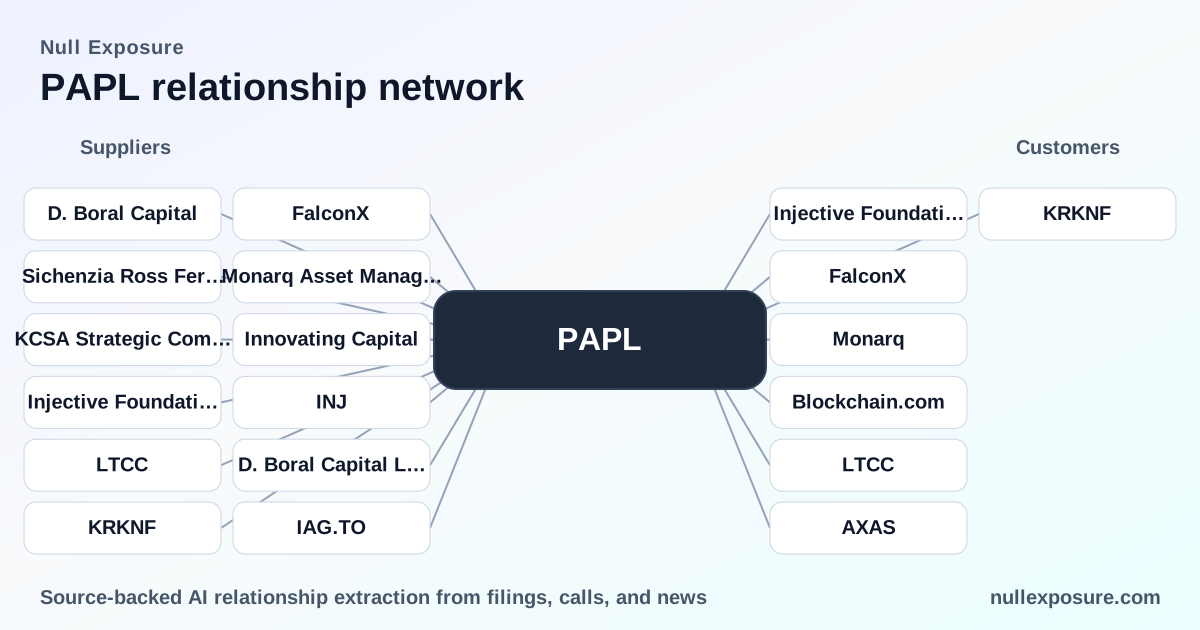
Pineapple Financial (PAPL) — Customer relationships anchored by a strategic crypto financing
Pineapple Financial operates as a Canadian mortgage technology and brokerage platform that monetizes through a blended model: subscription fees for access to its Pineapple Plus platform, per-deal transaction fees for underwriting/documentation, and commissions from insurance and mortgage brokering. Recent corporate announcements show Pineapple is also diversifying its balance sheet and investor base via a $100 million private placement that brought in both traditional and crypto-native financial counterparties—an outcome that changes the company’s counterparty map and treasury posture. For a focused view of counterparties tied to that financing and what it implies for PAPL’s operating profile, read on. For more background on how we source and contextualize counterparties, visit https://nullexposure.com/.
Executive summary — investment thesis in one line
- Pineapple combines recurring SaaS-like subscription revenue with commission-based brokerage economics, and has used a high-profile private placement to bring crypto intermediaries into its capital structure; this mix increases both revenue diversification but also introduces non-traditional counterparty and treasury risk.
Key takeaways
- Revenue is predominantly Canadian, broker/agent-facing, and service-led; subscription and per-deal fees are smaller but recurring contributors.
- The $100M private placement broadens the investor/counterparty set to include crypto exchanges, market-makers and foundations, shifting treasury and investor relations risk into a mixed financial/crypto ecosystem.
- Credit and collection dynamics worsened in FY2025, with a material ECL recognized — an operational signal investors must track.
What the March 2026 financings reveal about counterparties Pineapple issued two related press releases in March 2026: one announcing the launch of a $100 million Injective digital-asset treasury strategy and another closing a $100 million private placement. Both releases list participating institutions. The roster reads like a cross-section of traditional crypto infrastructure and institutional market participants, indicating Pineapple’s strategic decision to attract liquidity from both camps and to position part of its treasury in digital assets. (Newsfile press releases, March 10, 2026: https://www.newsfilecorp.com/release/264735 and https://www.newsfilecorp.com/release/265250.)
Counterparty relationships — plain-English summaries and sources
-
Blockchain.com — Pineapple’s private placement and Injective treasury launch counted Blockchain.com among participating investors, signaling direct engagement with a major crypto custody and exchange services provider. (Newsfile press release, March 10, 2026: https://www.newsfilecorp.com/release/265250)
-
FalconX — FalconX participated in the financing rounds, connecting Pineapple to a crypto-native prime broker and liquidity provider that could support trading or custody needs tied to the company’s digital-asset treasury activity. (Newsfile press release, March 10, 2026: https://www.newsfilecorp.com/release/265250)
-
Injective Foundation — The Injective Foundation is explicitly tied to Pineapple’s announced Injective digital-asset treasury strategy, making it both a strategic partner in the token exposure plan and a signaling conduit to the Injective ecosystem. (Newsfile press release, March 10, 2026: https://www.newsfilecorp.com/release/264735)
-
Monarq — Monarq is listed among participating investors in the private placement, indicating Pineapple attracted alternative finance and market-making capital to its financing round. (Newsfile press release, March 10, 2026: https://www.newsfilecorp.com/release/265250)
-
Canary Capital — Canary Capital is named as a participant in the financing, providing Pineapple with institutional backing that diversifies its investor base beyond retail and management ownership. (Newsfile press release, March 10, 2026: https://www.newsfilecorp.com/release/265250)
-
Abraxas — Abraxas appears in the list of financing participants; press coverage also identifies the ticker AXAS in related references, which suggests market-facing recognition of that investor. Abraxas’ participation brings additional institutional capital to the placement. (Newsfile press releases, March 10, 2026: https://www.newsfilecorp.com/release/264735 and https://www.newsfilecorp.com/release/265250)
-
AXAS — The press material lists AXAS (an inferred ticker for Abraxas in coverage), repeating Abraxas’ presence in the financing roster and reinforcing that the same institutional actor is acknowledged under both name and ticker in public reporting. (Newsfile press releases, March 10, 2026: https://www.newsfilecorp.com/release/265250)
-
Kraken — Kraken, the crypto exchange, participated in the financing, indicating Pineapple’s direct ties to a major exchange counterparty that could support liquidity, custody access, or execution for the company’s Injective holdings. (Newsfile press releases, March 10, 2026: https://www.newsfilecorp.com/release/264735 and https://www.newsfilecorp.com/release/265250)
Constraints and operating-model signals (company-level) These disclosures and Pineapple’s filings illuminate several structural characteristics of the business that shape counterparty risk and contract posture:
-
Contracting posture: mixed recurring subscription + transactional — Pineapple charges a flat monthly fee for Pineapple Plus users (documented at $145.00 per month) while also charging per-deal fees for pre-underwriting and documentation; subscription revenue is recognized over the service period. These terms create a hybrid monetization profile that blends predictable recurring cash with variable transaction revenue.
-
Concentration and geography: Canada-centric operations — The company operates exclusively within the Canadian mortgage market and recognizes nearly all revenue in CAD; counterparties on the operational side are primarily Canadian broker/agent customers, but financing/investor counterparties are now international and crypto-focused.
-
Counterparty type and criticality: retail and professional agents + institutional investors — Primary clients are mortgage agents, brokers and consumers; the investor and treasury counterparties now include institutional crypto entities, which are critical to Pineapple’s capital and treasury strategy but are non-traditional for a mortgage brokerage.
-
Materiality: small fees vs. credit risk — Subscription and per-deal fees represent a modest portion of gross revenue (disclosed at ~3% and ~1.3% respectively), classifying them as immaterial revenue streams in isolation; however, the company recorded a material expected credit loss (ECL) in FY2025, signaling elevated receivables risk and requiring active collection management.
-
Role flexibility: both principal and agent — Pineapple acts as a principal when brokering third-party insurance products and as an agent for mortgage brokerage commission billing, so counterparty contracts span principal obligations and agency arrangements.
What investors should watch next
-
Treasury composition and custody: follow disclosures on the $100M Injective strategy, custody arrangements, and counterparties used to hold tokenized assets. Institutional crypto counterparties change balance-sheet risk in ways that differ from bank deposits.
-
Credit performance and collections: the FY2025 ECL shows deterioration in receivables; monitor subsequent quarters for normalization or continued pressure.
-
Revenue mix and customer concentration: subscription and per-deal fees are small but strategically important for product stickiness; watch growth in Pineapple Plus adoption and any shift in percent revenue contribution.
-
Counterparty reputational and regulatory risk: new crypto participants provide capital but also introduce regulatory complexity for a Canadian mortgage operator; track regulatory commentary and counterparties’ compliance posture.
Conclusion and action Pineapple’s shift to include crypto-native and institutional participants in a $100M private placement is a deliberate recalibration of capital and treasury strategy that broadens its counterparty map. For investors, the key trade-off is between diversified capital access and the introduction of non-traditional treasury counterparties and volatility in liquid holdings. For ongoing tracking of PAPL counterparties and structured commentary, visit https://nullexposure.com/.
For deeper diligence on counterparty relationships and to monitor changes in Pineapple’s capital and treasury counterparties over time, explore additional coverage at https://nullexposure.com/.