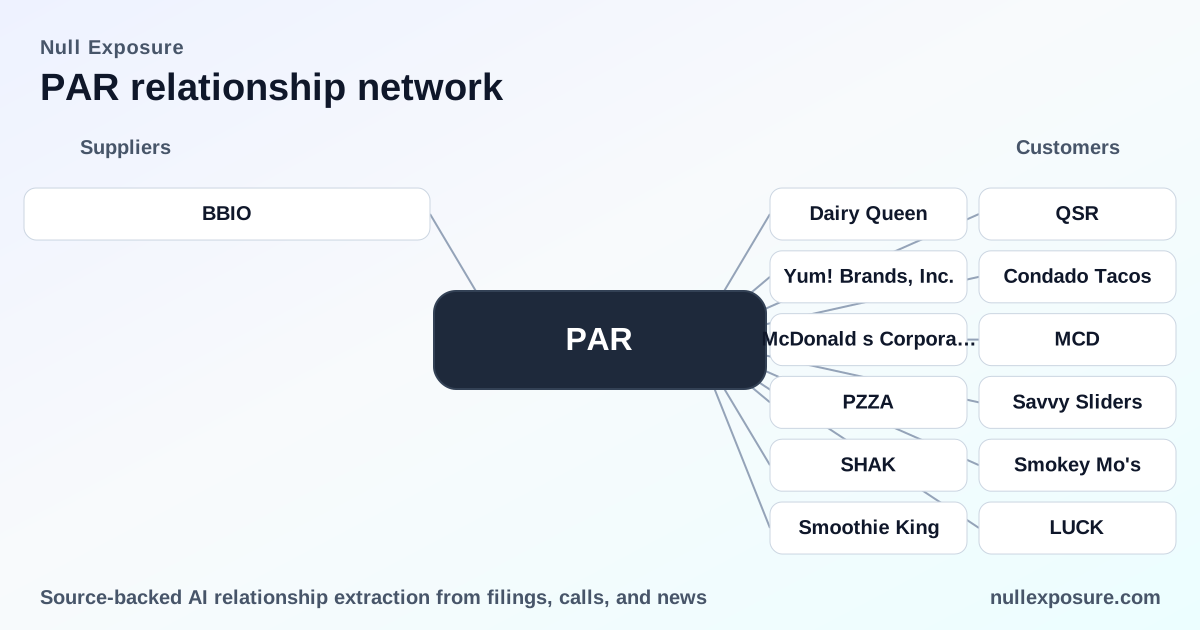
PAR Technology: customer footprint, concentration and what it means for investors
PAR Technology sells and services point-of-sale hardware and cloud software to restaurants, retail and entertainment operators and monetizes through a mix of hardware sales, subscription SaaS, professional services and transaction-linked fees. Enterprise accounts drive recurring revenue and concentration, while newer multi-year platform wins are expanding the recurring base and creating sizable deployment pipelines that will influence revenue visibility and capital intensity over the next several fiscal years. For a consolidated view of PAR’s commercial positioning, see https://nullexposure.com/.
Executive snapshot — the investment thesis in one paragraph
PAR combines hardware-led deployments (POS terminals, kiosks, headsets) with software subscriptions and managed services, creating a hybrid revenue model that benefits from initial installation economics and longer-term annuity streams. Large branded rollouts — whether incremental upgrades for franchise systems or full technology modernizations — are the lever that converts one-time hardware sales into multi-year, higher-margin subscription relationships. Recent contract announcements and 10‑K disclosures indicate meaningful customer concentration, growing enterprise wins, and an active enterprise sales pipeline that together constitute both upside and execution risk for investors.
Documented customer relationships (each result, source-first)
-
McDonald’s Corporation — PAR reports McDonald’s accounted for 15% of consolidated revenues in FY2024, making it a material customer by the company’s own disclosure in the FY2024 10‑K. According to PAR’s FY2024 Form 10‑K, McDonald’s represented 15% of revenue for the year ended December 31, 2024. (10‑K, par-2024-12-31)
-
Dairy Queen — Dairy Queen is listed among customers contributing materially to revenue history (8% in FY2024). PAR’s FY2024 10‑K lists Dairy Queen as an identifiable revenue source in the same customer concentration table. (10‑K, par-2024-12-31)
-
Yum! Brands, Inc. — Yum! Brands is reported at 9% of PAR’s revenue in FY2024 per the company’s customer concentration table in its FY2024 10‑K. (10‑K, par-2024-12-31)
-
PZZA (Papa John’s) — Papa John’s confirmed a partnership with PAR on a 2025 Q4 earnings call: PAR was selected to power Papa John’s in-store tech stack and the company referenced a decade-long deployment commitment for ~3,200 U.S. locations in subsequent press coverage. (earnings call pzza-2025q4-earnings-call; news: franchising.com, Digital Transactions, restauranttechnologynews, March 2026)
-
Papa Johns (multiple news references) — Multiple press reports and industry outlets state Papa John’s selected PAR POS and PAR OPS for a U.S. rollout of roughly 3,200 corporate and franchise locations as part of a multi-year modernization. (news aggregation incl. franchising.com; Digital Transactions; restauranttechnologynews; March 2026)
-
Shake Shack (SHAK) — PAR named Shake Shack as one of the new Punchh brand wins in Q4 commentary and industry reports list Shake Shack among new clients. (news_sentiment / earnings call transcript, InsiderMonkey; Digital Transactions, March 2026)
-
Condado Tacos — PAR disclosed the first large sale to Condado Tacos during the quarter and noted a competitor displacement. (news_sentiment / earnings call transcript, InsiderMonkey, March 2026)
-
MOD Pizza — MOD Pizza publicly integrated PAR’s Recovery and Delivery Operations modules to protect delivery revenue from third‑party errors, per a company press release covered by Fast Casual. (news_sentiment / Fast Casual, May 2026)
-
Burger King — PAR commentary points to resumed Burger King rollout activity as a contributor to POS momentum and deployment volume in Q4. (news_sentiment / earnings call transcript, InsiderMonkey, March 2026)
-
Smoothie King — PAR reported the first major deployment of PAR Games with Smoothie King and initial sales of PAR Smart passes during the quarter. (news_sentiment / InsiderMonkey, March 2026)
-
Savvy Sliders — PAR’s Ordering product line added Savvy Sliders as a new brand during the reported quarter. (news_sentiment / InsiderMonkey, March 2026)
-
Smokey Mo’s — PAR added Smokey Mo’s as a new Ordering customer in the quarter, per company remarks. (news_sentiment / InsiderMonkey, March 2026)
-
RaceWay — Industry coverage identifies RaceWay as a client tapping PAR to power rewards programs as PAR expands into retail loyalty solutions. (news_sentiment / Retail Customer Experience, May 2026)
-
Lucky Strike Entertainment (LUCK) — PAR disclosed a Punchh win with Lucky Strike Entertainment as part of expansion into the entertainment vertical; press reports and call transcripts reference the client. (news_sentiment / InsiderMonkey and Digital Transactions, March 2026)
-
LUCK (duplicate entry) — Digital Transactions and other outlets echoed the Lucky Strike Entertainment win when reporting PAR’s Q4 commentary. (news_sentiment / Digital Transactions, March 2026)
-
PZZA (news repetition entries) — Several news outlets repeated the Papa John’s selection narrative and referenced the decade‑long commitment and 3,200‑site rollout as central to PAR’s FY2026 commercial updates. (news_sentiment aggregated across InsiderMonkey, Digital Transactions, Franchising.com, March 2026)
-
MCD / McDonald’s (news duplicates) — Industry write-ups covering PAR’s earnings call reiterated McDonald’s as a contributor to international and POS momentum. (news_sentiment / InsiderMonkey, March 2026)
-
QSR (generic category reference) — PAR’s earnings commentary also referenced steady demand across large QSR enterprise brands, including Dairy Queen and Burger King, linking remodels and platform upgrades to deployment volumes. (news_sentiment / InsiderMonkey, March 2026)
Note: the results set contains multiple press and transcript repetitions of the same underlying wins; I listed each source entry above to reflect the full evidence trail in the supplied results.
What PAR’s customer list and disclosures imply about the operating model
-
Revenue mix: hybrid hardware and recurring SaaS. PAR sells physical POS hardware alongside SaaS subscriptions and managed services, so cash flow profiles combine front-loaded hardware revenue with multi-year subscription annuity streams, and transaction fees give upside tied to customer volumes.
-
Subscription and usage-based contracts are central. Corporate disclosures state subscription contracts typically run 12–36 months and include transaction-based payment processing fees; PAR groups subscription and transaction revenues in its product lines, supporting both recurring revenue growth and variable, volume-linked upside.
-
Enterprise concentration and customer criticality. PAR’s FY2024 customer table identifies several enterprise-brand relationships and a single customer representing 15% of consolidated revenue — a material concentration that increases operating leverage but also introduces execution risk if large rollouts delay or contract terms change.
-
Counterparty segmentation and sales motion. The company runs dedicated enterprise sales for tier‑one/tier‑two accounts (brands with 50–500+ sites) alongside a faster SMB motion; this structure explains both large multi‑year wins and steady smaller deployments.
-
Geographic footprint. PAR describes its platform as global, with exposures in North America, EMEA and APAC, implying multi-currency operational complexity and international expansion opportunities tempered by FX and local market execution.
Investor implications — upside and risk in plain language
-
Upside: Multi-year, large-brand rollouts (Papa John’s, Shake Shack, Lucky Strike) convert into recurring revenue and higher lifetime value per customer; successful execution on these implementations will materially expand subscription revenues and improve forward visibility.
-
Risks: Customer concentration (one customer at 15% of revenue in FY2024) and the hardware-heavy component of sales increase the potential for quarter-to-quarter volatility; enterprise rollouts also carry implementation and franchisee-acceptance execution risk.
-
Profile fit: PAR suits investors seeking exposure to restaurant tech with a hybrid hardware/SaaS model and differentiated enterprise pipeline; allocate based on conviction in PAR’s ability to convert wins into stable recurring cashflows.
For additional context on PAR’s revenue drivers, product segmentation and recent commercial wins, visit https://nullexposure.com/ for consolidated sourcing and intelligence.
Bottom line
PAR’s customer disclosures show a clear strategy: capture marquee enterprise deals that scale across thousands of sites while expanding recurring SaaS and transaction revenue. That strategy amplifies growth potential but raises concentration and execution risk, making PAR a play on enterprise deployment execution and the company’s ability to stitch hardware, software and services into durable annuities.