Park Dental Partners (PARK): Customer relationships and what the Ironwood Dental addition signals for investors
Park Dental Partners operates as a dental support organization (DSO) that affiliates independent dental practices and provides centralized business services—billing, operations, and administrative support—while capturing revenue through affiliation agreements and management fees shared with practice owners. The company reports meaningful scale (Revenue TTM $244.5M, EBITDA $9.8M) and trades at valuation multiples consistent with growth-stage healthcare services consolidators (EV/Revenue ~0.47, EV/EBITDA ~11.9). For investors, the core thesis is straightforward: PARK grows valuation through inorganic expansion of affiliated practices and the steady monetization of operational services across an increasingly geographically dispersed network. Learn more about our coverage at https://nullexposure.com/.
A discrete network expansion: Ironwood Dental joins the Park platform
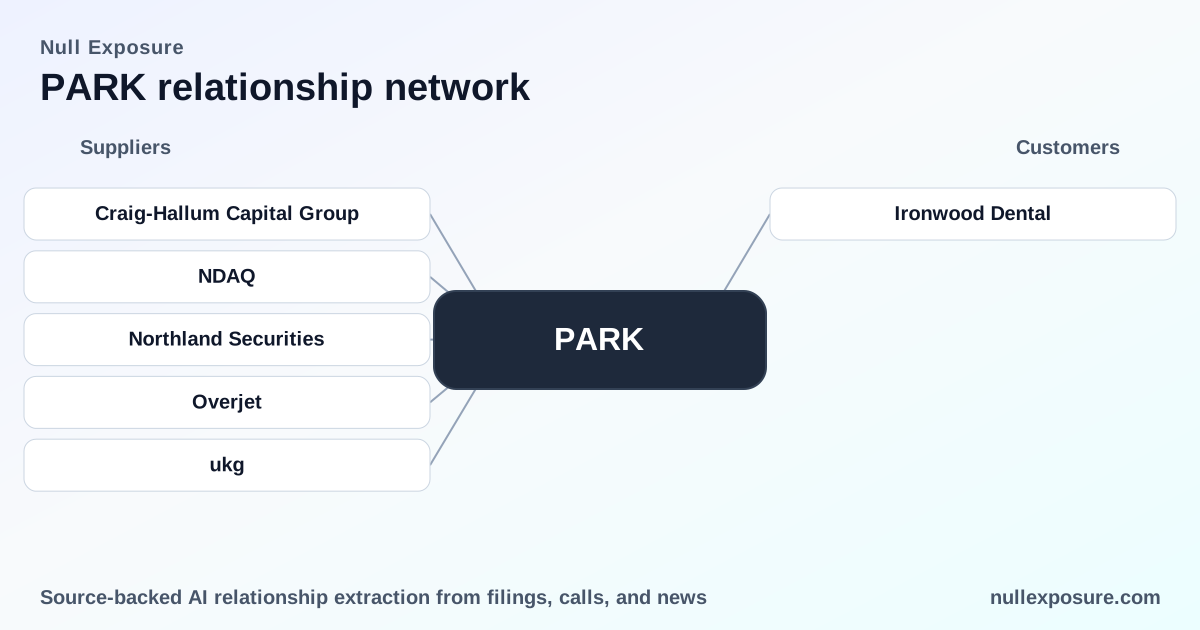
Park’s most recent publicized customer relationship expansion is the addition of Ironwood Dental in Tucson, Arizona. Park announced that Ironwood Dental “joins the Park Dental Partners network of affiliated dental practices,” a classic DSO affiliation that increases scale and local penetration in the Arizona market. This development was distributed in company press coverage and investor-facing news outlets (GlobeNewswire press release dated January 28, 2026; Yahoo Finance coverage referencing the January 23, 2026 announcement).
Relationship roster — every entry in the results
-
Ironwood Dental — press coverage on Yahoo Finance: Park announced on January 23, 2026 that Ironwood Dental (Tucson, AZ) joins its network, reflecting continued geographic expansion outside its historical Minnesota/Wisconsin base; coverage published on Yahoo Finance on May 3, 2026 documented the affiliation and its strategic intent (see Yahoo Finance coverage: https://finance.yahoo.com/news/park-dental-partners-expands-presence-211700863.html).
-
Ironwood Dental — GlobeNewswire press release: the company issued a formal GlobeNewswire release dated January 28, 2026 confirming Ironwood Dental’s integration into the Park Dental Partners network and highlighting the practice-level affiliation as part of Park’s FY2026 growth activity (see GlobeNewswire release: https://www.globenewswire.com/news-release/2026/01/28/3228078/0/en/Park-Dental-Partners-Expands-Presence-in-Arizona-with-Addition-of-Ironwood-Dental.html).
Both items reference the same underlying affiliation event; the dual listings reflect press distribution and media pickup rather than distinct contractual types.
What the Ironwood affiliation reveals about operating posture
-
Affiliation-focused growth: The Ironwood addition confirms Park executes a classic DSO playbook—accrete practice-level revenue and operational scale through signed affiliations rather than greenfield practice builds. Press disclosures emphasize network expansion as the primary objective.
-
Geographic diversification: Ironwood’s location in Tucson signals active expansion beyond Park’s Minnesota/Wisconsin roots and contributes to risk diversification across state markets.
-
Low public contract granularity: The disclosed materials are promotional and do not contain specific commercial terms (length, revenue-share, exclusivity). The dataset provided contains no explicit contractual constraints, which is a company-level signal that detailed economics of practice affiliations are not publicly disclosed in these announcements.
Business-model characteristics investors should weigh
-
Contracting posture: Park’s public communications reflect relationship-driven, practice-level affiliation agreements typical of DSOs. Those agreements convert local cash flows into platform-level recurring revenue streams and operational fee income.
-
Customer concentration and criticality: Park’s model distributes revenue across many small customers (individual practices). This inherently limits single-customer concentration risk while making aggregate same-store performance critical to enterprise cash flow.
-
Maturity and growth profile: Financials show a company at scaling stage—Revenue TTM $244.5M and negative EPS (-$0.18) indicate ongoing investment in growth and integration. Insider ownership (~20%) and institutional ownership (~20%) reflect a balanced governance profile where management and public investors both have meaningful stakes.
-
Disclosure posture: The absence of contract-level constraints in the provided dataset signals that investors must rely on macro indicators (number of affiliated practices, same-store revenue trends, and occasional press releases like Ironwood) to assess deal economics.
Key takeaways and risk considerations
-
Expansion is continuing: The Ironwood announcement is a tangible example of Park executing on M&A-style growth through practice affiliations, strengthening the top-line growth narrative.
-
Valuation context matters: With EV/EBITDA near 12 and Price-to-Sales around 0.33, investors should assess how future practice additions convert to EBITDA given current operating margins (Operating Margin TTM approximately -13.4%).
-
Transparency gap on deal economics: Public announcements do not disclose revenue-share, integration costs, or contract duration; investors must treat headline additions as volume signals, not direct guides to near-term margin expansion.
-
Execution risk at the practice level: The business relies on consistent operational integration and retention of affiliated practice owners; lapse in integration effectiveness would have outsized impact on profitability despite distributed customer risk.
How to use this signal set in an evaluation
-
Use affiliation announcements (like Ironwood) as leading indicators of platform growth velocity and geographic diversification. Track cadence of similar press notices over rolling 12-month windows to model new-affiliate contribution to revenue.
-
Combine public announcements with quarterly filings and same-store metrics to reconcile headline growth with actual contribution to EBITDA and free cash flow.
-
For active investors and operators evaluating partnerships, prioritize meetings that clarify contract economics, transition support, and termination provisions—these are the terms not disclosed in press releases.
If you want a structured feed of relationship-level signals and press coverage for Park Dental Partners and comparable DSOs, explore more at https://nullexposure.com/.
Conclusion: the Ironwood Dental affiliation is a clear, incremental win for Park’s expansion strategy and reinforces the company’s operating model of scaling through affiliated practice integrations. Investors should treat such announcements as network-growth confirmations while demanding more disclosure on the economics that convert scale into sustainable margins.