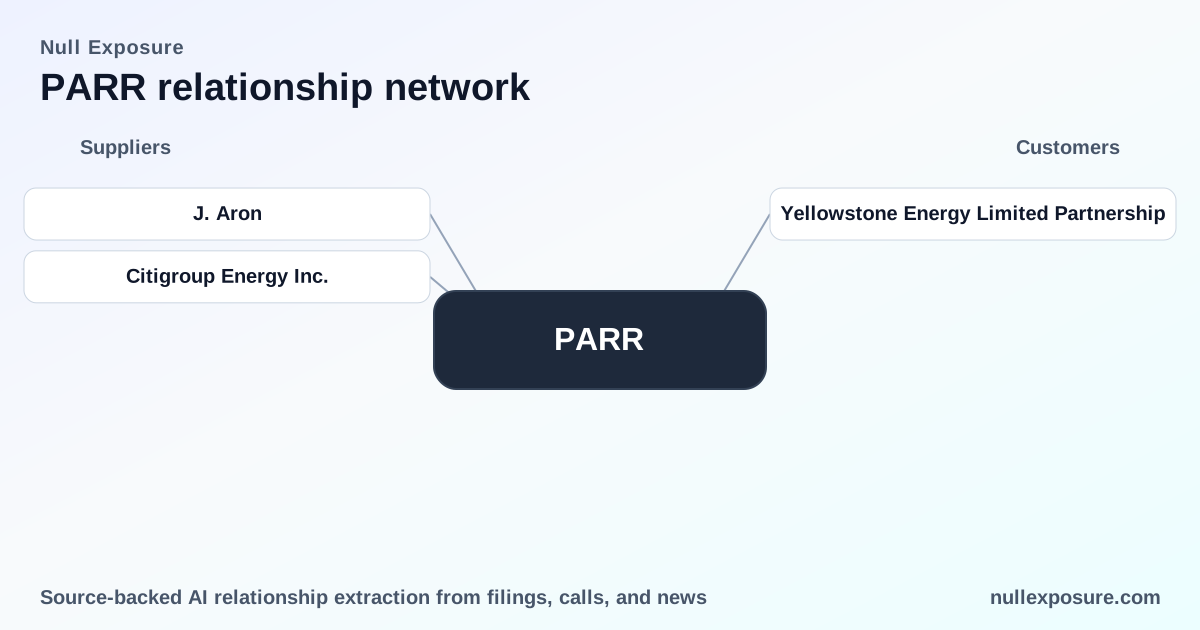
Par Pacific (PARR): Customer Relationships Drive Refining Cash Flow and Operational Leverage
Par Pacific operates, refines and markets fuels across the western United States and monetizes through three linked channels: refining and bulk product sales (largely short-term and spot contracts), retail fuel outlets, and complementary industrial sales such as feedstock supply for local power generation. The company converts crude into refined products and sells them at the refinery gate, into wholesale channels, and through company-owned retail sites; this mix produces a high-turnover working capital profile and concentrated customer exposures that are material to near-term earnings. For investors, the customer book is a mix of short-duration commercial contracts with occasional multi‑year supply arrangements that reduce near-term revenue volatility. Learn more about our research platform at https://nullexposure.com/.
How Par Pacific’s customer posture shapes the investment case
Par Pacific’s disclosed customer attributes reveal several defining operating characteristics that matter for valuation and risk assessment:
- Short-term sales and spot exposure: The company sells the majority of refined products under short-term contracts or on the spot market, and customer payments are due quickly (commonly within 2–30 days). This produces high revenue cyclicality and a working-capital-intensive model that amplifies refining margin swings.
- Material customer concentration: One refining-segment customer accounted for 12% of consolidated revenue in 2024 (and 13% in 2023), a level of concentration that creates identifiable counterparty risk to the P&L if volumes or pricing change.
- Geographic focus: Operations and customer flows are concentrated in the western U.S., aligning demand exposure to regional economic and seasonal cycles rather than a national footprint.
- Seller-first commercial role: Par Pacific recognizes revenue on physical delivery and functions predominantly as a seller of refined products, with retail outlets and wholesale accounts forming the core product segment of revenues.
- Active relationships with core-product customers: Filings indicate ongoing, active commercial relationships (retail operations in Hawaii, Washington and Idaho, and recurring refinery sales), supporting near-term revenue predictability despite short contract lengths.
Those signals create a profile that blends operational leverage to refining margins with counterparty concentration and cash conversion risk — important inputs for modeling free cash flow and stress-testing scenarios.
Relationship snapshots: every named customer and counterparty
Yellowstone Energy Limited Partnership (YELP)
Par Pacific supplies petroleum coke from its Montana refinery to Yellowstone Energy’s cogeneration facility in Billings, Montana, where that feedstock is converted into power sold to the local utility grid. This is a direct industrial sale that links refinery byproducts to downstream power markets and underlines localized interdependencies in Par Pacific’s Montana operations. Source: Par Pacific 2024 Form 10‑K (FY2024).
CHS Cooperative (CHSCL)
Par Pacific entered a multi‑year fuel supply agreement with CHS to exchange and supply refined products across Wyoming, South Dakota, Montana, Idaho and eastern Washington; the arrangement establishes a regional wholesale distribution partnership that smooths volumes versus pure spot selling. This agreement was reported during the company’s 2018 retail acquisition activity and represents a strategically reciprocal commercial tie to an agricultural cooperative with an established distribution network. Source: CSNews report on Par Pacific’s acquisition and supply agreement (FY2018).
What each relationship implies for operations and financials
Yellowstone Energy: integration and localized criticality
The YELP relationship shows that Par Pacific’s refinery output is directly embedded in regional industrial customers that convert refinery byproducts into electricity. That linkage adds operational complexity — refinery throughput decisions affect local power feedstock supply — and creates a localized, mutually dependent commercial exposure that impacts both throughput planning and product slate optimization. Source: 2024 Form 10‑K.
CHS Cooperative: multi‑year volume stability within a short‑term market posture
The CHS supply agreement demonstrates that Par Pacific blends spot and contract sales strategically: although the majority of product sales are short duration, multi‑year contracts with well-capitalized regional counterparties provide partial revenue smoothing and distribution scale that mitigates immediate spot volatility. Source: CSNews (2018).
Investment implications — what to model and monitor
- Margin sensitivity and cash conversion: Given the short payment terms (2–30 days) and spot-heavy sales mix, model scenarios with sharp refining-margin compression and assess working capital strain; receivable and inventory turns will drive near-term free cash flow. Evidence for this payment profile is in Par Pacific’s disclosures on payment terms and contract tenor.
- Counterparty concentration risk: A single refining customer contributing 12% of 2024 revenue is a material concentration that should be tested in downside cases — loss or significant volume reduction with that customer would be earnings‑negative without offsetting spot or other contract growth.
- Operational interdependence: Industrial buyers like YELP create operational coupling between refinery output and local power markets; evaluate contingency plans for feedstock substitutions and the commercial terms that secure those sales.
- Geographic demand cyclicality: Western U.S. focus concentrates exposure to regional economic and transportation dynamics; incorporate regional demand scenarios into volume and price assumptions.
- Commercial maturity and strategic mix: The combination of active retail operations, periodic multi-year supply arrangements (e.g., CHS), and largely short‑term wholesale sales gives Par Pacific a hybrid commercial posture: enough contractual stability to support baseline volumes, but remaining exposed to market cycles that drive upside and downside volatility.
Bottom line for investors
Par Pacific is a refining-and-marketing operator whose customer relationships are a core driver of cash flow volatility and upside leverage. Key positives include operating-scale in regional markets, retail distribution, and selective multi‑year commercial arrangements that provide partial revenue stability. Key risks include short contract tenors, material customer concentration, and tight working capital dynamics that amplify refining-margin cycles. Active monitoring of counterparties like Yellowstone Energy (industrial feedstock buyer) and CHS (regional supply partner) is essential to any investment thesis.
For a deeper view of counterparty exposures and contract-level signals, visit our research hub at https://nullexposure.com/.