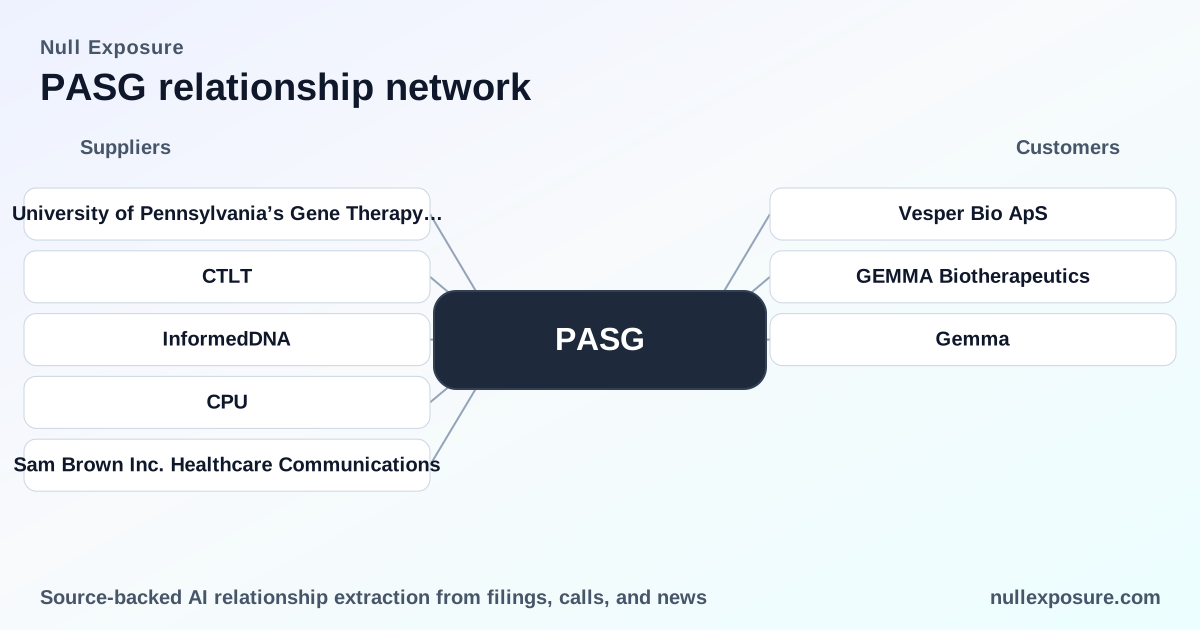
Passage Bio (PASG): Customer relationships that reshape near‑term cash and long‑term optionality
Passage Bio operates as a genetic medicines company focused on rare monogenic CNS diseases and monetizes primarily by advancing programs to value inflection points and outsourcing commercialization via out‑licenses, upfront payments and milestone contingencies. Recent disclosures show a clear tilt toward partner monetization of pediatric and CNS programs — a strategy that converts development assets into liquidity today while transferring later‑stage development and commercialization risk to counterparties. For a focused view of these customer/partner ties, see more at https://nullexposure.com/.
How these partner moves read through an investor lens
Passage Bio’s public filings and news releases reveal a commercial posture that favors strategic out‑licensing and collaborations over unilateral late‑stage buildout. That posture produces several company‑level signals investors must weigh:
- Contracting posture: Passage is executing out‑licenses and research collaborations, receiving upfront cash and contingent payments rather than retaining sole commercialization responsibility. This is a revenue‑generation technique that reduces near‑term cash burn and shifts execution risk to partners.
- Concentration: The disclosed activity involves a small set of counterparties; a narrow partner base increases counterparty concentration risk if one or two partners carry most of the obligations.
- Criticality: When partners assume payments and development duties (as documented below), they become critical to the programs’ advancement and to Passage’s ability to monetize those assets.
- Maturity: The counterparty activity covers early clinical and pediatric gene therapy programs and reflects an operational model that monetizes mid‑stage assets rather than progressing every program in‑house.
These are company‑level signals drawn from the disclosed customer relationships and are not attributed to any single counterpart unless the source explicitly names that counterpart.
Partners on the public record
Below are every partner relationship captured in public materials to date, with a concise plain‑English summary and the reporting source.
Vesper Bio ApS
Passage Bio’s 2024 Form 10‑K notes that Vesper Bio ApS began enrollment of a Phase 1b/2a study of a small‑molecule sortilin antagonist in asymptomatic GRN mutation carriers in January 2025, signaling an active clinical collaboration or supported trial. According to Passage Bio’s 2024 Form 10‑K filing, this activity is recorded in the FY2024 disclosures.
GEMMA Biotherapeutics
A Passage Bio press release distributed via GlobeNewswire on August 1, 2024 states that Passage out‑licensed three pediatric gene therapy programs to GEMMA Biotherapeutics and will receive $10 million upfront for clinical product supply plus up to an additional $10 million tied to GEMMA milestones, reflecting an immediate cash inflow and contingent upside. (GlobeNewswire, Aug 1, 2024.)
Gemma (TradingView report)
A TradingView news post in March 2026 reports that Passage out‑licensed its GM1, Krabbe and MLD programs to Gemma; Gemma assumed payment obligations to the University of Pennsylvania and will either advance or further out‑license those programs, reinforcing the transfer of program responsibilities and financial commitments away from Passage. (TradingView coverage, Mar 2026.)
What each relationship means for cash flow and risk
The disclosed partner activity converts program value into two distinct financial levers for Passage:
- Upfront and supply payments (near‑term cash): The GlobeNewswire deal documents a concrete $10 million initial payment for clinical product supply — a direct and realizable cash boost that improves the company’s runway without dilutive financing. This is the most tangible short‑term revenue item.
- Contingent milestones (deferred optionality): The additional up to $10 million in contingent payments is performance‑linked and delivers asymmetric upside only if partners hit development or commercial milestones; these payments are materially lower probability but preserve upside without additional capex from Passage.
- Transfer of execution and payment obligations (risk transfer): TradingView’s reporting that Gemma assumed payment obligations to Penn indicates Passage has shed both cash outlays and credit exposure associated with specific program costs — a net reduction of operational burden and contingent liabilities.
Collectively, these moves sharpen short‑term liquidity while reducing Passage’s capital intensity, but they also cap the company’s upside on successful commercialization relative to internal development.
Operational and financial constraints to monitor
Investors and operators should treat the following as ongoing monitoring priorities — these are firm‑level constraints that emerge from the disclosed partner strategy rather than attributes of any single counterparty.
- Counterparty concentration: A small number of counterparties receiving major program rights amplifies counterparty credit and execution risk; a delay or default by a partner would materially affect program progression and contingent payments.
- Milestone crystallization risk: Contingent payments convert upside into probabilistic receipts; investors should track partner development timelines, regulatory milestones, and commercialization plans that trigger those payments.
- Execution dependency: With partners assuming development responsibilities and third‑party obligations, the pace and quality of program advancement depend on the partner’s operational capacity and strategic priorities.
- Revenue recognition timing: Upfront payments are recorded immediately but milestone and royalty streams will be lumpy and uncertain; treat upfront cash as runway relief, not as a sustainable revenue base.
- Intellectual property and reversion terms: While not detailed in the disclosed excerpts, standard out‑licenses carry reversion and commercialization clauses; investors should review filings for termination and reversion triggers that could alter future optionality.
Risk checklist for operators and investors
- Confirm counterparty financial strength and balance‑sheet capacity to fund development milestones.
- Monitor clinical milestones and regulatory filings tied to the contingent payments.
- Review any indemnity, patent or royalty structures in filings that affect long‑term economics.
- Track timeline alignment between partner development plans and Passage’s corporate runway.
Bottom line: measured monetization, shifted execution
Passage Bio’s public record shows an intentional strategy of monetizing assets through out‑licenses and research collaborations, delivering immediate cash and shifting downstream development risk to partners. The GlobeNewswire out‑license supplies a clear near‑term cash infusion ($10M) while TradingView’s coverage confirms the transfer of program obligations to Gemma, reducing Passage’s capital burden. These moves strengthen near‑term liquidity but concentrate program value in a narrow partner base and replace potential blockbuster upside with contingent, partner‑dependent payments.
For investors focused on liquidity, dilution avoidance and downside protection, Passage’s partner strategy is favorable; for investors seeking retained upside from in‑house commercialization, the tradeoff is clear. For ongoing tracking of these customer and partner ties, visit https://nullexposure.com/ for detailed relationship mapping and updates.