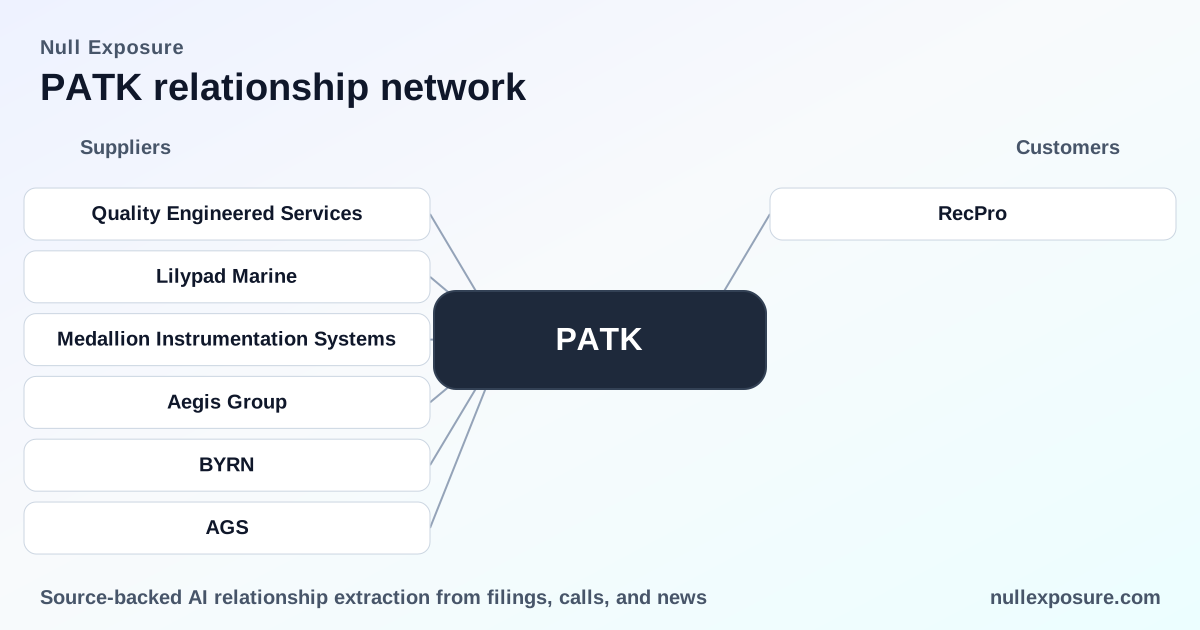
Patrick Industries (PATK): Customer Relationships, Channels, and Strategic Signals Investors Should Track
Patrick Industries manufactures and distributes component products for the recreational vehicle (RV), marine, manufactured housing and industrial markets, monetizing through two core segments: Manufacturing (≈74% of sales) and Distribution (≈26% of sales). Revenue derives from selling finished components to OEMs and a growing aftermarket/direct-to-consumer channel that captures higher margins and reduces cyclicality. Investors should evaluate how emerging customer channels and concentration dynamics affect margins, working capital and strategic optionality.
If you want a consolidated view of customer signals and relationship evidence for decision-making, visit https://nullexposure.com/ for deeper visibility.
Recent relationship signals investors need to know
Below are every customer-related result in the available coverage. Each item is presented in plain English with the original source cited.
RecPro — RVBusiness coverage of FY2026 aftermarket growth
Patrick reported more than 500 Patrick SKUs listed on the RecPro site and disclosed a 30% year-over-year increase in aftermarket sales, indicating meaningful traction in direct-to-consumer and aftermarket channels for FY2026. This expansion signals an explicit strategy to capture higher-margin, less cyclical revenue outside OEM production programs. Source: RVBusiness, March 10, 2026 — https://rvbusiness.com/patrick-sees-disciplined-q1-26-with-modest-uptick-in-q2-q3/
RecPro — SimplyWallSt analysis on diversification benefits
Analysts at SimplyWallSt highlighted that accelerated growth in the aftermarket segment, including DTC sales via RecPro and expanded SKUs, creates new, less cyclical revenue streams that help stabilize topline and margins relative to OEM exposure. The coverage frames RecPro as a structural de-risking lever for Patrick’s revenue profile. Source: SimplyWallSt, May 3, 2026 — https://simplywall.st/stocks/us/automobiles/nasdaq-patk/patrick-industries/news/assessing-patrick-industries-patk-valuation-as-recent-share
LII (LCI Industries) — M&A chatter and industry consolidation context
Coverage discussing a potential combination with LCI Industries notes that a merger would combine two established RV suppliers, concentrating scale in a consolidating supplier market and changing competitive dynamics across components and distribution. Investors should treat this as industry-level strategic optionality rather than a confirmed transaction. Source: SimplyWallSt, May 3, 2026 — https://simplywall.st/stocks/us/automobiles/nasdaq-patk/patrick-industries/news/potential-patrick-industries-lci-merger-and-what-it-means-fo/amp
RecPro — Q4 FY2025 / FY2026 earnings call transcript (InsiderMonkey)
In the Q4 earnings commentary, management reiterated that there are over 500 Patrick SKUs on the RecPro site across outdoor enthusiast markets, underscoring that the aftermarket/DTC channel is a deliberate and repeatable revenue stream, not a transitory experiment. Source: InsiderMonkey transcript, March 10, 2026 — https://www.insidermonkey.com/blog/patrick-industries-inc-nasdaqpatk-q4-2025-earnings-call-transcript-1690279/
How these relationships translate into the operating model and business constraints
Patrick’s customer and channel signals align with a specific set of company-level characteristics that drive risk and opportunity.
- Contracting posture: short-term revenue visibility. Patrick’s contracts generally result in cash collection within one year and the company does not treat significant financing components as part of its revenue recognition. This operational posture increases exposure to near-term demand swings but preserves working capital flexibility.
- Geographic concentration in North America. Operations and customers are primarily in the United States and Canada, supported by an extensive network of manufacturing and distribution facilities; this geography focus concentrates exposure to North American RV and housing cycles.
- Material customer concentration is meaningful. Two RV customers accounted for 29% of consolidated net sales in 2024; the loss or volume reduction from either would have a material impact on results. This is a structural concentration risk for investors.
- Dual role as manufacturer and distributor. Patrick operates as both a component manufacturer and a wholesale distributor, with manufacturing representing ~74% of sales and distribution ~26%, which gives the company margin diversification but increases integration complexity.
- Segment maturity and service scope. The business combines mature manufacturing operations with broad distribution logistics and aftermarket services; the result is scale in production plus rising digital DTC channels (e.g., RecPro) that lift margin optionality.
Each of these constraints is a company-level signal drawn from Patrick’s disclosures and public commentary; they should inform revenue sensitivity analyses and scenario modeling.
Investment implications — what to watch and why it matters
- Aftermarket/DTC is a high-conviction upside. The expansion to more than 500 SKUs on RecPro and reported 30% aftermarket growth are concrete indicators that Patrick is successfully converting core product lines into consumer-facing sales, which improves gross margin mix and reduces reliance on OEM order cycles.
- Concentration risk requires active monitoring. With two customers representing close to a third of sales, investor models should build in downside scenarios where OEM orders normalize or shift to competitors. Customer retention and pricing power with major OEMs are primary risk factors.
- M&A and consolidation change the competitive set. Talk of combining with LCI Industries changes industry structure; scaling through M&A would improve bargaining power with OEMs and raise synergies, but execution risk and integration costs are immediate concerns.
- Operational leverage is significant. Patrick’s large installed base of plants and distribution centers supports volume-driven margin expansion, but capital intensity and working capital swings will amplify cyclical revenue moves.
For a consolidated investor-grade view of Patrick’s customer relationships and how they feed valuation and risk assessment, explore more at https://nullexposure.com/.
Practical next steps for analysts and operators
- Stress-test models for a 15–30% OEM volume decline and offset with 20–40% growth in aftermarket/DTC to understand margin resilience.
- Track RecPro SKU growth and DTC conversion rates quarterly as a leading indicator of margin improvement.
- Monitor any formal M&A announcements involving LCI Industries as they will materially reshape competition and scale economics.
Conclusion: Patrick is executing a deliberate shift to diversify revenue through aftermarket and DTC channels while retaining a capital-intensive manufacturing and distribution backbone; this combination delivers upside through margin mix improvement but requires active surveillance of customer concentration and integration risk.