Paymentus (PAY): Customer Relationships, Revenue Model, and Strategic Partners
Paymentus operates a cloud-native bill-pay and payments orchestration platform that connects billers, consumers and third‑party payment channels. The company monetizes primarily through usage‑based transaction fees, supplemented by subscription and maintenance contracts, and scales via strategic partnerships that drive distribution and network effects. With roughly $1.20B in trailing revenue and a market capitalization near $3.6B, Paymentus presents a high‑growth payments infrastructure profile anchored in recurring flows and partner-led reach. For further context and data intelligence, visit NullExposure.
Thesis in one line
Paymentus is a SaaS payments enabler that converts biller volume into recurring, usage‑tied revenue and leverages distribution partners and integrations to expand network effects and cross‑channel payment access.
How Paymentus contracts and gets paid
Paymentus’s commercial model combines three characteristic elements: long‑dated commercial relationships, usage‑based economics, and a subscription/maintenance overlay. Company disclosures indicate initial customer contract terms are typically three to five years, and the bulk of revenue is generated as a fee per transaction (percentage or fixed fee) that aligns Paymentus’s revenue growth with biller volumes. The firm also records maintenance and subscription revenue as a secondary, steadier component of its go‑to‑market economics.
- Contracting posture: Predominantly multi‑year engagements that lock in platform access and the option to scale volumes over time.
- Revenue mix: Usage‑based transaction fees are the primary driver, with subscription/maintenance as a complement.
- Customer composition: Paymentus serves a wide spectrum — government, large enterprises, and small businesses — which supports diversified demand while keeping pricing tied to transaction activity.
- Concentration and scale: No single customer accounted for more than 10% of revenue through 2024, and the platform supported roughly 46 million consumers across ~2,500 biller clients, indicating breadth rather than customer concentration.
Why partners matter: distribution and criticality
Paymentus’s role is both principal in completing payments and a service provider delivering SaaS bill‑presentment and payment infrastructure. That dual role supports gross recognition of transaction revenue and positions the company as a critical vendor for non‑discretionary billers (utilities, government, insurance), where uptime and channel breadth are economically material.
For investors, this means Paymentus’s revenue is:
- Predictable at the contract level (multi‑year commitments and subscription fees), and
- Variable at scale (transaction volumes drive the majority of top‑line expansion), with partner integrations materially expanding reachable payment endpoints.
If you want a curated view of Paymentus’ commercial relationships and partner momentum, see NullExposure for ongoing monitoring and signal aggregation.
The partner and customer relationships reported in recent coverage
Below I cover each relationship flagged in the monitored coverage. Each item is a plain‑English take with a concise source note.
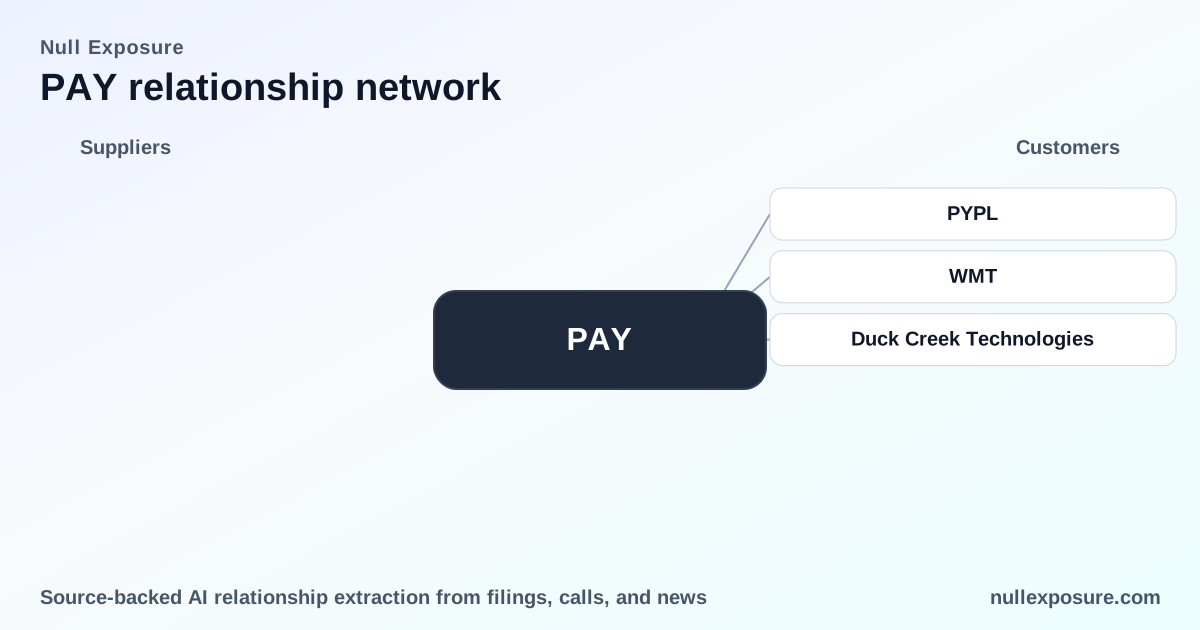
PayPal (PYPL)
Paymentus works with PayPal as a partner that expands payment choice for bill pay customers and enhances reach through PayPal’s consumer network. According to a Yahoo Finance article covering market reaction in March 2026, Paymentus “connects thousands of billers and partners like PayPal,” highlighting the strategic distribution value PayPal adds to Paymentus’s network effects. (Yahoo Finance, March 10, 2026)
Walmart
Walmart is cited as a distribution partner that broadens offline and omnichannel payment access for Paymentus billers, effectively increasing points of payment acceptance for consumers. The March 2026 Yahoo Finance piece named Walmart among partners that expand Paymentus’s reach and network effects. (Yahoo Finance, March 10, 2026)
WMT (duplicate Walmart listing)
The dataset also lists Walmart under its ticker symbol WMT, reflecting the same partnership: Paymentus integrates with large retail channels to capture consumer payment demand outside traditional bank rails, a capability markets flagged in the March 10, 2026 coverage. (Yahoo Finance, March 10, 2026)
Duck Creek Technologies (press release)
Duck Creek announced a formal integration with Paymentus to surface Paymentus services in Duck Creek’s Payments Marketplace, positioning Paymentus as a payments option embedded in insurance systems and partner ecosystems. Duck Creek’s February 4, 2025 press release on GlobeNewswire described the partnership as an integration aimed at simplifying adoption and bringing Paymentus into Duck Creek’s marketplace. (GlobeNewswire, February 4, 2025)
Duck Creek Technologies (industry write‑up)
Independent trade coverage confirmed Duck Creek’s partnership could bring “billions in payment volume” to the new Payments Marketplace, underscoring the potential volume uplift and channel leverage Paymentus gains through vertical software marketplaces. This analysis appeared in an industry piece on ReInsurance.News (reported subsequently). (ReInsurance.News, reporting on Duck Creek launch)
Implications for investors: constraints and strategic signals
The relationship and constraint evidence yields a compact set of investment‑relevant signals:
- Contract maturity and stickiness: Multi‑year contracts (typically three to five years) provide revenue visibility and reduce churn exposure. This is a company‑level characteristic reported in corporate disclosures.
- Variable‑income growth engine: The firm’s economic sensitivity is to transaction volume because the majority of revenue is usage‑based; scaling biller throughput directly scales top line.
- Diversified counterparty base: Paymentus serves government, large enterprises and small businesses across multiple verticals, which reduces single‑counterparty concentration (no customer >10% revenue).
- Geographic posture: The business is global in reach but U.S.‑centric in revenue contribution; the U.S. segment accounts for the vast majority of net sales and gross profit.
- Role and recognition: Paymentus operates as both a seller/merchant of payment services (recognized as principal for transactions) and a service provider via SaaS, which affects revenue recognition and margin dynamics.
Risk checklist and monitoring priorities
- Volume sensitivity: Usage‑based revenue implies susceptibility to macro‑driven payment volume changes.
- Partner execution: Integration with large channels (e.g., PayPal, Walmart, Duck Creek) is a growth hinge; partner adoption speed and contractual terms drive future throughput.
- Operational criticality: Serving non‑discretionary billers raises the bar for uptime and compliance, making product reliability and margin on payments both strategic and operational risks.
Bottom line
Paymentus’s model converts biller relationships and partner distribution into recurring, usage‑tied revenue with network effects from large payments partners and vertical software marketplaces. For investors tracking customer relationships, the most important signals are the volume leverage of usage fees, the multi‑year contract backbone, and partner integrations that materially expand addressable payment endpoints.
For ongoing signal tracking and relationship analytics on Paymentus and its partners, explore NullExposure for curated coverage.