Payoneer’s Enterprise Partnerships: Who Pays the Bills and Why It Matters
Payoneer operates a global cross-border payments and commerce platform that monetizes primarily through transaction and processing fees, value-added services (working capital, multicurrency accounts), and commercial partnerships with large marketplaces and platforms. Enterprise relationships—marketplaces, commerce platforms, and select retailers—both drive volume and concentrate revenue, while strategic technology tie-ups expand settlement rails and product scope. Investors should view Payoneer as a payments infrastructure company that balances a broad SMB base with a handful of high-material customers and platform partnerships that shape revenue volatility and margin upside. For a deeper look at Payoneer’s customer exposures and implications for credit and growth, visit https://nullexposure.com/.
The strategic frame: network economics and concentration in practice
Payoneer is a two-sided payments network serving buyers, suppliers, marketplaces and marketplace sellers through accounts receivable and payable capabilities and technology-driven services. The company reported approximately 2 million active customers and over 500,000 customers that fit its ideal profile, underscoring scale and monetization potential through repeat volume. Payoneer’s cross-border reach—supporting customers in more than 190 countries—creates meaningful operational complexity and regulatory surface area while enabling price leverage in FX and settlement services.
At the portfolio level, concentration risk is real: Payoneer disclosed that payments received from Amazon marketplaces generated 23% of revenue in FY2024, a single-counterparty share that investors must monitor closely alongside efforts to diversify through enterprise partnerships. Payoneer’s operating model targets customers who process materially through the platform (the company calls out a focus on customers processing at least $10,000 per month) which positions the firm between high-volume SMBs and mid-market buyers/sellers—a profile that supports recurring fee revenue but concentrates counterparty exposure.
Who Payoneer named in Q4 2025 — the enterprise roster and what it signals
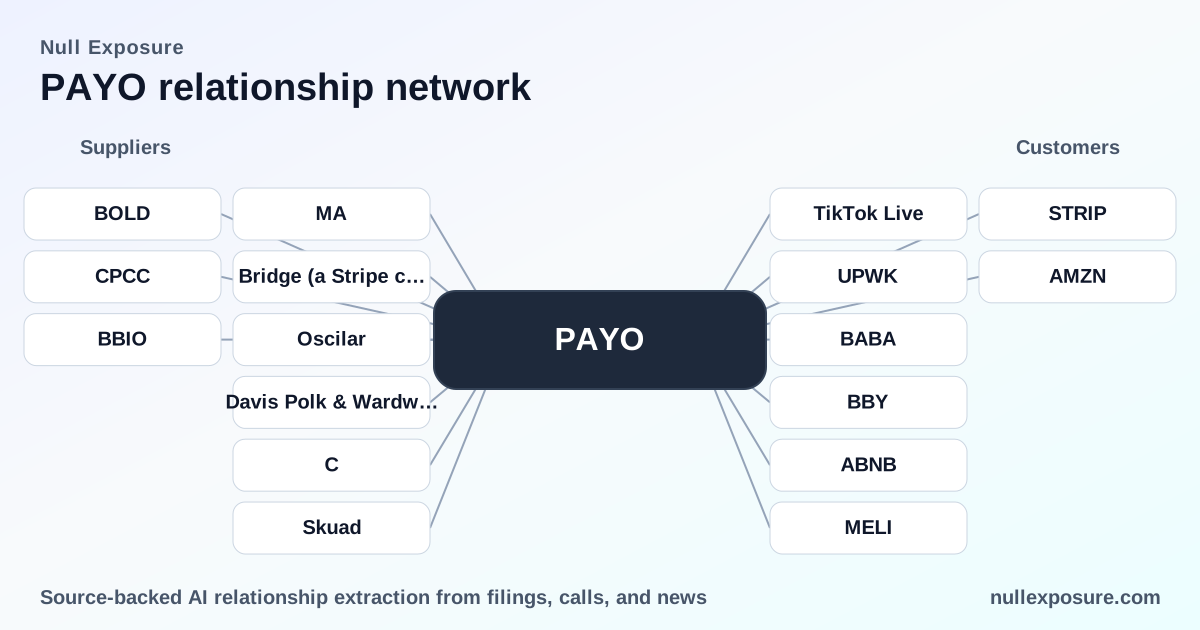
Payoneer’s 2025 Q4 commentary highlighted a group of enterprise relationships that serve as both revenue channels and marketing distribution for its SMB-focused stack. Below I summarize each named relationship and its source.
Amazon — the revenue anchor
Payoneer reported that payments our customers received from Amazon marketplaces around the world generated 23% of revenues during the year ended December 31, 2024, making Amazon a material single-source revenue driver for the company. This disclosure comes from Payoneer’s FY2024 Form 10‑K. (FY2024 10‑K)
Airbnb (ABNB) — marketplace distribution for service providers
Management stated that Payoneer strengthened and expanded relationships with Airbnb alongside other platforms in its 2025 Q4 earnings call, positioning Airbnb as a distribution channel to travel-related sellers and service providers. The mention is recorded in the company’s 2025 Q4 earnings call (March 7, 2026). (2025 Q4 earnings call)
Upwork (UPWK) — access to freelance payment flows
Payoneer listed Upwork among expanded enterprise relationships in the 2025 Q4 earnings call, which aligns with Payoneer’s strategy to capture gig‑economy payouts and monetize cross-border freelancer flows. (2025 Q4 earnings call)
TikTok Live — engagement with creator monetization
TikTok Live was specifically named as part of the expanded enterprise ecosystem in the 2025 Q4 earnings call, signaling Payoneer’s push into creator and live-stream payments where fast settlement and payout rails matter. (2025 Q4 earnings call)
Alibaba (BABA) — marketplace scale in APAC corridors
Payoneer included Alibaba in its list of strengthened enterprise relationships during the 2025 Q4 earnings call, reinforcing Payoneer’s exposure to large APAC marketplace flows that complement its Greater China revenue exposure. (2025 Q4 earnings call)
Mercado Libre (MELI) — LatAm marketplace access
Mercado Libre was called out in the 2025 Q4 earnings call as an enterprise partner, reflecting Payoneer’s role in Latin American marketplace settlement and seller payouts. (2025 Q4 earnings call)
Best Buy (BBY) — retail/merchant channel
Best Buy featured among the enterprise relationships management cited in the 2025 Q4 earnings call, indicating Payoneer’s engagement with large retail partners beyond pure marketplaces. (2025 Q4 earnings call)
Stripe / Bridge (listed as STRIP) — stablecoin and settlement innovation
Payoneer announced a partnership with Bridge, a Stripe company, to launch stablecoin capabilities, a strategic technology and rails initiative disclosed on the 2025 Q4 earnings call that expands how Payoneer can settle cross-border flows. (2025 Q4 earnings call)
What the company-level constraints tell investors about operating posture
- Customer mix and contracting posture: Payoneer is purpose-built for SMBs and mid-market customers, with an explicit focus on those processing at least $10,000 per month; this indicates contracts skew toward recurring, volume-based fee structures rather than large bespoke enterprise contracts.
- Geographic footprint and concentration: The business is global (customers in 190+ countries) with material exposure to Greater China (about 35% of revenue in 2024), which amplifies regulatory and macro sensitivity while offering large growth corridors.
- Role and criticality: Payoneer functions as a service provider and facilitator for both buyers and sellers on marketplaces—the company’s stack provides AR/AP, multicurrency accounts, working capital, and tech delivery through web, mobile and APIs, making it operationally critical to many SMB clients.
- Maturity and stage: With ~2 million active customers and established marketplace relationships, Payoneer sits in a mature growth phase where margin expansion and revenue diversification (beyond dominant channel partners) are central to investor returns.
- Spend profile: The firm signals a preference for higher-volume customers, aligning GTM for higher lifetime value but also concentrating exposure to fewer, larger flows.
Investment implications — risks and levers to watch
- Concentration vs. diversification: The Amazon 23% revenue share creates a clear downside lever; enterprise expansions (Airbnb, Alibaba, Upwork, Mercado Libre, Best Buy, TikTok Live) and the Stripe/Bridge rails initiative act as diversification levers that improve resilience and margin mix over time. (FY2024 10‑K; 2025 Q4 earnings call)
- Product and rails innovation: The Bridge/Stripe stablecoin partnership is an operationally important strategic initiative that could lower settlement costs and accelerate cross-border payouts if executed, altering unit economics. (2025 Q4 earnings call)
- Geopolitical and regulatory exposure: Heavy exposure to Greater China and broad global operations increase regulatory and FX risk; monitoring regional revenue trends and compliance costs is essential.
- Customer composition: The SMB emphasis supports predictable transaction volumes, but the targeted spend band suggests Payoneer’s growth depends on upgrading SMBs to higher-volume profiles and continuing marketplace integrations.
Explore more company-level customer intelligence and sector comparisons at https://nullexposure.com/.
Bold takeaway: Payoneer monetizes a two-sided global payments footprint that combines a broad SMB base with a small set of highly material marketplace partners; revenue concentration (notably Amazon) is the principal risk, while enterprise platform wins and new settlement rails are the primary levers for durable margin and revenue diversification.