Paychex (PAYX) — Customer Relationships, Commercial Footprint, and What It Means for Investors
Paychex provides payroll, HR and benefits outsourcing primarily to U.S. small- and medium-sized businesses and monetizes through a hybrid model of SaaS subscriptions (Paychex Flex, SurePayroll), recurring services (ASO, PEO, HR outsourcing), and cash-management flows tied to payroll tax administration. The company’s economics blend high-margin software revenue with steady services income and short-duration client contracts that drive predictable, subscription-like revenue but leave exposure to near-term churn. For a concise investor dossier on customer links and commercial constraints, read on. If you want an at-a-glance view of our coverage, visit https://nullexposure.com/.
Why customer relationships define Paychex’s earnings profile
Paychex’s revenue mix is driven by two complementary channels: software subscription products that scale ARPU and services that generate steady fee income and working-capital benefits (funds collected for payroll and taxes). The company discloses that most contracts do not have fixed terms and are terminable on 30 days’ notice, which translates to a contracting posture that is commercially flexible for clients but operationally requires continuous client service and retention investment. Paychex serves predominantly U.S. clients (substantially all revenue is U.S.-based), with modest EMEA exposure and operations support in India — a footprint that concentrates geopolitical and regulatory risk in North America while retaining low-cost delivery capability offshore.
Key commercial constraints and what they mean for investors
- Short-term, cancellable agreements: Management states that client agreements “generally do not contain specified contract periods and may be terminated by either party with 30-days’ notice of termination.” That structure creates ongoing exposure to monthly churn and makes retention metrics central to revenue stability.
- Subscription-first product posture: The company markets Paychex Flex and SurePayroll as SaaS offerings, aligning its incentives with recurring revenue growth and platform adoption rather than large one-time professional fees.
- Customer concentration is low: Paychex discloses no single client had a material effect on accounts receivable or service revenue for recent fiscal years, which reduces counterparty concentration risk.
- Geographic concentration in North America: Substantially all revenue is generated in the U.S.; Europe contributes roughly 1% and operations exist in India. This reinforces U.S. market exposure as the dominant macro sensitivity.
- Segment balance — services plus software: The business mixes high-touch services (ASO, PEO, payroll administration) with software subscriptions, so margin dynamics are a function of both scale in software and efficiency in service delivery.
- Mature relationships with high retention: Reported client retention for Paychex clients was in the 82–83% range for fiscal 2025, signaling durable book economics once clients are onboarded.
These constraints are company-level signals except where explicitly named (for example, Paycor is referenced by management as a primary SaaS-based HCM platform for larger businesses).
The relationship map — every customer mention in the available results
Below are concise, source-backed summaries of each relationship referenced in the collected results.
-
BILL
Bill has executed agreements with major ERP and HR platforms, including Paychex, that are positioned as channel and integration partnerships to expand Bill’s payments reach. According to Payments Dive (May 2, 2026), Bill highlighted agreements with Paychex, Acumatica and Oracle NetSuite as evidence of increased market interest. (https://www.paymentsdive.com/news/bill-open-to-ma-deals-ceo-says-saas-software-activist-investors/813750/) -
Paycor (Paycor / PYCR)
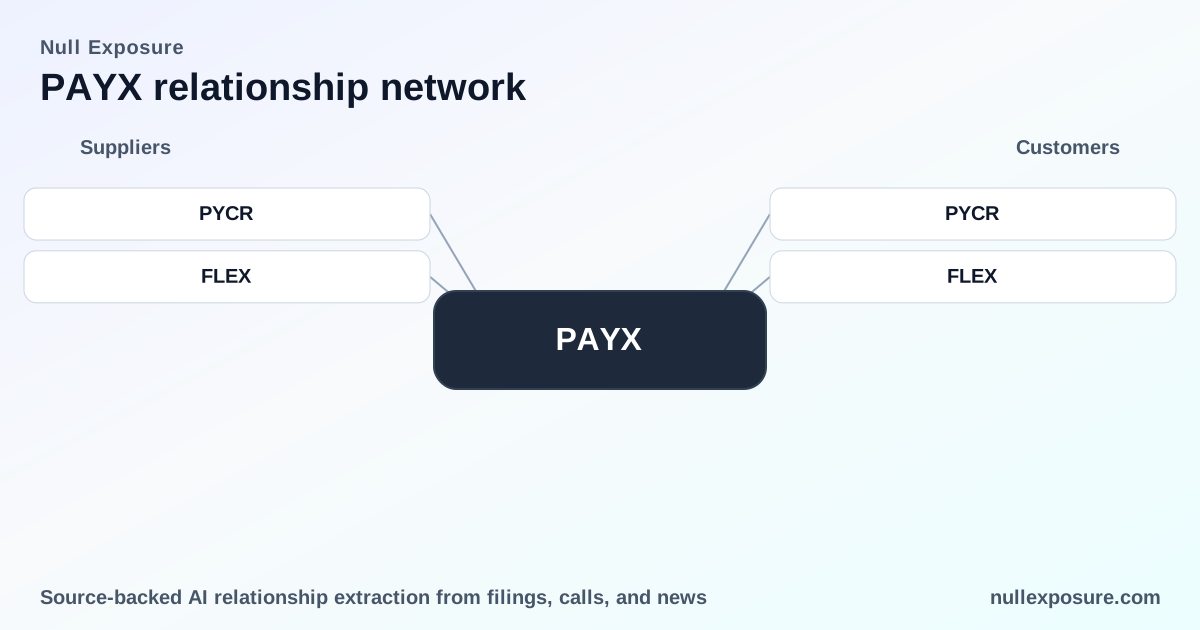
Paychex rolled out AI-driven workforce management tools that are explicitly positioned for integration with Paycor’s platform, signaling product-level cooperation or interoperability that enhances Paychex’s addressable market in larger HCM deployments. Finviz reported on March 9, 2026 that Paychex unveiled AI-driven workforce management tools for Paycor (ticker PYCR) and other platforms. (https://finviz.com/news/329588/5-large-cap-fintech-stocks-to-buy-to-tap-huge-near-term-upside) -
PYCR (duplicate listing of Paycor)
The news entry listed Paychex and PYCR separately; the substance is identical: Paychex’s AI-driven workforce management tools are marketed for Paycor’s platform, indicating product integration and an outreach strategy into Paycor’s customer base. Finviz (Mar 9, 2026) provides the coverage. (https://finviz.com/news/329588/5-large-cap-fintech-stocks-to-buy-to-tap-huge-near-term-upside) -
Flex
Paychex is actively positioning its Paychex Flex platform as the recipient of new AI-driven workforce management capabilities, and the March 2026 coverage describes those tools as targeted to both Paycor and Flex platforms — suggesting Paychex is layering AI features across its own SaaS backbone and partner integrations. Finviz’s March 9, 2026 piece documents this product rollout. (https://finviz.com/news/329588/5-large-cap-fintech-stocks-to-buy-to-tap-huge-near-term-upside)
Bottom line on relationships: the set of results emphasizes integrations and product-level alliances rather than single large, revenue-driving customers; Paychex’s approach is platform-first with external partnerships to broaden distribution and functionality.
What these relationships imply for growth and risk
- Growth vector: AI-driven enhancements and channel integrations (Paycor, Bill, Flex) support improved ARPU and upsell — especially where Paychex can convert integrations into active subscribers on Paychex Flex or forward higher-margin services.
- Operational risk: Short-term contract language and modest contractual lock-in increase sensitivity to service quality and competitor promotions. Continuous investment in product and client success is required to sustain retention above the 80%+ band.
- Concentration and counterparty risk: The company’s disclosures that no single client is material validate a diversified client base, which dampens idiosyncratic counterparty risk even as the business leans heavily on the U.S. market.
If you want a deeper reconciliation of Paychex’s customer disclosures against public filings and news flow, visit https://nullexposure.com/ for our research portal.
Investment takeaways and risk checklist
- Thesis: Paychex converts scale in payroll and HR services into recurring, subscription-like cash flows while monetizing working-capital positions tied to payroll tax administration. The company’s growth runway runs through product enhancements (AI) and integrations with other HR/ERP platforms.
- Key upside: Higher ARPU from AI-enabled features and expanded integrations; operating leverage as software mix grows.
- Key risks: Contractual cancellability (30-day termination), U.S.-centric revenue exposure, and the execution requirement to keep retention above historical bands.
For investors evaluating Paychex, the relationships highlighted here point to a platform-led commercial strategy with low counterparty concentration but elevated churn-sensitivity. For ongoing coverage and datasets that map customer linkages to filings and news, check our research hub at https://nullexposure.com/.
Conclusion: Paychex’s customer relationships are broadly diversified and partnership-oriented; the firm’s near-term performance will be driven by retention stability and success converting integrations (Paycor, Flex, Bill) into higher-value, retained subscribers with rising ARPU.