Prosperity Bancshares (PB): Customer Relationships and What They Mean for Investors
Prosperity Bancshares is a Texas‑based regional bank holding company that earns the bulk of its revenue by transforming customer deposits into interest‑bearing loans and collecting fees for ancillary services (trust, mortgage, brokerage, card sponsorship). The business model is classic community/regional banking: deposit funding, a diversified loan book spanning consumer, commercial and mortgage products, and fee income from mortgage and fiduciary services. For investors, the important signal is scale plus operating leverage—deposits are the primary funding source and loans/securities are the primary uses of funds, creating direct sensitivity to net interest margin, credit mix and local economic cycles. For a consolidated view of Prosperity’s customer relationships, see the NullExposure coverage at https://nullexposure.com/.
How Prosperity converts customer relationships into earnings
Prosperity monetizes relationships across three vectors: (1) interest spread on loans funded by deposit balances, (2) fee income from mortgage lending, trust and brokerage services, and (3) scale benefits from branch density across Texas and Oklahoma. The company’s publicly reported metrics show a profitable franchise with a trailing P/E around 12.6, a high profit margin and a return on equity that reflects a mix of stable core earnings and regional credit exposure. Deposits are the balance sheet center of gravity, and loan composition—consumer versus commercial versus mortgage—drives earnings volatility and capital consumption.
A pragmatic next step for analysts is to cross‑reference Prosperity’s relationship map to quantify deposit and loan flows; a summary relationship view is available at NullExposure: https://nullexposure.com/.
Recent customer‑level development investors should note
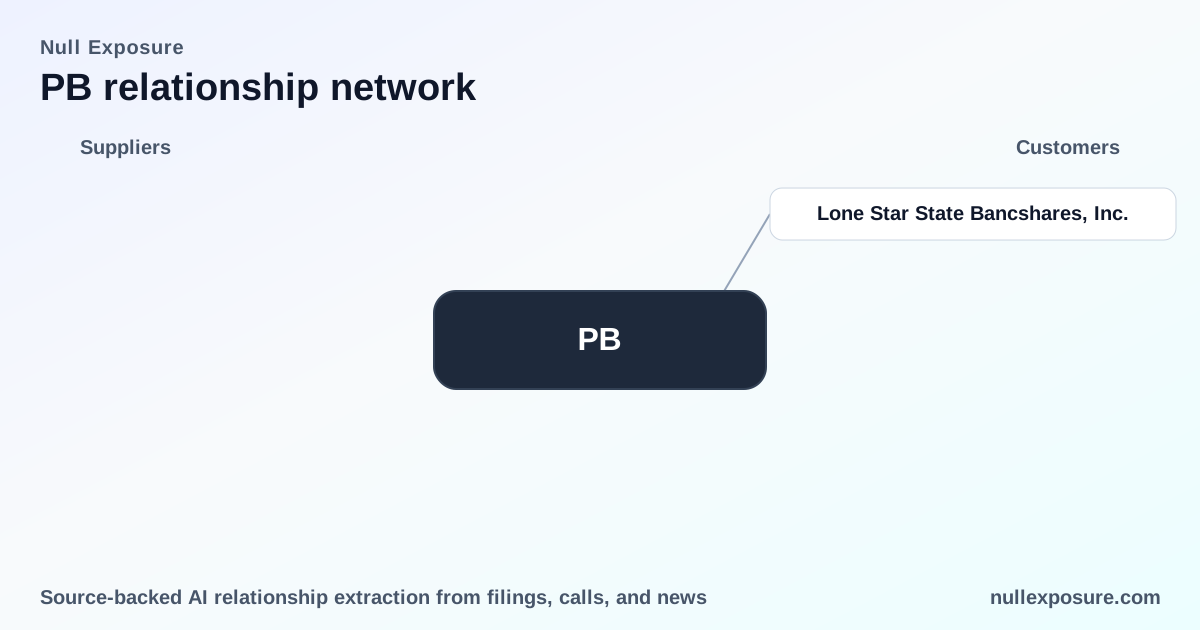
Lone Star State Bancshares, Inc. — an acquisition that expands the customer base
Prosperity announced it received regulatory and shareholder approvals to acquire Lone Star State Bancshares, bringing Lone Star customers and staff into Prosperity Bank “in several weeks,” according to a LubbockOnline report published March 21, 2024; CEO David Zalman was quoted welcoming the integration. This transaction is explicitly customer‑facing and will add retail and commercial deposit relationships in the Lubbock market. (Source: LubbockOnline, March 21, 2024.)
The operating constraints and what they tell investors about customer risk and revenue durability
Prosperity’s public disclosures and filings surface several consistent operating characteristics that shape customer relationships and revenue predictability. Treat these as company‑level signals that explain why certain customer relationships are valuable and where risk concentrates:
- Contract maturity profile is mixed but mortgage exposure is long‑dated. The bank’s mortgage portfolio generally amortizes over five to 30 years, which creates long‑duration credit exposure and potential sensitivity of interest income to duration mismatches. (Company disclosures.)
- Short-term funding and warehouse activity are also material. Individual mortgage loans are often warehoused for brief periods (averaging less than 30 days), and the bank makes a substantial number of short‑ to medium‑term commercial loans used for working capital and equipment. This combination implies active balance sheet turnover in certain segments and operational emphasis on pipeline management. (Company disclosures.)
- Customer base skews toward individuals and local businesses. Prosperity explicitly serves individual consumers and businesses throughout Texas and Oklahoma, with product offerings ranging from A‑credit auto loans to agriculture financing—this produces a retail‑heavy deposit base and localized credit concentration. (Company disclosures.)
- Geographic concentration is regional—Texas and Oklahoma. Branch density (over 280 full‑service centers reported) and loan originations are principally in these states, making local economic conditions a direct business driver. (Company disclosures.)
- Deposit funding is critical to the franchise. The firm states deposits are its largest source of funds and loans/securities are the main uses, establishing deposit retention and acquisition as primary strategic objectives. (Company disclosures.)
- The bank acts as a service provider across multiple segments. Prosperity earns non‑interest revenue from mortgage origination, trust and brokerage services, credit card sponsorship and brokered services, which improves earnings diversity beyond pure interest spread. (Company disclosures.)
- Customer relationships are active and operationally embedded. The bank records hundreds of thousands of deposit accounts and tens of thousands of loan accounts, and it regularly enters into interest rate lock commitments with mortgage consumers—evidence of an active, ongoing customer base. (Company disclosures.)
- Middle‑market commercial exposure size is material to underwriting workflow. Loans where aggregate borrower relationships exceed $1.0M but are below $5.0M are subject to senior credit officer review, implying a meaningful spend band where credit decisioning is centralized and risk is monitored closely. (Company disclosures.)
Why the Lone Star integration matters in context
The Lone Star acquisition is not merely a deal headline; it is a discrete customer relationship transfer that aligns with Prosperity’s strategy of regional consolidation. Adding Lone Star customers will increase deposit stores and advance branch density in Lubbock, directly supporting the company’s top‑line deposit growth objective and potentially lowering marginal funding costs through scale. Integration success will determine whether the deal contributes to durable loan growth and deposit stickiness or creates short‑term integration costs and attrition. (Source: LubbockOnline, March 21, 2024.)
Investment implications — what to watch and the risk framework
- Earnings sensitivity: Given the funding/loan structure, Prosperity’s net interest income reacts to both rate moves and local loan demand; monitor margin compression risk if deposit costs rise or if loan yields reprice slower than funding.
- Credit mix risk: The mix of long‑duration mortgages and short‑term commercial loans creates asymmetric credit cycles—mortgage duration raises interest‑rate risk while commercial loans increase cyclical credit exposure.
- Concentration risk: Geographic concentration in Texas and Oklahoma amplifies exposure to regional economic shocks (energy, agriculture, commercial real estate).
- Deal execution: Acquisitions such as Lone Star provide growth but bring integration and retention risk; deposit retention post‑close is the key early metric.
- Operational leverage: Fee businesses (mortgage, trust, brokerage, card sponsorship) offer diversification and margin benefit if mortgage origination volumes and asset‑management flows remain stable.
Key takeaway: Prosperity’s customer franchise is valuable because deposits are large and loan pipelines diverse, but geographic concentration and the mixed maturity profile of the loan book create acute sensitivity to local economic cycles and interest‑rate dynamics.
Bottom line and actions for analysts
For investors and credit analysts, the recommended focus is twofold: measure deposit retention and cost after each acquisition (starting with Lone Star) and track loan mix evolution between long‑duration mortgage exposure and short‑term commercial lending. Those metrics will reveal whether Prosperity is expanding durable core relationships or merely increasing short‑lived balances. For a curated, relationship‑level view of Prosperity’s customers and recent deal activity, consult the NullExposure coverage at https://nullexposure.com/.
Overall, Prosperity Bancshares operates a stable regional banking franchise with critical dependence on deposits and diversified revenue streams, and the Lone Star transaction is a clear extension of that strategy rather than a strategic pivot. (Sources: company disclosures; LubbockOnline, March 21, 2024.)