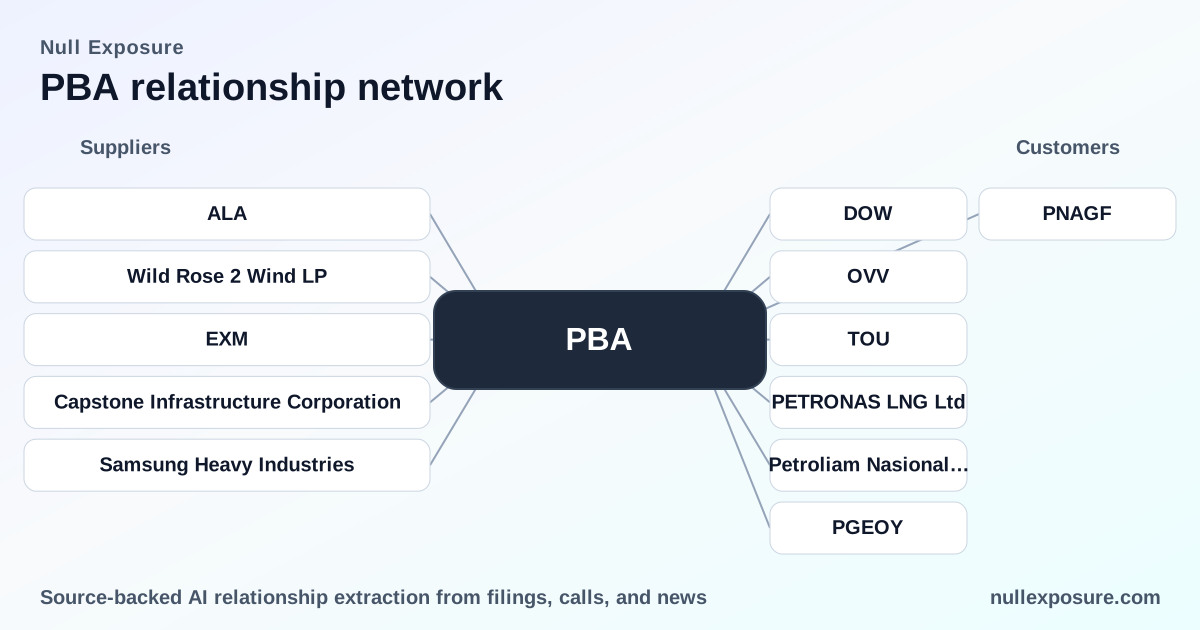
Pembina Pipeline (PBA): customer map and commercial implications for investors
Pembina operates as a midstream energy platform that monetizes through long-term transportation, processing and liquefaction contracts, often under synthetic liquefaction or take‑or‑pay structures tied to its Cedar LNG and broader pipeline network. The company converts capital‑intensive infrastructure into predictable cash flows by remarketing capacity and signing multi‑year offtake or service agreements with major producers and international buyers. For a concise, data‑driven look at counterparties and contractual posture, visit https://nullexposure.com/.
The commercial model in plain English
Pembina’s business is infrastructure-led and contract-driven: it builds and operates pipelines, gas processing and liquefaction capacity, then secures long-term service arrangements that produce stable revenue streams. The firm’s use of synthetic liquefaction service structures and take‑or‑pay terms pushes cash‑flow risk to counterparties and supports capital recovery over multi‑decade horizons. That contracting posture implies high revenue visibility but concentrated counterparty and project execution risk — key considerations for valuation and credit analysis.
Deal-by-deal: the customer relationships that matter
Below are the counterparties surfaced in the company’s recent disclosures and markets coverage, summarized in plain language with source citations.
Ovintiv (OVV)
Pembina signed a 12‑year agreement to provide transportation and liquefaction capacity enabling Ovintiv to export 0.5 mtpa from Cedar LNG, part of the remarketing of Pembina’s 1.5 mtpa stake. This is a material long‑tenor commercial arrangement that converts capacity into a predictable revenue stream. According to Offshore‑Energy and corroborating coverage in late 2025/early 2026, the contract begins with Cedar LNG commercial operations anticipated in late 2028 (Offshore‑Energy, Mar 2026).
PETRONAS / Petronas LNG Ltd (PNAGF / PGEOY references)
Pembina completed a 20‑year synthetic liquefaction service agreement for 1.0 mtpa with Petronas, under which Pembina supplies transportation and liquefaction capacity and Petronas takes long‑term service. The structure yields stable, take‑or‑pay style revenue with potential for incremental upside. This deal was disclosed in Pembina’s remarketing update and reported in Rigzone and Euro‑Petrole in December 2025/Mar 2026 (Rigzone, Dec 2025; Euro‑Petrole, Mar 2026).
Tourmaline (TOU)
Management explicitly described an extended partnership with Tourmaline, identifying the producer as one of Pembina’s largest customers across Western Canada. That positioning underscores the importance of large domestic producers to midstream throughput volumes and fee revenue. The comment originates from Pembina’s Q4 2025 earnings call (Pembina Q4 2025 earnings call).
Dow (DOW)
Dow is referenced in Pembina’s Q4 2025 call in connection with Path2Zero project timelines (Phase 1 by year‑end 2029, Phase 2 by year‑end 2030), signaling Pembina’s dialogue with industrial counterparties on decarbonization timelines and infrastructure coordination. The mention is procedural but indicates Pembina’s exposure to industrial timelines and third‑party project schedules (Pembina Q4 2025 earnings call).
Canadian Natural Resources (CNQ)
A historical entry in the news file recalls Pembina’s 2006 investment posture — budgeting C$290 million for pipeline additions to serve the Horizon oil sands project — illustrating the company’s longstanding strategy of locking in long‑life oil sands and heavy crude transport opportunities. This item comes from a 2005 Petroleum News report that documents Pembina’s historical project execution (Petroleum News, Sept 2005).
Syncrude Canada
Pembina’s past projects have included pipeline loops built to carry Syncrude synthetic crude, reflecting the company’s role as a contracted transporter for large bitumen and synthetic crude producers. The reference is part of the same 2005 Petroleum News coverage and serves as a historical reminder of Pembina’s legacy customer base in oilsands logistics (Petroleum News, Sept 2005).
What the relationship map tells investors
-
Contract tenor and revenue quality: The Cedar LNG agreements — 20 years with Petronas and 12 years with Ovintiv — confirm Pembina’s preference for long‑dated, take‑or‑pay or synthetic service contracts that stabilize cash flow and support balance‑sheet financing. Those contract structures materially de‑risk near‑term revenue volatility.
-
Concentration and counterparty mix: A small set of large counterparties (international buyers like Petronas, large Canadian producers such as Ovintiv and Tourmaline) dominate the commercial picture; this creates concentration risk even as individual contracts are credit‑anchored. Investors should trade off high cash‑flow visibility against single‑project execution and counterparty credit exposure.
-
Project execution and timing risk: Cedar LNG’s commercial operations, referenced across earnings commentary and trade press, are anticipated to begin in the late‑2028 window; slippage or commissioning issues would shift expected cash flows and remarketing value.
-
Strategic positioning on decarbonization: Mentions of industrial programs — for example, Dow’s Path2Zero timeline cited in the earnings call — signal that Pembina engages with customers on low‑carbon project schedules. That creates optionality for future service revenue tied to carbon capture, hydrogen, or electrified LNG circuits, but also ties value creation to third‑party project delivery.
Quick investor checklist
- Monitor Cedar LNG commissioning milestones and first‑commercial‑gas notices; project timing drives revenue realization from these long‑term contracts.
- Track credit signals from major counterparties (Petronas, Ovintiv, Tourmaline) because take‑or‑pay economics transfer cash‑flow risk to customers.
- Watch for additional remarketing or re‑allocations of capacity that would change Pembina’s contracted utilization and upside potential.
Final take
Pembina’s customer relationships are strategically large, contractually long, and commercially defensive: the firm converts infrastructure ownership into predictable cash flows through synthetic liquefaction and long‑dated transport contracts. That profile supports valuation stability but concentrates sensitivity around a handful of major counterparties and the Cedar LNG execution timeline. For ongoing monitoring and a full relational feed, explore the Pembina coverage hub at https://nullexposure.com/.
Sources referenced above include Pembina’s Q4 2025 earnings call and trade coverage in Offshore‑Energy, Rigzone, Euro‑Petrole, Boereport and Petroleum News (Dec 2025–Mar 2026 and earlier archival reporting).