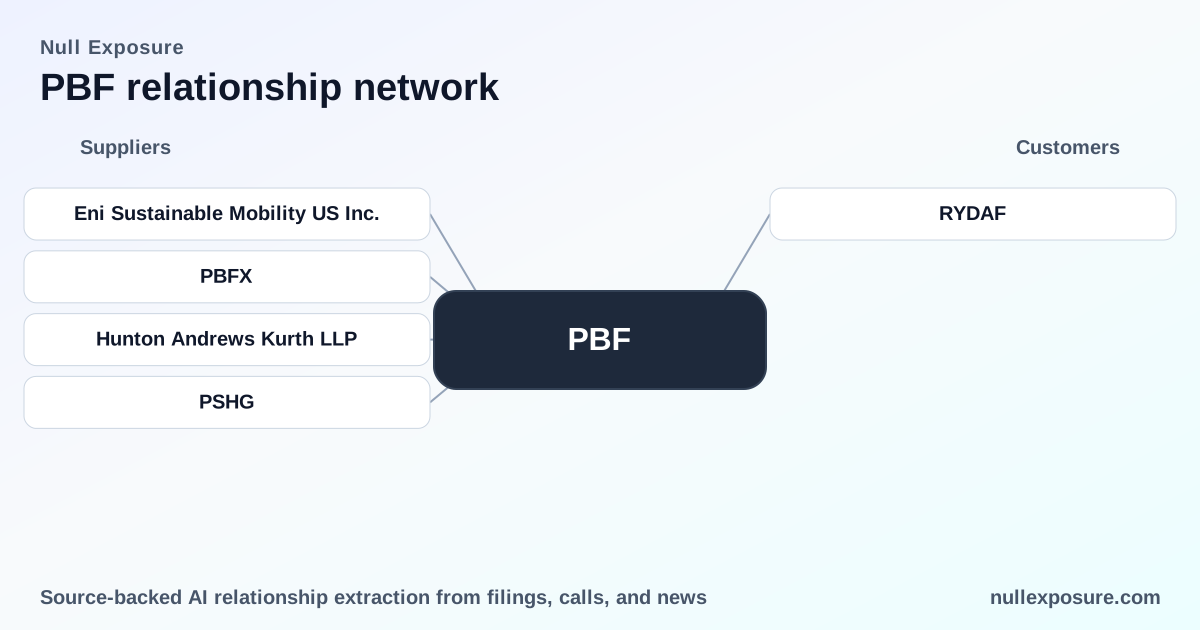
PBF Energy: customer relationships, operating posture, and what investors should know
PBF Energy is a downstream refiner and logistics operator that monetizes through the sale of refined petroleum products and fee-based logistics services tied to its terminals and pipelines. The company earns refining margin-based revenue from product sales and generates recurring, fee-for-service cash flows from its logistics segment, with a meaningful portion of commercial exposure concentrated in a small number of large counterparties. For investors evaluating counterparty risk and operational durability, the customer disclosures in PBF’s 2025 Form 10‑K are the primary guideposts. For a concise view of these relationships and enterprise-level constraints, visit https://nullexposure.com/.
A straightforward customer picture: concentration around a single large counterparty
PBF’s customer disclosures are notable for their simplicity: only one customer—Shell plc—accounted for 10% or more of revenues in both FY2025 and FY2024, at approximately 13% each year. That concentration is material from a counterparty-risk perspective because it compresses revenue exposure into a small set of industrial offtakes, even though the firm sells broadly across regional markets. According to PBF’s 2025 Form 10‑K, the company reported this concentration directly in its annual filing (Form 10‑K, filed Feb 2026).
Relationship rundown — the specific counterparties in the record
Shell plc
PBF’s 2025 Form 10‑K identifies Shell plc as the sole customer that represented 10% or more of revenues, contributing roughly 13% of total revenue in both FY2025 and FY2024. This makes Shell a clearly high-profile, high-concentration commercial partner for the period covered. (Source: PBF 2025 Form 10‑K, filing referencing FY2025 revenue concentration.)
RYDAF
The disclosure set returned a second record labeled RYDAF tied to the same 10‑K excerpt; the underlying text in the filing names Shell plc as the only >10% customer. Treat the RYDAF entry as an indexed reference point in the records, with the substantive customer identified in the public filing being Shell plc. (Source: PBF 2025 Form 10‑K; record first indexed Feb 14, 2026.)
What the contract language and segment descriptions tell investors
PBF’s public filings provide several operating-model signals that affect how investors should view customer risk, revenue stability, and cash-flow quality:
- Long‑term fee-based logistics contracts exist at the PBFX level (PBFX receives, handles, stores and transfers crude and refined products under agreements that include minimum volume commitments). This indicates a contractual backbone to the logistics cash flows separate from spot product margin volatility. (Company-level disclosure in the 2025 Form 10‑K.)
- Geographic footprint is overwhelmingly U.S.-centric, with operations and sales across the Northeast, Midwest, Gulf Coast and West Coast and commercial access to Canada, Mexico and other international destinations; regulatory obligations such as RINs are tied to domestic shipments. This regional concentration increases exposure to U.S. fuel regulatory regimes and seasonal demand cycles. (Company-level disclosure in the 2025 Form 10‑K.)
- Materiality signal for PBFX services is limited: PBFX currently does not generate significant third‑party revenues and intersegment related-party revenues are eliminated on consolidation, which frames PBFX as primarily captive to PBF affiliates rather than a major standalone third‑party revenue generator. (Company-level disclosure in the 2025 Form 10‑K.)
- Dual commercial roles exist across the enterprise: PBF operates as a product seller in its Refining segment and as a service provider in its Logistics segment—marketing refined products to various customers on the spot market or through term agreements while charging fee-based terminaling, storage and pipeline fees for logistics services. This hybrid model blends margin exposure from product sales with more predictable logistics fee income. (Company-level disclosure in the 2025 Form 10‑K.)
- Segment definitions confirm core manufacturing and services: the Refining segment handles production of transportation fuels, heating oil, petrochemical feedstocks and lubricants, while the Logistics segment monetizes terminaling, storage and transport capacity under fee structures that often include minimum volume commitments. This structure explains how the company balances cyclical refining margins with contracted throughput revenue. (Company-level disclosure in the 2025 Form 10‑K.)
How these facts translate to investment considerations
- Concentration risk is real but manageable if counterparty credit is strong. Shell’s 13% revenue share is meaningful; investors should treat Shell exposure as a concentration risk that is mitigated in part by Shell’s credit profile and PBF’s ability to reallocate volumes on the spot market when necessary. The logistics contracts with minimum volumes provide an additional buffer to downside volatility in throughput.
- Cash-flow mix matters. The combination of cyclical refining margins and fee-based logistics services creates a dual risk-return profile: refining margins drive short-term earnings swings, while logistics contracts smooth cash flow and support leverage metrics through minimum commitments.
- Geography and regulation drive near-term variability. U.S.-centric operations mean PBF is directly exposed to U.S. fuel regulations (e.g., RINs) and regional demand patterns; investors should monitor regulatory and seasonal factors as part of forward cash‑flow forecasts.
If you want a structured view of these commercial relationships and how they feed into counterparty and segment exposure, more detailed extraction is available at https://nullexposure.com/.
Bottom line for investors
PBF’s public disclosure is concise: a single large customer (Shell) represented about 13% of revenue in both 2024 and 2025, while the company’s logistics arm operates under long‑term, fee-based arrangements that include minimum volume commitments and provide a counterbalance to refining cyclicality. For investors, the core tradeoff is between refining cyclicality and logistics contract durability—monitor counterparty concentration, track minimum-volume enforcement in logistics contracts, and factor U.S. regulatory developments into near-term forecasts.
For further research on corporate relationships and counterparty concentration across midstream and downstream energy firms, visit https://nullexposure.com/ for structured analyses and primary-document references.