Prestige Brand (PBH): Customer Concentration and What It Means for Investors
Prestige Brand Holdings sells over‑the‑counter consumer healthcare products through large retailers and e‑commerce channels and monetizes by marketing branded SKUs into mass, drug, dollar and club chains while capturing retail margins through volume and promotional intensity. Revenue is generated largely from spot sales to retailers and marketplaces rather than long‑term supply contracts, making retail placement and promotional programs the primary drivers of short‑term top‑line performance. For direct access to ongoing customer‑level intelligence on PBH, visit https://nullexposure.com/.
Big customers drive the math — concentrated, transactional revenue
Prestige’s customer mix is highly concentrated: a small number of retailers account for a meaningful share of gross revenue. That concentration translates into clear operational characteristics: the company operates with a transactional contracting posture (individual sales orders dominate), faces high counterparty bargaining power from large retailers, and relies on a distribution footprint focused on North America with selective exposure to Australia and other international markets. Company disclosures flag dependence on a limited set of customers as a material business risk, and the business model is that of a mature branded consumer packaged goods (CPG) player — stable margins but limited contractual revenue visibility.
Key company‑level signals from PBH’s 2025 filings:
- Contracting posture: spot sales dominate. PBH states it typically does not enter long‑term contracts with customers and sells primarily on individual purchase orders, which limits revenue visibility quarter to quarter.
- Geographic footprint: North America first, Australia second. The firm emphasizes distribution across the U.S., Canada and Australia alongside certain other international markets.
- Concentration is material. The company explicitly cites dependence on a limited number of customers for a large portion of sales as a material risk.
- Role: seller to mass channels and e‑commerce. PBH’s business model is branded manufacturing and distribution into mass merchandisers, drug, food, dollar, convenience and club stores and e‑commerce channels.
These factors together create a profile where brand strength and channel execution determine near‑term revenue, while fixed costs and gross margins support profitable operating leverage in stable periods.
What PBH’s 10‑K lists as major customers (every reported relationship)
Below I cover every customer relationship listed in the sourced results from PBH’s FY2025 10‑K. Each entry is presented exactly as found in the filing.
Amazon (as listed: "Amazon")
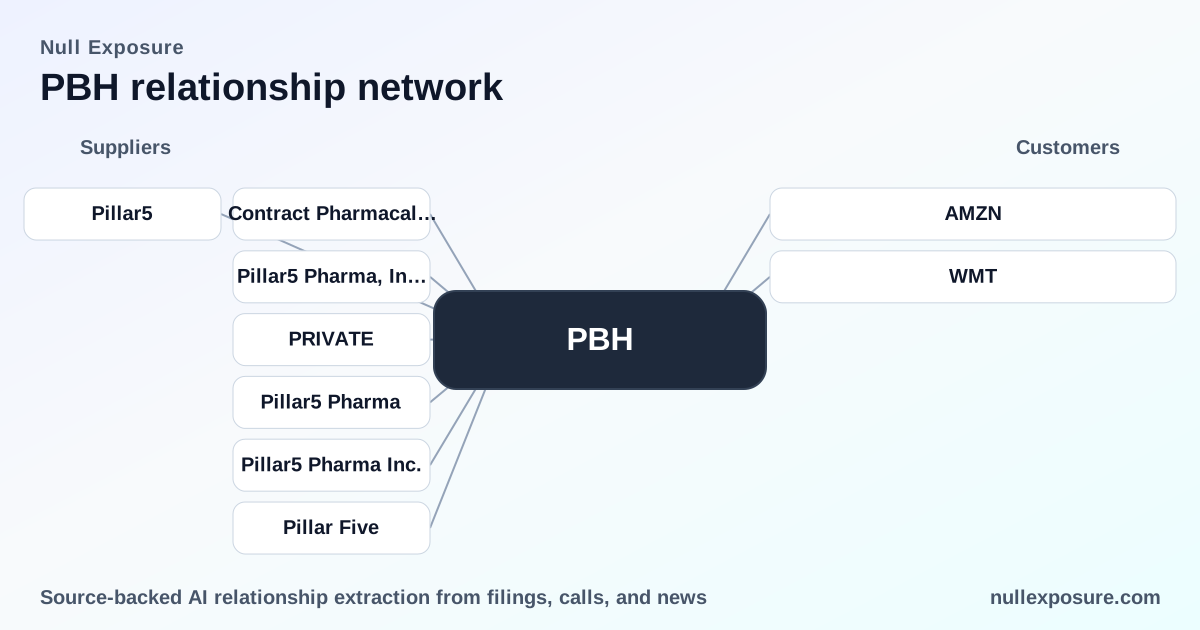
Amazon accounted for approximately 14% of PBH’s gross revenues in FY2025 and 11% in FY2024, reflecting meaningful e‑commerce exposure and the importance of marketplace placement to PBH’s revenue mix. According to PBH’s Form 10‑K for the fiscal year ended March 31, 2025, Amazon represented this share of gross revenues.
AMZN (duplicate listing)
The filing also lists the same relationship under the ticker-style name AMZN, again noting Amazon’s contribution of roughly 14% of gross revenues in 2025 and 11% in 2024; this duplicate entry in the 10‑K underscores the materiality of Amazon as a channel partner. Source: PBH FY2025 Form 10‑K.
Walmart (as listed: "Walmart")
Walmart represented approximately 19% of PBH’s gross revenues in FY2025 and about 20% in each of FY2024 and FY2023, making Walmart the single largest retail outlet in PBH’s disclosed customer roster and a central driver of retail volume and promotional spending. These figures are reported in PBH’s fiscal 2025 Form 10‑K.
WMT (duplicate listing)
The filing includes a duplicate reference to Walmart under the shorthand WMT, restating Walmart’s contribution at roughly 19% in 2025 and 20% in earlier years, reinforcing Walmart’s central role in PBH’s distribution footprint. Source: PBH FY2025 Form 10‑K.
Takeaway: the 10‑K names two customers (Amazon and Walmart) that together account for a substantial slice of gross revenues; duplicate entries in the filing highlight both the prominence and the disclosure convention used.
Investment implications: risk‑reward focused on channel execution
Given PBH’s disclosed customer exposures and company signals, investors should weigh the following points:
- Concentration risk is elevated. With Walmart and Amazon accounting for roughly 33% of gross revenue combined in FY2025, promotional decisions or category changes at either retailer can materially impact near‑term sales. PBH’s own filing calls this dependence out as a material business risk.
- Revenue visibility is limited by spot contracting. The company’s transactional sales model means revenue is driven by retailer orders and promotional cadence rather than multi‑year supply contracts, increasing quarter‑to‑quarter volatility tied to retailer inventory and promotional calendars.
- Channel mix creates both growth and margin opportunities. Amazon’s growing share of PBH sales provides an e‑commerce upside to reach consumers directly through search and sponsored placements, while brick‑and‑mortar relationships (notably Walmart) deliver scale and predictable shelf presence.
- Operational maturity supports margin stability. PBH reports FY2025 trailing revenue of roughly $1.10 billion with a gross profit near $629 million and an operating margin around 29%, signaling a mature branded CPG profile capable of generating consistent profitability when retail programs are stable.
- Negotiation leverage rests with the retailers. Large customers control shelf space, promotions and payment terms; PBH’s dependence on a limited customer set amplifies the bargaining power of those retailers.
How investors should monitor PBH going forward
- Track quarterly disclosure for customer percentage changes (particularly Amazon and Walmart) to detect shifts in channel mix or retailer reliance.
- Watch promotional intensity and community pricing at Walmart and Amazon as leading indicators of short‑term volume and margin impact.
- Evaluate PBH’s inventory and working capital disclosures for evidence of retailer pull‑forward or destocking events that affect cash flow.
- Continue to assess international expansion (Australia and other markets) as a diversification vector against North American concentration.
For deeper customer‑level intelligence and rolling updates on PBH’s retailer exposures, visit https://nullexposure.com/ for ongoing monitoring and analyst briefs.
Bottom line
Prestige Brand operates a branded OTC CPG model with material revenue exposure to a small number of large retailers and marketplaces. That structure delivers predictable profitability in stable retail environments but creates elevated sensitivity to retailer programs and e‑commerce dynamics. Investors should treat customer concentration and the transactional contracting posture as primary drivers of short‑term volatility and central considerations in any valuation or risk assessment.