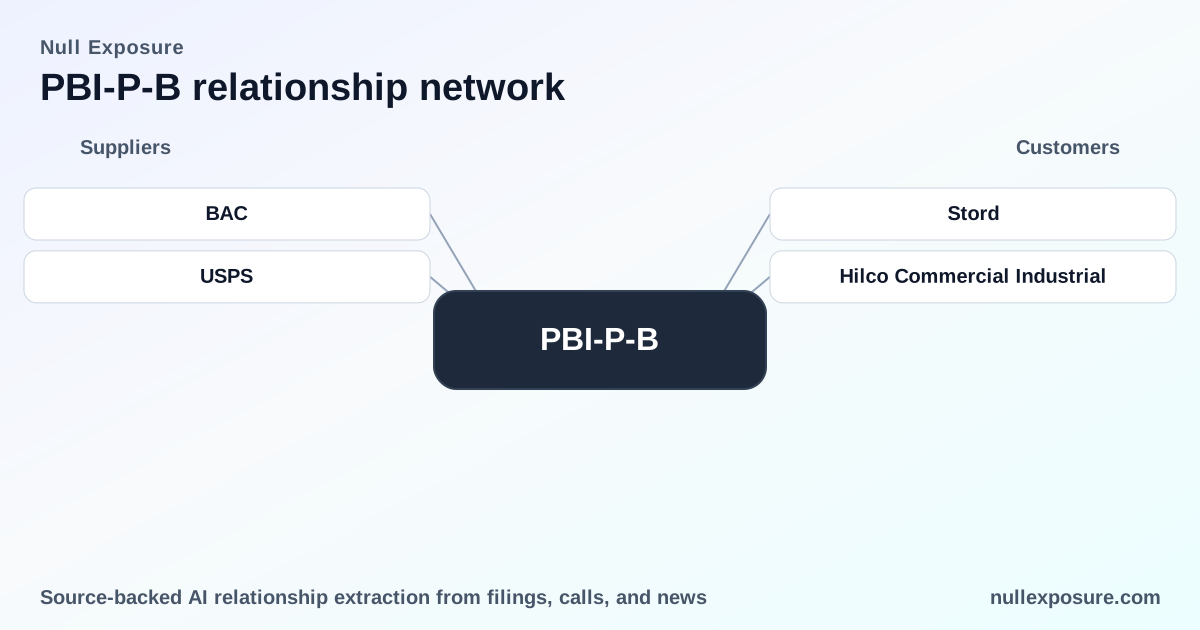
Pitney Bowes (PBI-P-B) — customer dynamics that matter to preferred-note investors
Pitney Bowes operates a diversified business across shipping and mailing hardware, software platforms, and services; it monetizes via device sales and leases, recurring platform subscriptions (notably SendPro® 360), and targeted services contracts—including logistics and fulfillment lines that the company has been actively reshaping through sales and restructurings. For holders of the PBI-P-B 6.70% notes due 2043, the relevant signal set is about counterparty quality, contract durability, and the company’s strategic move away from lower-margin fulfillment operations toward higher-margin, secure-platform revenue. Learn more about how we surface these relationship signals at https://nullexposure.com/.
Why customer relationships drive credit and upside for preferred-note holders
Customer contracts determine revenue visibility and the durability of cash available for interest payments on preferred securities. Long-term, security-cleared government contracts and recurring platform subscriptions increase revenue predictability and reduce rollover risk. Conversely, asset sales and distressed-transactions signal strategic retrenchment that can either shore up the balance sheet or reflect operational contraction—both relevant to preferred-credit analysis.
From the observed relationships for FY2026, Pitney Bowes is executing a clear repositioning: divesting a fulfillment business, securing elevated security authorization for its SendPro platform, and completing a sale of certain assets into a complex, bankruptcy-impacted transaction. These moves together shape the company’s contracting posture (shifting toward secure, contractually defensible platform revenue), concentration (less exposure to fulfillment), criticality (greater dependence on secure-platform customers), and maturity (active restructuring and portfolio optimization).
What the constraints tell us about operating posture
There are no explicit constraint excerpts provided in the record for PBI-P-B; as a company-level signal, the absence of constraints reduces the visibility into vendor or resource bottlenecks, but the relationship evidence itself is informative. Operationally, Pitney Bowes is signaling a lower tolerance for legacy, asset-heavy fulfillment exposure and a higher emphasis on secured, contract-grade software and services revenue. That shift is consequential for preferred-note investors evaluating revenue stability and recoverability.
Customer relationships you need to know (each covered)
Below are the three customer or counterparty relationships flagged in FY2026, with concise, source-backed takeaways.
Stord — buyer of the fulfillment services business
Pitney Bowes completed the sale of its fulfillment services business to Stord during its restructuring period, transferring that line of operations and the related revenue stream to a third-party logistics operator. According to an AlphaStreet report published March 10, 2026, this sale is part of Pitney Bowes’ broader portfolio simplification and reallocation of capital toward higher-margin platform offerings. (AlphaStreet, March 10, 2026)
U.S. Department of Defense — elevated authorization for SendPro® 360
Pitney Bowes achieved IL4 Provisional Authorization for its SendPro® 360 platform solutions, expanding secure shipping and mailing capabilities available to the U.S. Department of Defense and other cleared government customers. GuruFocus reported this development on May 3, 2026, which underscores institutional credentialing and the company’s ability to capture mission-critical, security-sensitive contracts. (GuruFocus, May 3, 2026)
Hilco Commercial Industrial — buyer of a majority interest in GEC entities (bankruptcy follow-up)
Pitney Bowes sold a majority interest in GEC entities to an affiliate of Hilco Commercial Industrial; those GEC entities subsequently filed for Chapter 11. AlphaStreet noted this transaction and the ensuing bankruptcy in its March 10, 2026 coverage, signaling that certain divestitures were executed into a complex and distressed-asset environment rather than into clean, operational handoffs. (AlphaStreet, March 10, 2026)
How these relationships change the investment calculus
- Contracting posture: The DoD IL4 authorization demonstrates Pitney Bowes’ ability to meet stringent security controls, enabling longer, higher-visibility contracts with government and regulated customers—this strengthens the quality of future recurring revenue streams supporting preferred coupon service.
- Concentration and criticality: Selling the fulfillment business to Stord reduces exposure to logistics execution risk and asset intensity, shifting revenue concentration toward platform and services customers that are contract-driven and potentially higher margin. At the same time, obtaining government-level security authorization increases the criticality of the SendPro platform to DoD and other secured customers.
- Maturity and restructuring risk: The sale of GEC interests to a Hilco affiliate that then entered Chapter 11 suggests that certain divestments were executed under distressed conditions; that can produce near-term proceeds and liability relief, but it also signals operational churn and potential legal/credit residue that deserves monitoring.
- Counterparty credit risk: Moving fulfillment operations to Stord transfers operational counterparty risk off Pitney Bowes’ balance sheet, but the bankruptcy of the GEC buyer introduces residual exposure depending on the structure of the sale and any retained obligations or indemnities.
Practical implications for preferred-note holders
- Positive: The IL4 authorization materially increases Pitney Bowes’ addressable, secure-contract market and supports the thesis of more predictable, subscription-style revenue—an important credit positive for fixed-income holders prioritizing cash-flow coverage.
- Neutral-to-negative: Divestitures improve balance-sheet flexibility but require scrutiny of transaction economics; sales into distressed-capital channels (the Hilco/GEC sequence) could leave behind contingent claims or reduce the value of realized proceeds relative to expectations.
- Actionable monitoring: Investors should track (1) continued growth and retention metrics for SendPro 360 with government and enterprise customers, (2) any disclosed sale proceeds and how they were applied to debt or capital maintenance, and (3) disclosures around remaining contingent liabilities tied to the GEC/Hilco transaction.
Bottom line — what to watch and next steps
Pitney Bowes is actively reshaping its business toward secure, platform-driven revenue while shedding asset-heavy fulfillment exposure. For holders of the PBI-P-B preferred notes, the DoD authorization is a clear positive for revenue quality; however, the Hilco/GEC bankruptcy sequence introduces uncertainty about the net benefit of some divestitures. Continued disclosure on how sale proceeds are used, plus adoption and retention trends for SendPro 360 among higher-credit customers, will be the primary credit-watch items.
If you want a concise tracker of counterparty moves and what they mean for Pitney Bowes’ debt and preferred instruments, visit our research hub at https://nullexposure.com/ for ongoing coverage and signals.