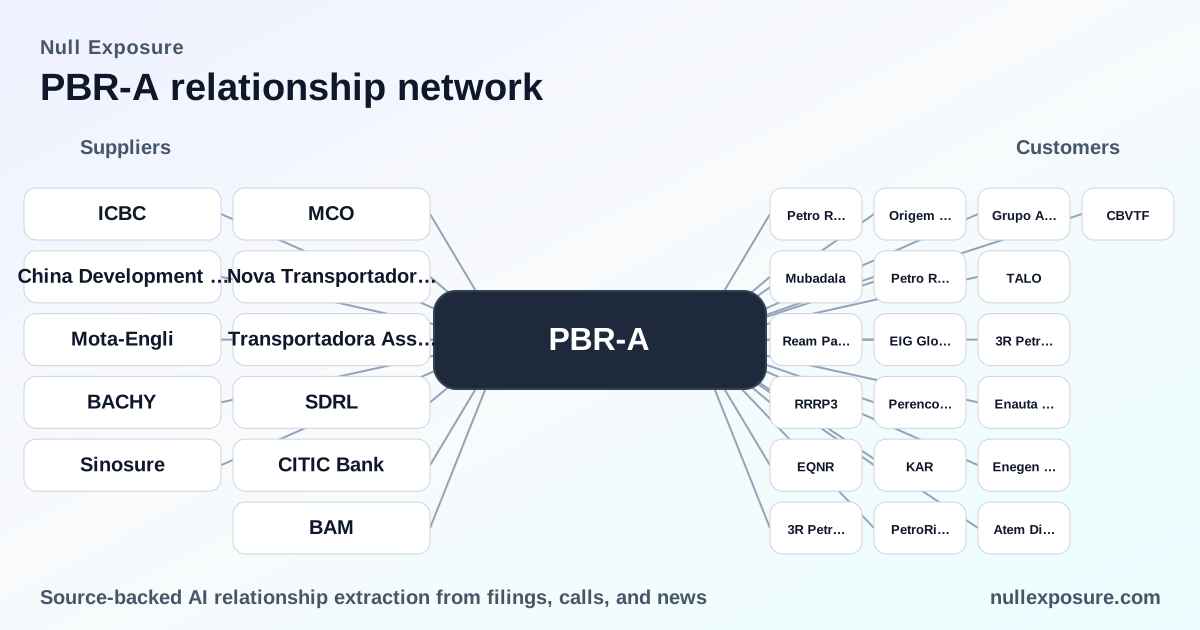
Petrobras (PBR‑A): Asset sales and partner footprint that reshape a national champion
Petrobras operates as Brazil’s integrated oil and gas behemoth, producing hydrocarbons, refining fuels and monetizing both through upstream production and targeted asset sales to private and strategic buyers; its preferred shares (PBR‑A) reflect ownership in a high‑cash‑flow, dividend‑paying company that actively executes a divestment program to optimize capital allocation. Investors should value Petrobras not only on production and refining margins but on the pace and counterparty mix of its asset dispositions, which create one‑time proceeds and alter future cash flows. Learn more about how relationship signals inform credit and equity risk at https://nullexposure.com/.
Strategic context: how customer and buyer relationships map to corporate strategy
Petrobras uses asset sales as a deliberate monetization lever alongside operating cash flow — selling fields and refineries to free capital while retaining scale in key basins. The company’s FY metrics underline that strategy: Revenue TTM of $497.5bn and EBITDA of $208.1bn indicate a business that can both fund operations and pursue selective divestments without balance‑sheet distress. At the same time, divestment activity increases commercial counterparty diversity (domestic buyers like Petro Rio and Grupo Atem, international players like Mubadala and Equinor), reducing single‑counterparty concentration but introducing execution and reputational considerations as assets transfer.
- Contracting posture: Petrobras is functioning as a seller of non‑core assets and a strategic partner on select projects.
- Concentration: Asset sales disperse operational concentration but concentrate proceeds and future supply relationships with new owners.
- Criticality: Many transactions involve upstream fields and regional refineries — operationally significant assets for Brazil’s fuel supply chain.
- Maturity: The company has run a multi‑year divestment program (post‑2017), implying an institutionalized process rather than ad hoc disposals.
Line‑by‑line: counterparties and the deals that matter
Below are every relationship captured in the record set, with a concise, investor‑oriented summary and source.
- Petro Rio SA — Petrobras’ board approved the sale of its stake in the Albacora Leste oilfield to Petro Rio SA for $2.2 billion, representing one of the larger upstream divestments in recent cycles; reported by OE Digital on March 10, 2026 (https://www.oedigital.com/news/496114-petro-rio-buys-petrobras-albacora-leste-offshore-oil-field-for-2-2-billion).
- Mubadala — Petrobras disclosed the sale of the Landulpho Alves refinery (RLAM) to Mubadala for $1.65 billion as part of its refining rationalization program; reported in local press and summarized on March 10, 2026 (https://18horas.com.br/amazonas/petrobras-assina-contrato-para-venda-da-refinaria-de-manaus-ao-grupo-atem-por-us1895-mi/).
- Ream Participações — Petrobras executed a contract to sell the Isaac Sabbá (REMAN) refinery and associated logistics to Ream Participações for $189.5 million, reflecting a pattern of regional refinery divestitures; reported March 10, 2026 (https://18horas.com.br/amazonas/petrobras-assina-contrato-para-venda-da-refinaria-de-manaus-ao-grupo-atem-por-us1895-mi/).
- 3R Petroleum Offshore S.A. (3R Offshore) — Petrobras signed a contract transferring its entire interest in the Papa‑Terra production field to 3R Offshore, shifting operatorship and production economics to a smaller specialist player; reported July 12, 2021 by Brazil Energy Insight (https://brazilenergyinsight.com/2021/07/12/petrobras-signs-contract-for-the-sale-of-the-papa-terra-field/).
- RRRP3 — The transaction with 3R Offshore is identified in market filings under the RRRP3 ticker, formalizing the Papa‑Terra transfer into a publicly traded vehicle; see Brazil Energy Insight, July 2021 (https://brazilenergyinsight.com/2021/07/12/petrobras-signs-contract-for-the-sale-of-the-papa-terra-field/).
- EQNR (Equinor ASA) — Coverage cited Equinor as a precedent strategic buyer (Roncador stake) and as a participant in bid interest for Albacora, showing international national champions compete for Brazilian assets; reported July 13, 2021 by Brazil Energy Insight (https://brazilenergyinsight.com/2021/07/13/report-at-least-three-firms-vying-for-petrobras-albacora-fields/).
- Equinor ASA — Equinor’s prior $2.9 billion Roncador purchase is referenced as a comparable transaction and demonstrates the appetite of large IOC buyers for major Petrobras assets; Brazil Energy Insight, July 2021 (https://brazilenergyinsight.com/2021/07/13/report-at-least-three-firms-vying-for-petrobras-albacora-fields/).
- Origem Energia — Origem has purchased onshore natural gas fields from Petrobras and identifies Petrobras as its principal commercial partner, signaling ongoing domestic supply and offtake relationships; noted by Buenos Aires Times coverage (https://www.batimes.com.ar/news/economy/lula-has-big-petrobras-plans-that-would-undo-privatisation-push.phtml).
- Petro Rio Jaguar Petroleo Ltda — Petro Rio’s subsidiary was the transactional vehicle named in the Albacora Leste sale, illustrating typical use of local subsidiaries in offshore asset transfers; OE Digital, March 10, 2026 (https://www.oedigital.com/news/496114-petro-rio-buys-petrobras-albacora-leste-offshore-oil-field-for-2-2-billion).
- EIG Global Energy Partners — EIG featured in a bidding consortium for Albacora, representing private capital interest in Petrobras’ divestments and the role of energy‑focused PE in basin consolidation; Brazil Energy Insight, July 13, 2021 (https://brazilenergyinsight.com/2021/07/13/report-at-least-three-firms-vying-for-petrobras-albacora-fields/).
- Enegen Participações S.A. — Enegen completed acquisition of the remaining 30% stake in Brentech from Petrobras (May 31, FY2025), an example of minority stake exits to regional energy players; reported on SimplyWall.st (https://simplywall.st/stocks/us/energy/nyse-pbr/petroleo-brasileiro-petrobras).
- Perenco Petróleo e Gás do Brasil Ltda — Perenco finalized acquisition of the Cherne and Bagre shallow‑water fields from Petrobras (Aug 6, FY2025), reinforcing a trend of transferring mature shallow assets to mid‑cap operators; SimplyWall.st (https://simplywall.st/stocks/us/energy/nyse-pbr/petroleo-brasileiro-petrobras).
- KAR / Karoon Energy Ltd — Karoon submitted a non‑binding offer for Albacora, showing participation by Australian E&P players in Petrobras’ sales processes; Brazil Energy Insight, July 13, 2021 (https://brazilenergyinsight.com/2021/07/13/report-at-least-three-firms-vying-for-petrobras-albacora-fields/).
- Grupo Atem — Grupo Atem contracted to buy the Manaus refinery (Isaac Sabbá) for $189.5 million, reflecting domestic downstream consolidation through regional distributors; 18horas report, March 10, 2026 (https://18horas.com.br/amazonas/petrobras-assina-contrato-para-venda-da-refinaria-de-manaus-ao-grupo-atem-por-us1895-mi/).
- Atem Distribuidora de Petróleo S.A. — Ream Participações is tied to Atem’s owners as the vehicle that bought REMAN, demonstrating how distributor groups acquire refining capacity for integrated supply; 18horas, March 10, 2026 (https://18horas.com.br/amazonas/petrobras-assina-contrato-para-venda-da-refinaria-de-manaus-ao-grupo-atem-por-us1895-mi/).
- PetroRio SA — PetroRio is cited again among bidders and in consortium activity, confirming the company’s prominent role in acquiring Petrobras assets; Brazil Energy Insight, July 13, 2021 (https://brazilenergyinsight.com/2021/07/13/report-at-least-three-firms-vying-for-petrobras-albacora-fields/).
- TALO / Talos Energy Inc — Talos featured in a Houston‑based consortium bidding for Albacora, indicating US independent E&Ps are also active buyers; Brazil Energy Insight, July 13, 2021 (https://brazilenergyinsight.com/2021/07/13/report-at-least-three-firms-vying-for-petrobras-albacora-fields/).
- Talos Energy Inc — Talos’ participation exemplifies the consortium approach (Talos, EIG, Enauta, 3R) used to acquire larger asset packages from Petrobras; Brazil Energy Insight, July 2021 (https://brazilenergyinsight.com/2021/07/13/report-at-least-three-firms-vying-for-petrobras-albacora-fields/).
- 3R Petroleum Oleo e Gas SA — The 3R group appears both as buyer and consortium member, underscoring how vertically integrated local players expand through Petrobras disposals; Brazil Energy Insight, July 13, 2021 (https://brazilenergyinsight.com/2021/07/13/report-at-least-three-firms-vying-for-petrobras-albacora-fields/).
- Enauta Participacoes SA — Enauta was part of the consortium bids for Albacora, demonstrating regional operators’ appetite for block aggregation in the Campos Basin; Brazil Energy Insight, July 13, 2021 (https://brazilenergyinsight.com/2021/07/13/report-at-least-three-firms-vying-for-petrobras-albacora-fields/).
- CBVTF / Cobra (unit of Vinci SA) — Cobra (identified under CBVTF in reporting) partnered with PetroRio in a bidding vehicle, signaling participation by construction and services majors in upstream asset ownership strategies; Brazil Energy Insight, July 13, 2021 (https://brazilenergyinsight.com/2021/07/13/report-at-least-three-firms-vying-for-petrobras-albacora-fields/).
Investment implications and primary risks
- Divestments are a structural earnings lever. Asset sales deliver large one‑time proceeds that materially affect free cash flow and dividends in the near term; Petrobras’ dividend per share and 7.44% yield reflect distributable cash backed by strong EBITDA.
- Counterparty mix reduces concentration risk but raises operational transition risk. Selling core fields to a mosaic of buyers deconcentrates operational risk but creates execution risk during handovers and potential downstream supply volatility.
- Valuation and governance dominate investment thesis. With a trailing P/E of 6.48 and forward P/E of 4.44, market pricing already reflects strong cash flows and the expectation of continued monetization, so downside from failed transactions or regulatory reversal would be meaningful. Petrobras’ institutional ownership of ~7.9% and state ownership history remain governance considerations.
If you want a deeper, transaction‑level exposure analysis or counterparty credit mapping for PBR‑A, see our research hub at https://nullexposure.com/ for tailored reports.
Bottom line
Petrobras executes a deliberate strategy of monetizing assets to optimize capital returns while remaining an industrially dominant producer and refiner in Brazil. For investors in PBR‑A, the critical factors are the pace of divestitures, the credit and capability of the new asset owners, and how one‑time proceeds convert into sustainable shareholder returns. Monitoring counterparties named above provides direct visibility into the trajectory of Petrobras’ future cash flows and operational footprint.