Puma Biotechnology (PBYI): Customer Relationships and Commercial Footprint
Puma Biotechnology is a single-product commercial biopharma that monetizes primarily through sales of NERLYNX in the U.S. and royalties/license fees from sub-licensees internationally. The company sells directly into a concentrated specialty pharmacy and distributor network domestically while licensing regional commercialization rights overseas; this dual model drives near-term cash flow from U.S. product sales and recurring royalty streams from partners abroad. For investors tracking counterparty risk and route-to-market dynamics, Puma’s customer roster and sublicense partners define its revenue stability and upside potential. For a broader view of customer exposures across small-cap healthcare names, visit https://nullexposure.com/.
How Puma’s operating model shapes revenue and risk
Puma operates with a hybrid commercial posture: a direct U.S. specialty sales force (roughly 35 specialists) sells NERLYNX into a small number of specialty pharmacies and specialty distributors, while the company uses exclusive sub-license agreements to pursue regulatory approvals and commercialization outside the U.S. This structure creates four salient business-model characteristics for investors:
- Concentration: Puma discloses that four customers represented large single-digit to high-20% shares of product revenue in 2024, a structurally concentrated receivables base that elevates counterparty risk.
- Contracting posture: Licensing is an explicit component of Puma’s international rollout; sublicense agreements transfer regulatory and commercial execution to regional partners while preserving royalty streams for Puma.
- Channel criticality: The U.S. specialty pharmacy/distributor network is mission-critical—these buyers are the primary on‑ramp to patients and therefore key to near-term revenue realization.
- Maturity and stage: NERLYNX is Puma’s only product currently generating product revenue, and relationships are active commercial arrangements rather than early-stage collaborations.
These signals are drawn from Puma’s 2024 Form 10‑K and accompanying investor materials, which together describe both the direct-sell U.S. model and the sublicense footprint overseas.
Customer roster: who Puma sells to and who licenses its product
Below are the named customers and partners cited in Puma filings and investor materials, each summarized in plain English with the underlying source noted.
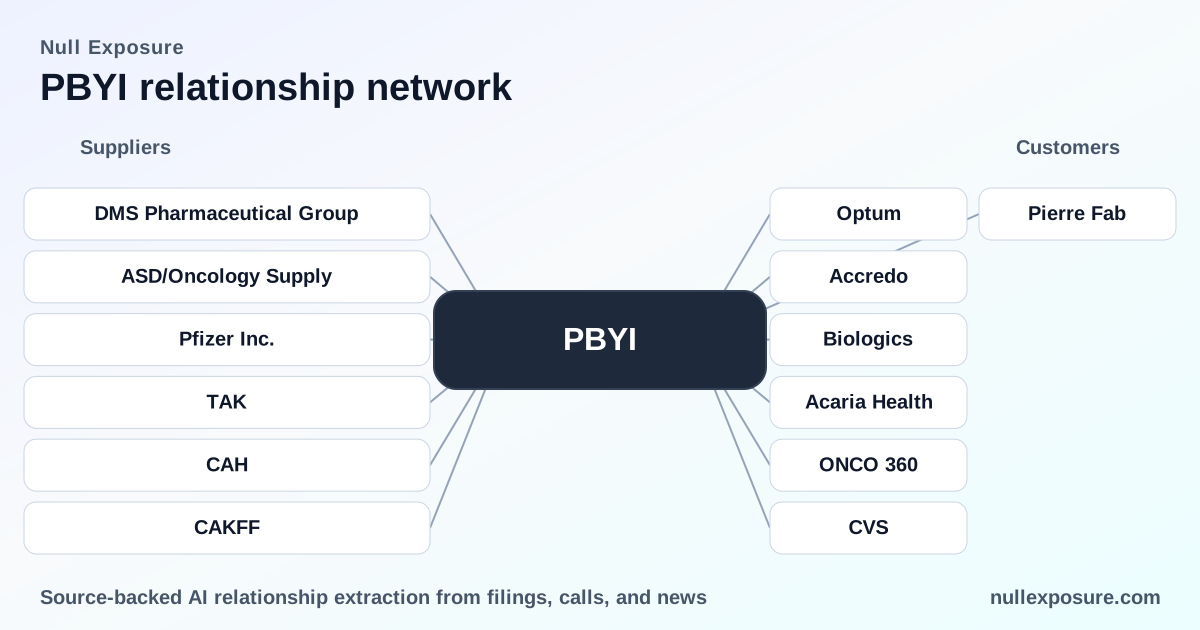
- Acaria Health — Listed as a member of Puma’s U.S. specialty pharmacy network that sells directly to patients, meaning Acaria is a direct channel for NERLYNX distribution in the U.S. (Puma 2024 Form 10‑K).
- Accredo — Named among the specialty pharmacies in Puma’s U.S. network that receive NERLYNX and dispense to patients, representing a core distribution pathway for product revenue. (Puma 2024 Form 10‑K).
- Biologics — Identified alongside other specialty pharmacies in Puma’s disclosure; Biologics functions as a reseller/dispenser within the company’s U.S. specialty channel. (Puma 2024 Form 10‑K).
- ONCO 360 — Included in the company’s specialty pharmacy network that sells directly to patients and forms part of Puma’s domestic distribution footprint. (Puma 2024 Form 10‑K).
- Optum — Named as a specialty pharmacy participant in Puma’s U.S. channel; Optum’s scale makes it a consequential buyer in Puma’s accounts receivable mix. (Puma 2024 Form 10‑K).
- CVS (CVS) — Explicitly listed as a member of the specialty pharmacy network that sells directly to patients and is therefore a principal U.S. distribution partner for NERLYNX. (Puma 2024 Form 10‑K).
- Pierre Fabre — Holds regional partnership rights in Australia and Southeast Asia and has driven offshore sales into China that generated royalty revenue, per Puma’s investor slides and call material. (Q4 2025 investor slides on Investing.com; Q3 2024 earnings call transcript remarks posted by InsiderMonkey referencing royalty sales to China).
- Specialised Therapeutics Asia — Identified as Puma’s Greater China partner, responsible for regulatory approvals and local commercial launches (e.g., extended adjuvant approval in Taiwan and metastatic approvals in Hong Kong) and subsequent commercialization activity. (Q4 2025 investor slides on Investing.com).
- Vandeputte — Named as Puma’s Latin America sub-license partner, representing a regionally localized commercialization and potential royalty stream outside the core U.S. business. (Q4 2025 investor slides on Investing.com).
- Pierre Fab — Puma referenced royalty revenue tied to offshore partner sales to China in a prior earnings call; context and name usage in the transcript suggest the same Pierre Fabre commercial relationship contributed royalty revenue in Q3 2024. (Q3 2024 earnings call transcript published by InsiderMonkey).
- Gencurix — Named as Puma’s South Korea partner in investor slides; this sublicense expands Puma’s commercial reach in APAC and creates an incremental royalty channel. (Q4 2025 investor slides on Investing.com).
These entries collectively represent Puma’s domestic distribution network and its international sublicense partners as disclosed in Puma’s 2024 Form 10‑K and 2025 investor materials.
Regional mechanics and the royalty engine
Puma’s international model is license-and-royalty centric. The company has executed exclusive sub-license agreements across multiple regions—EMEA, APAC, LATAM, and North America (outside the U.S. direct channel)—and explicitly notes that the majority of royalty revenue is derived from sub-licensee sales into China. That geographic split converts regional regulatory wins and partner execution into recurring royalty inflows, providing revenue diversification away from U.S. product sales while leaving Puma dependent on partners for local market execution (Puma 2024 Form 10‑K; Q4 2025 investor slides).
Investment implications: what to watch and where value lives
- Revenue concentration is the principal risk. Puma’s top customers together account for a large portion of product revenue, which makes accounts receivable and reimbursement dynamics key monitoring points. (Puma 2024 Form 10‑K).
- Distribution partners are operationally critical. Large pharmacy chains and specialty distributors drive cash conversion and access to patients—disruption or contracting changes with these entities would materially affect short-term revenue. (Puma 2024 Form 10‑K).
- Licensing creates optionality and volatility. International sub-licenses convert regulatory approvals into royalties, offering upside as partners launch in new territories; however, royalty streams are dependent on third-party commercial execution and local reimbursement. (Puma 2024 Form 10‑K).
- Single-product exposure is a defining feature. NERLYNX constitutes the vast majority of Puma’s product revenue, so product lifecycle events, label expansions, and competitive dynamics directly drive company-level performance. (Puma 2024 Form 10‑K).
If you track revenue concentration across small-cap biotechs, Puma is a clear example of a company with high channel concentration domestically and diversified but partner-dependent international royalties.
Next steps for analysis
For investors and operators evaluating Puma’s counterparty exposure, prioritize: contractual terms with top specialty pharmacies and distributors, royalty waterfalls and reporting from key sub-licensees (notably China partners), and the timeline for regulatory and commercial milestones in APAC and LATAM. For expanded coverage of customer relationship mapping and counterparty risk for healthcare issuers, see https://nullexposure.com/.
Overall, Puma’s commercial model produces predictable U.S. product revenue through a small number of large distribution partners while delivering incremental, partner-driven royalty upside internationally; that combination creates clear levers for upside and concentrated exposure for downside.