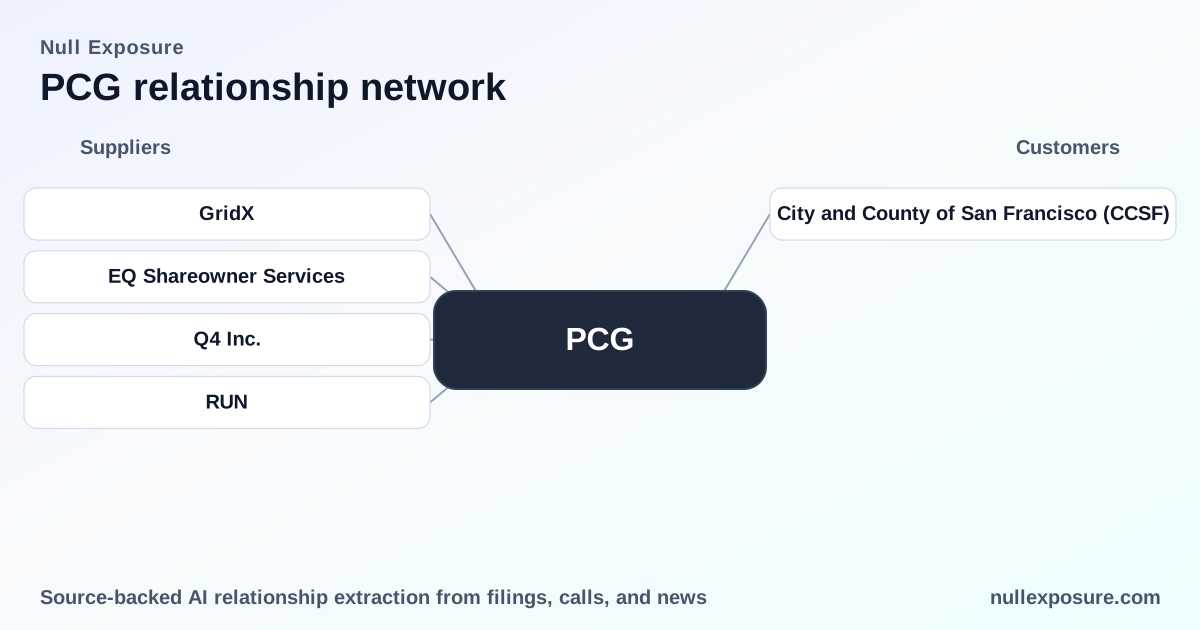
PG&E (PCG) Customer Relationships: Who Pays, Who Partners, and What Investors Should Watch
PG&E (PCG) is a rate‑regulated utility that monetizes primarily through the sale and delivery of electricity and natural gas across northern and central California, collecting revenue via tariffs, regulated transmission projects, and long‑term service agreements that flow into its rate base. The company's customer ecosystem spans individual residential accounts, municipal and institutional customers, independent project developers, and regional market operators — each relationship imposing different cash‑flow timing, regulatory constraints, and execution risk. For an investor, the critical question is how these counterparties convert into predictable earnings, capex recovery, and regulatory exposure; read on for a relationship‑level map and the operating model signals that determine credit and equity outcomes. For additional diligence tools, visit https://nullexposure.com/.
What the relationship map actually shows investors
PG&E’s visible customer relationships in recent coverage fall into four categories: energy project developers/operators, municipal political actors, the regional grid operator, and project counterparties receiving grants or credits tied to PG&E. These relationships underscore PG&E’s dual role as a regulated seller and an active distribution/transmission operator — a company that both buys/sells energy and physically manages delivery infrastructure under long‑term obligations.
Detailed partner snapshots investors need to file away
Energy Vault / NRGV — distribution system operator role
Energy Vault (listed here under NRGV) owns the Calistoga Resiliency Center while PG&E serves as the distribution system operator under a long‑term energy services agreement, reflecting PG&E’s role as the physical operator of distributed resilience assets even when private developers own generation and storage. According to pv‑magazine USA (Sept 30, 2025), this structure emphasizes PG&E’s operational integration with third‑party owners and its ability to monetize grid services through O&M and service contracts.
City and County of San Francisco — political and rate pressure
The City and County of San Francisco is an active political counterparty; recent reporting highlights proposals and debates around a potential takeover or break‑up and points to CPUC guidance that any purchase would require San Francisco to pay materially above asset book value, which would raise rates for customers. A KCRA report covering legislative and municipal pushes (March 2026) frames this relationship as a direct source of regulatory and political risk that influences future rate recovery dynamics.
CAISO — transmission awards and project conversion risk
The California Independent System Operator (CAISO) has awarded roughly $4.16 billion of transmission projects to PG&E, signaling strong demand for large‑load transmission work, but the timeline and conversion from award to construction remain uncertain, which leaves earnings and capex pacing exposed to project execution risk. MarketBeat’s earnings coverage (April 23, 2026) documents the awards and the company’s reported pipeline of large‑load projects, which are material to medium‑term capex and rate‑base growth.
Aemetis (AMTX) — grant and incentive counterparty
Aemetis’s MVR project received approximately $19.7 million in grants and tax credits that include funding from PG&E alongside state and federal sources, demonstrating PG&E’s role as a funding or incentive counterparty for select industrial decarbonization projects. The Globe and Mail press release (May 2026) records this funding arrangement, which highlights PG&E’s participation in targeted grants and programmatic support that advance state energy objectives.
Operating model constraints and what they signal about business risk
The extracted constraints illuminate company‑level characteristics that shape contract posture, concentration, and criticality.
- Geographic concentration: PG&E operates principally across northern and central California, which creates single‑state regulatory exposure and concentrated physical risk (including wildfire and severe weather liabilities referenced in public filings). This concentration escalates systemic regulatory risk and ties earnings to California policy cycles.
- Counterparty mix: Evidence shows significant exposure to individual residential customers (illustrated by residential account references) and to governmental customers (public street and highway lighting instances), indicating a revenue mix dominated by high‑volume, low‑margin retail accounts and public contracting obligations.
- Dual role — seller and service provider: PG&E consistently functions as both a seller of electricity/gas and as a service provider for delivery, metering, billing, and distribution operations; this entrenches it in long‑term customer relationships with recurring cash flows but also creates operational liabilities tied to asset maintenance and disaster response.
- Relationship maturity and stage: Core product relationships are active and long‑standing, with the utility delivering bundled natural gas service to a very high percentage of core customers; this signals contractual maturity and predictability in baseline cash flows, while infrastructure segments drive capital intensity and execution risk.
Taken together, these constraints depict a company with regulated, contractually entrenched revenue streams that are nonetheless concentrated geographically and politically, and therefore sensitive to state regulatory decisions, municipal political initiatives, and large capital project execution.
Investor implications: where value and risk concentrate
- Value drivers: Rate‑base recovery from CAISO‑awarded transmission projects and ongoing billing/delivery margins from millions of residential and core customers will drive EBITDA and cash flow if capex converts to allowed rate base on schedule. PG&E’s embedded role as distribution operator for third‑party assets (e.g., the Calistoga Resiliency Center) creates incremental service revenue lines and strengthens its position in resilience markets.
- Key risks: Political pressure from large municipal actors (City and County of San Francisco), the operational uncertainty in converting multi‑billion dollar transmission awards into constructed assets, and geographically concentrated catastrophic risk (wildfires) are principal downside vectors. Regulatory outcomes can materially alter rate recovery and cost allocation, directly impacting shareholder returns.
- Counterparty dynamics: Heavy reliance on residential billing provides stable nominal cash flow but low pricing power outside CPUC rate cases; projects tied to grants or incentives (Aemetis example) show PG&E acting as a public‑policy execution partner, which can add reputational and execution obligations beyond simple commodity sales.
How to prioritize follow‑on diligence
- Track CPUC proceedings and municipal initiatives in San Francisco as leading indicators of regulatory re‑pricing risk.
- Monitor CAISO project milestones and PG&E construction schedules to assess the likely timing of rate‑base additions tied to the $4.16 billion in awards.
- Watch third‑party resilience project rollouts and long‑term service agreements for new recurring O&M or grid‑services revenue streams.
For a deeper, investor‑grade synthesis of customer and counterparty exposure across utilities, visit https://nullexposure.com/ for methodology notes and ongoing coverage.
Bottom line
PG&E’s customer relationships reveal a classic regulated utility profile: stable, contractually anchored retail cash flows paired with concentrated political and execution risk driven by regional exposure and large infrastructure projects. Investors who underwrite PCG must balance the predictability of regulated revenue against the timing and regulatory execution of capex recovery and municipal political actions that can reallocate cost burdens.